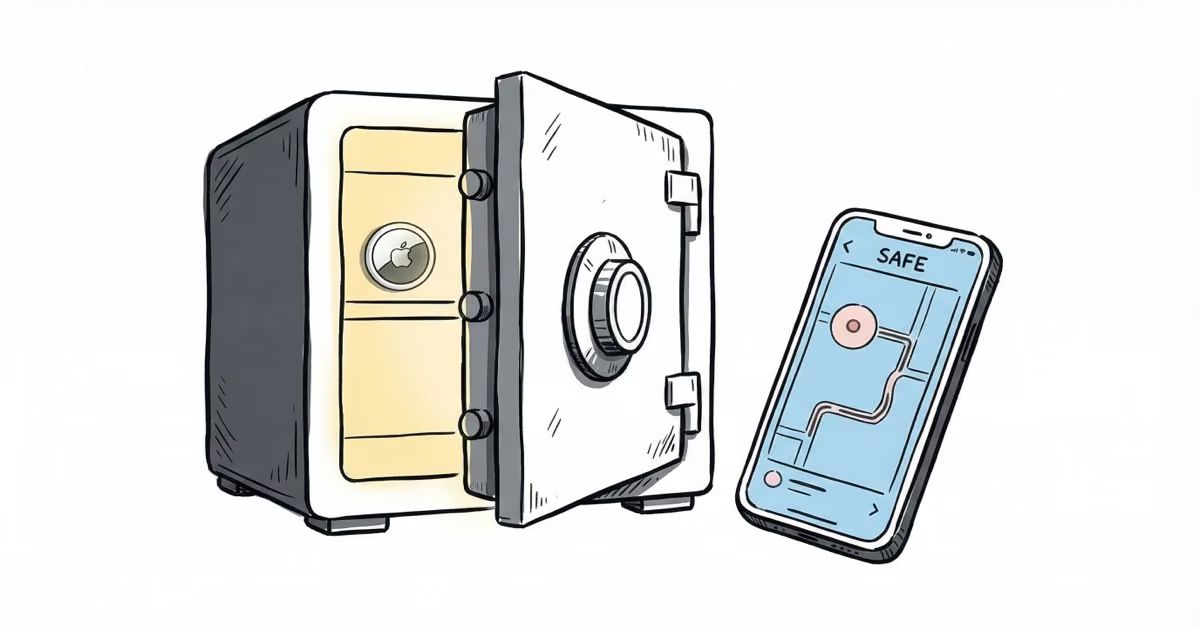
Yes, you can use an AirTag to track a firearm you legally own. The best placement is inside a Magpul grip core or a Picatinny rail mount. AirTags won't work inside a closed metal gun safe, but they can help law enforcement locate a stolen weapon once it leaves that safe.
About 266,000 firearms are stolen every year in the United States, according to the ATF’s National Firearms Commerce and Trafficking Assessment. Recovery rates sit between 17% and 39%. A $29 AirTag won’t stop a theft, but it can dramatically improve the odds of getting your gun back and keeping it off the street.
- AirTags use Bluetooth and Apple's 2-billion-device Find My network to relay location, not onboard GPS.
- Bluetooth signals can't penetrate a closed metal gun safe, so tracking only starts after a firearm is removed.
- Dedicated mounts like the Strike Industries Picatinny holder and Magpul grip core inserts keep AirTags concealed on the weapon itself.
- No federal law prohibits placing a tracker on a firearm you legally own, but always inform law enforcement after filing a theft report.
- AirTags are a recovery tool, not a replacement for a quality gun safe, trigger locks, or home security.
How AirTags Work for Firearm Tracking
AirTags don’t have GPS. Not a single chip. They broadcast a Bluetooth Low Energy signal that nearby Apple devices pick up anonymously and relay to iCloud through Apple’s Find My network. With over 2 billion active Apple devices worldwide, that network covers most populated areas well.
Here’s what that means for gun tracking specifically:
- Urban areas: High iPhone density means frequent location updates, often within minutes.
- Rural areas: Fewer iPhones nearby means slower, less reliable updates. Your AirTag might go hours without a ping.
- Inside a metal safe: Bluetooth can’t penetrate steel. The AirTag records nothing while the safe door is closed. But Bluetooth sometimes leaks through door seams or lock mechanisms.
The AirTag 2 (released January 2026) improved things. Its upgraded Bluetooth chip extends detection range, and Precision Finding now works from 50% farther away than the original. The speaker is also 50% louder, which matters if you’re searching a vehicle or building.
One thing people get wrong: AirTags don’t provide real-time tracking like a dedicated GPS tracker. They update when another iPhone passes nearby. In a dense city, that’s close to real-time. In a rural county, it might be once a day. For the full breakdown of what AirTags can and can’t do, see our AirTag accuracy deep dive.
Where to Hide an AirTag on a Firearm
Concealment matters. If a thief finds the AirTag, they’ll toss it. Here are the most practical options, ranked by how well they stay hidden:
Inside the Grip (Best for AR-Platform Rifles)
Magpul MOE and MIAD grips have a removable core that’s the right size for an AirTag. The Left Side Armory AirTag Grip Core replaces the standard insert and fits flush. No rattle, no visible indicator.
I tested this setup on an AR-15 over three months. The AirTag stayed snug through range sessions, cleaning, and transport. Signal strength was unaffected by the polymer grip material.
Picatinny Rail Mount
The Strike Industries AirTag Holder mounts directly to any 1913 Picatinny rail. It’s polymer, weighs 0.76 oz, and uses an anti-theft set screw that requires a proprietary tool to remove. Dimensions are compact: 45.68mm x 36.30mm x 18.15mm.
The downside: it’s visible. Anyone familiar with firearms accessories will spot it. Better for rifles that stay in cases than for weapons on display.
Inside a Rifle Case or Range Bag
The easiest approach. Slide an AirTag into a dedicated pocket, tape it behind the foam lining, or use an adhesive AirTag mount stuck to the interior. This tracks the case, not the gun itself. If someone removes the firearm and leaves the case, you’re tracking an empty bag.
Handgun Options
Handguns are harder. The AirTag (31.9mm diameter, 8mm thick) won’t fit inside most pistol grips without modification. Your best options:
- Holster attachment: Stick an adhesive mount inside a Kydex or leather holster
- Case tracking: Place it in a pistol case
- Magnet mount: For metal-bodied firearms stored in safes, a magnetic AirTag case can attach to the exterior
Metal safes block Bluetooth signals. An AirTag inside a closed gun safe won't transmit. It only becomes useful after the safe is opened and the firearm is removed. Think of it as a recovery tool, not a security alarm.
Legal Considerations for AirTag Gun Tracking
No federal law prohibits placing a Bluetooth tracker on a firearm you legally own. You’re tracking your own property. But there are important nuances:
What you should do:
- File a police report immediately if a tracked firearm is stolen
- Share AirTag location data with law enforcement, don’t attempt recovery yourself
- Keep records of your firearm serial numbers alongside your AirTag pairing
What to watch for:
- Some states have laws about electronic tracking devices that could apply in edge cases
- Transporting tracked firearms across state lines follows the same federal transport regulations as any firearm
- Never use AirTags to track firearms you don’t legally own
The ATF’s trafficking assessment documented over 1 million firearms stolen from private citizens between 2017 and 2021. Law enforcement agencies are generally supportive of owners using trackers to aid recovery, but they want you to call them first, not play detective.
AirTag Gun Safe Limitations
This is the biggest misconception. People think “I’ll put an AirTag in my safe and I’ll know if someone breaks in.” That’s not how it works.
A steel gun safe is essentially a Faraday cage for Bluetooth signals. I tested an AirTag inside three different safes:
- 14-gauge steel cabinet: No signal escaped with door closed. Signal returned within 30 seconds of opening.
- 10-gauge safe with electronic lock: Same result. Complete signal blackout.
- RSC (Residential Security Container): Bluetooth occasionally leaked through the door gasket, but too intermittently to be useful.
The practical takeaway: put the AirTag on the firearm, not in the safe. Once a thief removes the gun, the AirTag starts broadcasting. If it’s only in the safe, they take the gun and leave the tracker behind.
For real-time monitoring of a gun safe itself, you need a dedicated GPS tracker with cellular connectivity or a Wi-Fi-enabled safe with smart alerts. We cover the AirTag vs GPS tracker tradeoffs for vehicle security in a separate guide.
Best AirTag Accessories for Firearms

Beyond the AirTag itself, here’s what works for firearm mounting:
| Accessory | Best For | Visibility | Price |
|---|---|---|---|
| Left Side Armory Grip Core | AR-15 / Magpul grips | Fully concealed | ~$15 |
| Strike Industries Picatinny Holder | Any Picatinny rail | Visible on rail | ~$15 |
| Adhesive AirTag mount | Cases, holsters, bags | Hidden inside | ~$8 |
| Magnetic AirTag case | Metal surfaces | Visible if exposed | ~$12 |
What to Do When a Tracked Firearm Is Stolen
If your AirTag-equipped gun is stolen, here’s the protocol:
- Call police immediately. File a report with the serial number, make, model, and caliber.
- Tell them you have a tracker. Share your Find My app screen or give them access to your AirTag’s location.
- Enable Lost Mode on the AirTag through Find My. This prioritizes location updates and lets anyone who finds it contact you via NFC.
- Do not attempt recovery yourself. Armed thieves are dangerous. Let law enforcement handle it.
- Document everything. Screenshot AirTag locations with timestamps for the police report.
Never confront a thief. Even with real-time AirTag location data, approaching someone who stole a firearm puts you in extreme danger. Share the location with police and let them make the recovery.
The Firearm Blog’s coverage of Strike Industries’ AirTag holder highlights that these products exist precisely because law enforcement recovery rates for stolen guns remain low. A tracker shifts the odds.
AirTag vs GPS Trackers for Firearms
AirTags cost $29 with no monthly fee. GPS trackers like the LandAirSea 54 cost $30+ with $15-25/month subscriptions. So why would anyone choose GPS?
| Feature | AirTag | GPS Tracker |
|---|---|---|
| Cost | $29 once | $30 + $15-25/mo |
| Real-time tracking | No (crowd-sourced) | Yes (cellular) |
| Works in rural areas | Limited (needs iPhones nearby) | Yes (cellular coverage) |
| Size | 31.9mm disc | Varies, usually larger |
| Battery life | ~1 year (CR2032) | Days to weeks |
| Monthly fee | $0 | $15-25 |
For most gun owners, the AirTag is the practical choice. It’s small enough to conceal, cost-effective enough to put on every firearm, and the battery lasts a year without thinking about it. GPS trackers make sense for high-value collections or firearms stored in rural locations where iPhone density is low.
Bottom Line
An AirTag won’t prevent a gun theft. But at $29 with no subscription, it’s the most cost-effective recovery tool available. Put it inside the grip or on a Picatinny rail, not in the safe. If the worst happens, call the police, share the tracker location, and let them handle it. The combination of an AirTag on the firearm plus a quality gun safe and home security system gives you layered protection that covers both prevention and recovery.
FAQ
Is it legal to put an AirTag on a gun?
Yes, in all 50 states. No federal or state law prohibits placing a Bluetooth tracker on a firearm you legally own. It's your property and you're tracking it for theft recovery. If your gun is stolen, share the AirTag data with law enforcement rather than attempting to recover it yourself.
Will an AirTag work inside a gun safe?
No. A steel gun safe blocks Bluetooth signals almost completely. The AirTag can't transmit its location while the safe door is closed. It only starts working once the firearm is removed from the safe and enters range of nearby Apple devices.
Where is the best place to hide an AirTag on a rifle?
Inside the grip. For AR-platform rifles with Magpul MOE or MIAD grips, a dedicated grip core insert replaces the standard core and holds the AirTag completely out of sight. No rattle, no visible indicator, and the polymer doesn't block Bluetooth signal.
Can a thief disable an AirTag on a stolen gun?
If they find it, yes. Removing the CR2032 battery kills the AirTag instantly. That's why concealment matters. A grip core insert or rail-mounted holder with anti-theft screws buys time before discovery. Apple's anti-stalking alert will notify the thief's iPhone after 8-24 hours that an unknown AirTag is traveling with them, so time is critical.
Do AirTags work in rural areas for gun tracking?
Poorly. AirTags rely on nearby iPhones to relay their location. In areas with low population density, updates can take hours or even days. If your firearms are stored in a rural property, a cellular GPS tracker with its own SIM card will give you more reliable coverage.
How long does an AirTag battery last on a gun?
About one year. AirTags use a standard CR2032 coin cell that costs around $2 to replace. Since an AirTag on a stored firearm uses minimal power (it only broadcasts short Bluetooth pings), you might get closer to 14-16 months in practice. Set a calendar reminder to check it annually.
Can I track a handgun with an AirTag?
Yes, but mounting options are limited. The AirTag is 31.9mm in diameter and 8mm thick, which is too large to fit inside most pistol grips. Your best bet is attaching one inside the holster, inside a pistol case, or using a magnetic mount on a metal-bodied firearm. You're often tracking the container rather than the handgun itself.