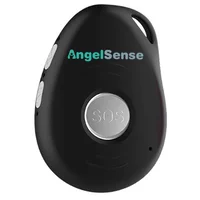
AngelSense wins for special needs kids (2-way voice + SOS + transit alerts). Jiobit wins for general kid tracking (18g, 5-7 day battery, cheaper).
Both AngelSense and Jiobit use cellular GPS to track your child’s location in real time.
That makes this a much closer comparison than pairing either one against a Bluetooth-only tracker like AirTag. The real question isn’t whether they track well. Both do. The question is whether you need AngelSense’s voice monitoring tools or Jiobit’s longer battery and smaller form factor.
These two trackers suit very different families, so the right pick depends heavily on your situation. A child with autism who tends to wander needs a crisis-response safety net with voice and listen-in tools. General after-school tracking for a 9-year-old has a much lower bar, where Jiobit’s smaller size and longer battery often matter more than AngelSense’s heavier safety feature set.
- AngelSense includes 2-way calling, listen-in mode, and transit alerts that Jiobit doesn’t offer at any price tier
- Jiobit’s battery lasts 5-7 days vs AngelSense’s 1-2 days, cutting charge anxiety significantly
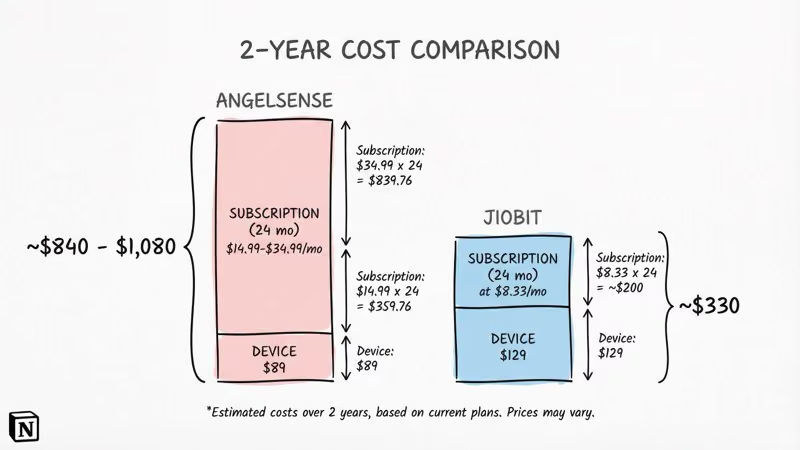
- Over 2 years, AngelSense costs $840-$1,080 in subscriptions alone while Jiobit totals about $330 all-in
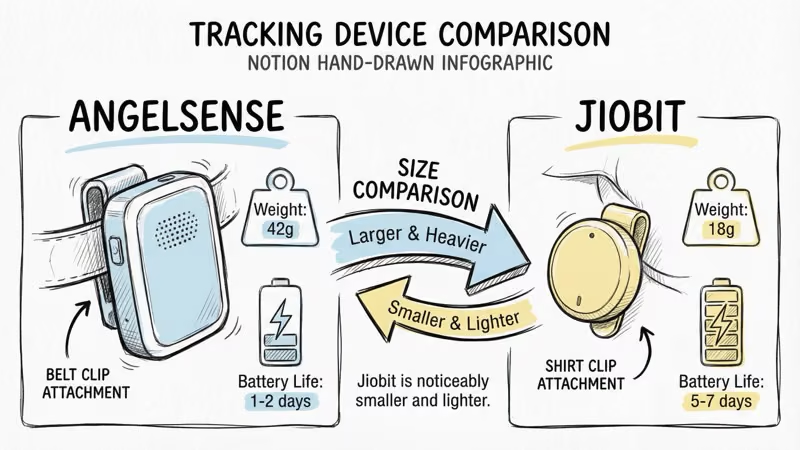
- Jiobit weighs 18 grams and clips to clothing; AngelSense weighs 42 grams and needs a belt attachment or adhesive
- AngelSense is sold only through angelsense.com with no Amazon option; Jiobit is available on Amazon for $129.99
How AngelSense and Jiobit Actually Differ
Strip away the marketing and these trackers serve different families with different worries. SafeWise’s family safety review found that AngelSense’s 30-second update interval refreshes location far more often than Jiobit’s standard tracking mode.
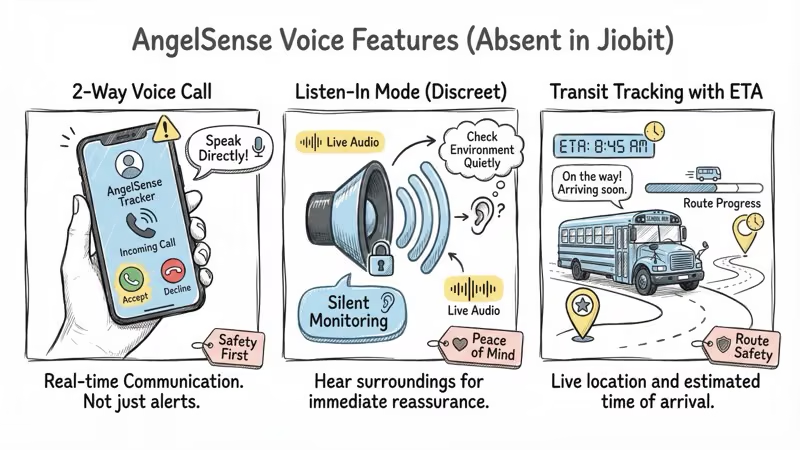
AngelSense is built for high-risk situations. It was designed specifically for children with autism, Down syndrome, and other conditions that increase wandering risk. The device includes a 2-way voice call feature (AngelCall), a listen-in mode that lets parents hear what’s happening around their child, and transit alerts that tell you when your child gets on and off a bus.
AngelSense even includes a lockable attachment so the child can’t remove the tracker. SafeWise’s kids GPS tracker guide covers how rival kid-trackers compare.
Jiobit takes a different approach, aimed at parents who want a discreet, lightweight device rather than a full monitoring suite. Instead of voice tools and listen-in features, it leans into simplicity and a small footprint, so the trade-off is fewer high-touch safety features in exchange for something your child is far more likely to keep wearing every day. It’s a general-purpose kid tracker that prioritizes being small enough to forget about.
At 18 grams, it clips to a waistband, slides into a shoe, or attaches to a backpack strap. No voice features, no listen-in. Just reliable location tracking with notifications when your child arrives at or leaves known places.
AngelSense vs Jiobit Gen 3: At a Glance
⇄ Head-to-head
AngelSense vs Jiobit Gen 3
- +2-way voice (AngelCall) + listen-in mode for non-verbal kids
- +30-second update interval (4x faster than Jiobit standard)
- +Transit alerts with real-time bus/car detection
- +Lockable attachment -- child can't remove it
- +Dedicated SOS button
- +Patented indoor positioning algorithm
- +18g lightweight clip-on -- forgettable on the body
- +5-7 day battery life (vs AngelSense's 1-2)
- +IPX8 submersible (vs AngelSense's splash-only)
- +Quad-mode positioning: GPS + cellular + Wi-Fi + BLE
- +Care Team sharing with up to 8 family members
- +$8.33/mo annual plan -- cheapest in cellular kid-tracker category
- −$34.99-$44.99/month -- most expensive in category
- −Only 1-2 day battery, daily charging
- −Heavier at 42g (vs Jiobit's 18g)
- −Splash-proof only (IP65)
- −Not sold on Amazon, direct from angelsense.com
- −No voice features (not even one-way audio)
- −Clip-on can be removed by determined child
- −No SOS button, no transit mode
- −Standard update interval slower than AngelSense
- ·Best for kids with autism, Down syndrome, or wandering risk
- ·Best when 2-way voice + listen-in matter
- ·Best for school bus families wanting transit tracking
- ·Best for general kid tracking when voice features aren't needed
- ·Best when battery life + small form factor matter most
- ·Best when monthly cost is a real factor
- ·Best for elderly family members wanting lightweight tracking
What Does Each Tracker Cost Over 2 Years?
This is where the gap gets real. Both trackers require monthly subscriptions, but AngelSense’s plans cost 3-4x more than Jiobit’s. If the use case is elder care, our Jiobit dementia use case covers setup and caregiver tradeoffs.
The full 2-year cost matrix appears in the head-to-head widget above. Over two years on the annual plan, AngelSense runs about $840 while Jiobit totals roughly $330 all-in, including the device — a $510 difference.
Is AngelSense worth the premium? For a family with a child who wanders and can’t communicate, absolutely. The listen-in feature alone provides safety information you can’t get from any other consumer tracker. But if your child is neurotypical and you just want to know they arrived at school, you’re paying for features you won’t use.
Tracking Accuracy and Reliability
Both trackers use cellular GPS, so outdoor accuracy depends on sky view, cellular coverage, and how often the device reports. The differences show up indoors and in transitional environments.
AngelSense uses a patented indoor tracking algorithm that combines GPS, Wi-Fi, and cellular triangulation.
Inside a large building, AngelSense can narrow the search area, but it isn’t room-level accurate.
Jiobit adds Bluetooth Low Energy (BLE) to its tracking stack, which helps with proximity detection when you’re close to the device.
Indoors, Jiobit leans on Wi-Fi and BLE positioning when GPS is weak.
For outdoor tracking, both are stronger than Bluetooth-only tags because they use cellular GPS rather than waiting for a nearby phone relay. AngelSense can feel faster because its default update interval is shorter.
Neither tracker works without cellular coverage. If your child spends time in very rural areas with no cell signal, GPS trackers won’t help. Consider whether a Bluetooth tracker like AirTag might work as a backup in those situations. Apple’s AirTag capabilities overview states that an AirTag locates itself through the Find My network of nearby Apple devices rather than a cellular plan, so it keeps reporting even where there is no SIM, on a single CR2032 battery.
Voice and Communication Features
This is AngelSense’s biggest advantage, and it’s not close.
AngelCall lets parents call the device directly. The child presses a button to answer, or parents can set it to auto-answer. For a child who doesn’t carry a phone or can’t operate one, this is the only way to communicate remotely. Treat the audio like a basic speakerphone: useful for safety context, but not a polished smartphone call.
Listen-in mode is more controversial but incredibly useful for special needs families. It lets you activate the microphone remotely to hear your child’s surroundings without them knowing. Parents often use it to verify their child arrived safely at a therapy appointment and is being spoken to appropriately by caregivers. AngelSense’s own documentation positions this as a safety tool, not a surveillance tool.
Jiobit has no voice features at all. No calling, no listening, no audio. It’s a location-only device.
Battery Life and Size
Jiobit wins both categories, and they’re connected. Smaller device, no speaker, no microphone means less power draw.
Jiobit lists 5-7 days on a single charge under normal use. The device charges via a magnetic cradle.
AngelSense is a daily-charge device. Listen-in sessions, Runner Mode, and frequent location checks shorten runtime. AngelSense sells an extended battery accessory that pushes rated runtime higher, but it adds bulk to an already larger device.
Size matters for kid trackers. A 9-year-old won’t want a visible device clipped to their clothes. Jiobit at 38 x 43 x 10.9 mm is small enough to hide in a shoe or clip inside a waistband. AngelSense is noticeably larger and heavier, though its secure attachment means it won’t fall off during recess.
Geofencing and Safe Zone Alerts
Both trackers let you draw geofence zones on a map and get push notifications when your child enters or leaves them. Standard stuff for GPS kid trackers.
AngelSense takes geofencing further with transit mode detection. It can identify when your child is in a moving vehicle and notify you with the route, speed, and estimated arrival time. If your child takes a school bus, this feature tells you exactly when the bus left school, where it’s right now, and when it should arrive at your stop. No other consumer kid tracker offers this level of transit intelligence.
Jiobit keeps geofencing simple. You set zones, you get alerts. The Jiobit app supports up to 10 trusted places, and you can share location access with up to 8 family members through the Care Team feature. Simple, reliable, and well-executed.
Which Tracker Should You Buy?
The full audience-fit checklist lives in the head-to-head widget at the top. Quick recap: pick AngelSense if your child has autism, Down syndrome, or another condition that increases wandering risk; if you need 2-way voice; or if a lockable non-removable attachment is a safety requirement. Pick Jiobit for general tracking of a neurotypical child where battery life, small size, and lower monthly cost matter more than voice features — it also works for elderly family members wanting a lightweight tracker.
What About AirTag Instead
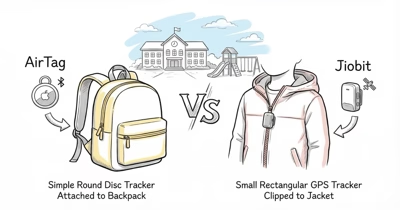
If you’re comparing costs and thinking an AirTag at $29 with no monthly fee sounds appealing, understand what you’re giving up. AirTag is a Bluetooth proximity tracker, not a GPS device. It doesn’t report real-time location, and it depends entirely on nearby iPhones to relay its position.
For a child who stays in urban or suburban areas with high iPhone density, an AirTag tucked in a backpack can provide rough location updates. But it won’t tell you when your child left school, it won’t alert you if they wander out of a geofence, and it absolutely won’t let you call or listen in. For a deeper breakdown, see our AirTag vs GPS tracker comparison.
If you’re exploring GPS options for elderly family members rather than children, Jiobit works for that use case too. We cover dedicated options in our GPS trackers with no monthly fee guide, and our cheapest GPS car tracking comparison covers vehicle use cases.
Bottom Line
Buy AngelSense if your child has special needs and you need voice communication plus listen-in capability. The $35-$45/month cost is high, but no other tracker offers that combination of safety features for high-risk children. For a deeper look at trackers designed for elopement prevention, see our GPS tracker for autism and special needs guide.
Buy Jiobit if you want reliable GPS tracking for a typical kid without paying premium prices for features you won’t use. At $8.33/month on the annual plan, it’s one of the most cost-effective cellular trackers available. For more options across all price ranges, see our best GPS trackers for kids guide. If your child doesn’t carry a phone, our guide on tracking children without a smartphone compares all four device categories.
FAQ
Does AngelSense work without a subscription?
No. AngelSense requires an active subscription for all features, including basic GPS tracking. The device is included free with the plan, but without a subscription it does nothing. Plans start at $34.99/month on the annual commitment or $44.99 month-to-month.
Can a child remove the Jiobit tracker?
Yes, though it takes effort. The Jiobit clips onto clothing or a belt loop with a spring-loaded clasp. A determined child can pull it off. AngelSense addresses this with a lockable attachment that requires a magnetic key to release. If removability is a safety concern, AngelSense is the more secure option.
Is AngelSense available on Amazon?
No. AngelSense is sold exclusively through angelsense.com. The company handles sales directly because the device is paired with its subscription service during activation. Jiobit is available on Amazon (ASIN: B0C46YNSDP) for $129.99.
Which tracker is better for a child with autism?
AngelSense was specifically designed for children with autism and developmental disabilities. The Autism Speaks technology resource page lists GPS trackers as a recommended safety tool for wandering prevention. AngelSense’s listen-in mode, 2-way calling, and non-removable attachment directly address the wandering risks documented among children with ASD, according to research published by the Interactive Autism Network.
How accurate are AngelSense and Jiobit indoors?
Both struggle with precision indoors compared to outdoor GPS. AngelSense combines cellular and Wi-Fi signals, while Jiobit adds Bluetooth beacons to its indoor positioning. Wi-Fi density and building layout matter more than the logo on the device. Neither will tell you which room your child is in.
Can you use Jiobit to track elderly parents?
Yes. Jiobit markets itself for both children and seniors. Its small size and rated multi-day battery make it practical for an elderly person who might forget to charge a larger device. The Care Team feature lets multiple family members monitor location. For dedicated elderly tracking options, check out our best item tracker roundup.
Do AngelSense or Jiobit work internationally?
AngelSense works in the US, Canada, UK, and Australia. International coverage outside these countries is limited because it depends on specific cellular band availability. Jiobit officially supports the US and Canada only, though some users report it working in countries with compatible LTE-M or Cat-M1 networks. Neither is a strong choice for frequent international travel.