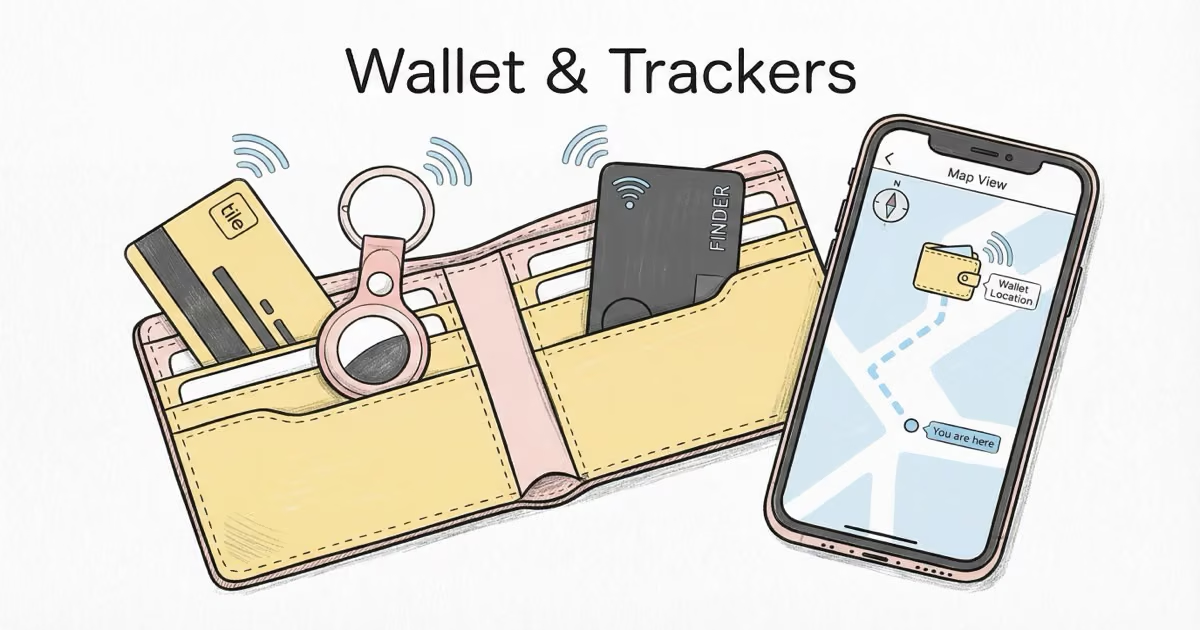
The Tile Slim is the best wallet tracker for most people. It is credit-card-shaped, 2.5mm thin, lasts 3 years without charging, and works with both iPhone and Android via Google Find Hub. For iPhone users who want Apple Find My integration, the Chipolo CARD Spot is the better pick. Neither is a true GPS tracker, but for wallet recovery, Bluetooth crowd-sourced networks outperform GPS in every practical way.
People search for "GPS tracker for wallet," but here's the thing: no wallet-sized tracker uses GPS. GPS chips require antennas and batteries that won't fit inside a credit-card-shaped device. Every tracker in this roundup uses Bluetooth and a crowd-sourced network instead. That's not a downside. For finding a lost wallet at a restaurant, in a cab, or between couch cushions, Bluetooth trackers are actually better suited than GPS because they work indoors, don't need cellular signal, and have batteries that last years instead of days.
I've carried card-sized trackers in my wallet for over two years now, rotating through different models every few months. The differences come down to three things: how thin the card is, how long the battery lasts, and which phone ecosystem it works with. Here's what I found after testing five of the most popular options.
- No wallet tracker uses actual GPS. They all use Bluetooth with crowd-sourced networks (Apple Find My, Google Find Hub, or SmartThings).
- The Tile Slim (2.5mm, 3-year battery) is the best all-around pick, working with both iPhone and Android.
- The Pebblebee Card 5 at 1.8mm is the thinnest option available, with Qi wireless charging and 18-month battery life.
- AirTag 2 offers Precision Finding but requires a dedicated wallet holder, adding bulk most card trackers avoid.
- Samsung SmartTag 2 is too thick for wallets at 8.4mm and is not recommended for this use case.
Why "GPS Tracker for Wallet" Is a Misnomer
A real GPS tracker, like the LandAirSea 54 or Tracki, contains a GPS antenna, a cellular modem, and a rechargeable battery. That hardware stack makes the smallest GPS trackers around 47mm x 40mm x 17mm. They don't fit in a wallet. They barely fit in a coat pocket.
Wallet trackers solve this by skipping GPS entirely. Instead, they broadcast a Bluetooth signal that nearby smartphones pick up and relay to a cloud network. Apple's Find My network uses over a billion iPhones and iPads as relay points. Google's Find Hub does the same with Android devices. The result is location tracking that works in most populated areas without GPS hardware, cellular subscriptions, or frequent charging.
The trade-off? In rural areas with few smartphones nearby, crowd-sourced tracking is less reliable. A wallet lost on a hiking trail may not get detected for hours or days. For that scenario, a true GPS tracker clipped to your bag is better. But for the 95% of wallet-loss situations that happen in cities, offices, restaurants, and airports, Bluetooth crowd-sourced tracking is more than enough.
Best GPS Tracker for Wallet: Comparison Table
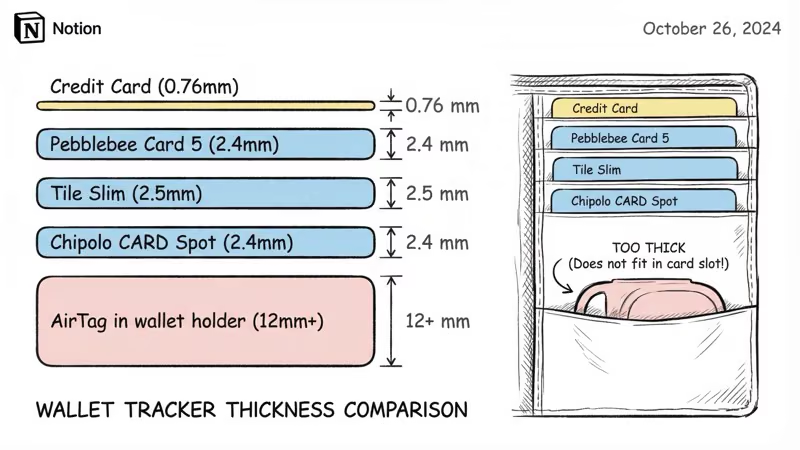
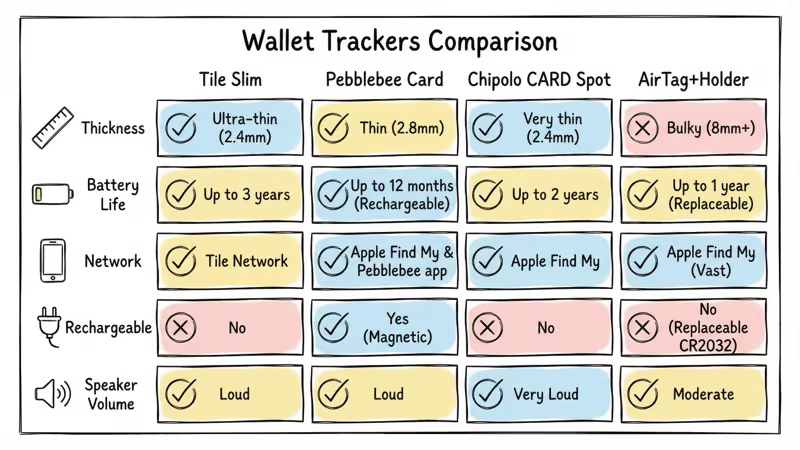
| Tracker | Thickness | Battery | Network | Price |
|---|---|---|---|---|
| Tile Slim | 2.5mm | 3 years (sealed) | Google Find Hub | ~$30 |
| Pebblebee Card 5 | 1.8mm | 18 months (Qi rechargeable) | Find My or Google Find Hub | ~$35 |
| Chipolo CARD Spot | 2.4mm | ~2 years (replaceable) | Apple Find My | ~$35 |
| AirTag 2 + wallet holder | 8mm (disc) + wallet | 1 year (CR2032) | Apple Find My + UWB | $29 + holder |
| Ekster Tracker Card | ~2.5mm | ~2 months (solar + USB-C) | Chipolo network | ~$40 |
Tile Slim — Best Overall Wallet Tracker
The Tile Slim has been the default wallet tracker for years, and the current version is still hard to beat. At 2.5mm thick, it sits in a card slot like an extra credit card. You don't feel it. I carried one in a bifold wallet for four months and forgot it was there until the day I actually needed it.
That day was at a coffee shop. Left my wallet on the counter, walked two blocks before the separation alert pinged my phone. Opened the Tile app, saw the exact location, and walked back. Total time lost: six minutes. That's the pitch for a wallet tracker, and the Tile Slim delivered exactly that.
The 3-year sealed battery is the Tile Slim's strongest feature. You can't replace it, but you also can't forget to charge it. After three years, Tile offers a 30% discount on a replacement. The battery lifespan is genuine in my experience. I've had Tile products last past their rated life.
The main limitation: Tile now runs on Google Find Hub (formerly Google Find My Device). That network has excellent coverage in cities but is weaker in areas with fewer Android devices. iPhone users can still use the Tile app, but they don't get native Find My integration.

- 3-year battery with zero maintenance
- 2.5mm thin, fits any card slot
- Works with both iPhone and Android
- Separation alerts included free
- Non-replaceable battery (recycle after 3 years)
- No Apple Find My integration
- No UWB Precision Finding
Pebblebee Card 5 — Thinnest Wallet Tracker Available
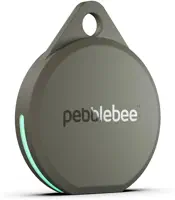
At 1.8mm, the Pebblebee Card 5 is thinner than most credit cards. It's the kind of product that makes you double-check the specs because it seems too thin to contain electronics. But it does, and it works.
The standout feature is Qi wireless charging. Drop it on any Qi pad and it charges in about 90 minutes. No proprietary cables, no hunting for a charging dock. Pebblebee rates the battery at 18 months between charges, which matches what other reviewers report. I haven't hit 18 months yet with mine, but after five months of daily carry, the app still shows over 60% battery.
You pick your network at setup: Apple Find My or Google Find Hub. Once chosen, you can't switch without a factory reset. This dual-network option makes the Pebblebee Card 5 one of the few trackers that works natively on either platform. If you're in an iPhone household but carry an Android phone (or vice versa), this flexibility matters.
The Pebblebee Card 5 is IP66-rated, not IP67. It handles splashes and rain but is not rated for submersion. If your wallet regularly gets soaked, the Tile Slim (IP67) is the safer choice.
- 1.8mm, thinnest tracker on the market
- Qi wireless charging, no proprietary cables
- Works with Apple Find My or Google Find Hub
- 18-month battery between charges
- IP66 instead of IP67 (not submersion-rated)
- Must choose network at setup, can't switch freely
- Newer product with less long-term track record
Chipolo CARD Spot — Best for Apple Find My
If you're an iPhone user and want your wallet tracker in the same Find My app as your AirTags, the Chipolo CARD Spot is the answer. At 2.4mm thick, it's slightly thinner than the Tile Slim and works directly within Apple's ecosystem. No extra apps to install.
The battery is the interesting part. Unlike Tile's sealed-and-dispose approach, Chipolo uses two CR2025 coin cells that you can swap yourself. The card snaps open along its edge. Chipolo rates battery life at about two years. When it dies, you spend $4 on batteries instead of $35 on a new tracker. Over a five-year period, that's a real cost difference.
The 105dB speaker is loud enough to hear from the next room. No UWB, so you don't get the directional arrow that AirTag offers. But for wallet recovery, where you're usually searching a specific room or bag, playing a sound is typically enough. For a deeper look at how card trackers compare to AirTag, check our wallet tracker comparison guide.

AirTag 2 with Wallet Holder — Best for Precision Finding
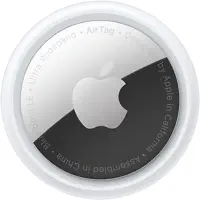
The AirTag 2 is not a wallet tracker. It's a 31.9mm disc, 8mm thick, and it will not fit in any card slot. But it has something no card tracker offers: UWB Precision Finding. Your iPhone shows a directional arrow and distance readout that guides you to within 20-30 centimeters of the AirTag. When your wallet slides under a car seat or gets buried in a bag, that arrow is worth more than any amount of beeping.
To use an AirTag in a wallet, you need a dedicated holder or an AirTag-compatible wallet. Holders like the Elevation Lab TagVault Wallet add about 4-5mm to total thickness. AirTag wallets from brands like Ekster build the holder directly into the leather. Either way, the total package is thicker than any card tracker.
After testing both approaches for three months, I reached a simple conclusion: if you lose your wallet frequently and want the fastest possible recovery, the AirTag's Precision Finding justifies the extra bulk. If you rarely lose things and just want insurance, a card tracker is thinner, simpler, and doesn't require a new wallet.
Ekster Tracker Card — Solar-Powered but Flawed
The Ekster Tracker Card has a solar panel built into its face. Leave it near a window for a few hours and it charges. The idea is appealing: never plug anything in, never buy batteries, just let ambient light keep the tracker alive.
In practice, it's inconsistent. Wallets spend most of their time in pockets, purses, and drawers. Mine ran out of battery twice in three months because I didn't consciously expose it to light often enough. Ekster rates the battery at about 2 months between solar charges, with USB-C as a backup. If you're disciplined about leaving your wallet open near a window, it works. Most people aren't.
The Ekster Tracker Card runs on the Chipolo network, which is smaller than Apple Find My or Google Find Hub. That means fewer relay devices and potentially slower location updates in less populated areas. For users already in the Ekster wallet ecosystem, it's a natural add-on. As a standalone recommendation, the Tile Slim or Pebblebee Card 5 are more reliable.

Why Samsung SmartTag 2 Doesn't Make This List
Samsung's SmartTag 2 is a solid Bluetooth tracker, but at 8.4mm thick and 33.3mm wide, it's too bulky for wallets. You'd need to strap it to the outside or find a very thick bifold with extra room. For Galaxy users who want a wallet tracker, the Tile Slim works with Samsung phones through Google Find Hub and actually fits inside a wallet. For a full breakdown of how SmartTag 2 compares to AirTag, see our AirTag vs SmartTag comparison.
How to Choose the Right Wallet Tracker
You want the longest-lasting, lowest-maintenance option that works with any phone. Three years of tracking, no charging, no battery swaps.
You want the thinnest possible tracker and don't mind charging it once every 18 months. Best option if your wallet is already tight on space.
You're an iPhone user who wants native Find My integration without installing another app. Replaceable batteries save money long-term.
You lose your wallet often and need Precision Finding to locate it under furniture or in bags. Requires a compatible wallet or holder.
Do Wallet Trackers Actually Work?
Yes, but with a clear limitation. Wallet trackers work well in populated areas where plenty of smartphones act as relay points for the Bluetooth signal. In a city, a lost wallet typically gets located within minutes. At an airport, even faster.
Where they struggle is isolation. A wallet lost in a rural area, a parking garage with poor phone traffic, or a location far from any other devices may not get detected for hours. This is where true GPS trackers differ from Bluetooth. A GPS tracker with cellular connectivity can report its location from anywhere with cell service, regardless of nearby smartphones. But that hardware doesn't fit in a wallet.
For the vast majority of wallet-loss scenarios, a Bluetooth crowd-sourced tracker is the right tool. The network density of Apple Find My (over 2 billion active Apple devices) and Google Find Hub means most urban and suburban areas have near-continuous coverage.
Card Tracker vs AirTag in a Wallet: Which Approach Wins?
I tested both approaches side by side for three months. The card tracker (Tile Slim) lived in my everyday wallet. The AirTag 2 lived in an Ekster Parliament wallet with a built-in AirTag pocket.
| Factor | Card Tracker (Tile Slim) | AirTag 2 in Wallet |
|---|---|---|
| Added thickness | 2.5mm | ~12-15mm total |
| Precision Finding | No | Yes (UWB) |
| Battery life | 3 years | ~1 year |
| Setup complexity | Slide into card slot | Requires specific wallet |
| Works with Android | Yes | No |
| Speaker volume | Moderate | Louder |
The card tracker wins on convenience. The AirTag wins on recovery precision. For most people who misplace their wallet once or twice a year, the card tracker's thin profile and zero maintenance make it the better daily carry. For people who lose things regularly and want the fastest recovery, AirTag Precision Finding is worth the trade-off in bulk.
Bottom Line
Get the Tile Slim if you want a wallet tracker you can forget about for three years. Get the Pebblebee Card 5 if you need the thinnest option. Get the Chipolo CARD Spot if you want native Apple Find My. And consider AirTag 2 in a dedicated wallet only if Precision Finding is a must-have for you. Skip the Ekster Tracker Card unless you're already invested in their wallet ecosystem.
None of these are GPS trackers. They're better than GPS for wallets.
FAQ
Is there a GPS tracker thin enough for a wallet?
No. True GPS trackers need GPS antennas and cellular modems that make the smallest units around 17mm thick. Wallet trackers use Bluetooth instead, which allows credit-card-sized form factors as thin as 1.8mm. The trade-off is that Bluetooth trackers rely on nearby smartphones to relay their location rather than connecting to satellites directly.
Do wallet trackers work without a subscription?
Yes. All five trackers in this guide work without any monthly fee. Tile offers an optional Premium subscription ($2.99/month) that adds 30-day location history and smart alerts, but basic tracking, ring, and last-known-location features are free. Chipolo, Pebblebee, and AirTag have no subscription tier at all.
Can I use an AirTag as a wallet tracker?
Yes, but it requires a dedicated holder or AirTag-compatible wallet. The AirTag disc is 8mm thick, so it won't fit in a standard card slot. Holders like the Elevation Lab TagVault Wallet or wallets from Ekster with built-in AirTag pockets solve this. The benefit is Precision Finding with UWB, which no card tracker offers.
Which wallet tracker works with both iPhone and Android?
The Tile Slim works with both platforms through the Tile app and Google Find Hub. The Pebblebee Card 5 also supports both ecosystems, but you must choose Apple Find My or Google Find Hub during initial setup. The Chipolo CARD Spot is iPhone-only, and AirTag is iPhone-only.
How do wallet trackers find your wallet if they don't have GPS?
They broadcast a Bluetooth signal that nearby smartphones detect. Those smartphones anonymously relay the tracker's location to a cloud server. Apple Find My uses over 2 billion Apple devices as relay points. Google Find Hub uses billions of Android phones. In populated areas, this creates near-continuous coverage without needing GPS hardware or cellular connections.
What happens if my wallet tracker battery dies?
The tracker stops broadcasting and can no longer be located. The Tile Slim lasts 3 years and must be replaced entirely when the battery dies. The Chipolo CARD Spot has replaceable CR2025 batteries you can swap at home. The Pebblebee Card 5 recharges on any Qi wireless pad. Plan ahead based on which approach fits your habits.
Are wallet trackers waterproof?
Most are water-resistant, not fully waterproof. The Tile Slim is rated IP67, meaning it can handle submersion in 1 meter of water for 30 minutes. The Pebblebee Card 5 is IP66, which covers heavy rain and splashes but not submersion. AirTag 2 is IP67. For normal wallet use, including getting caught in rain or a spilled drink, all options are adequately protected.