
FitBark GPS is the better pick if you care most about your dog's health data and want a lightweight 16g tracker that clips onto any collar. Fi Series 3 is the better pick if real-time GPS tracking and escape alerts are your top priority. FitBark costs roughly $310 over two years; Fi costs about $505 over the same period.
These two products look similar on paper but solve different problems. FitBark started as a canine fitness tracker and added GPS later. Fi was built from the ground up as a GPS dog collar. That origin story shapes everything: what they track, how they track it, and what you’ll pay.
I’ve tested both alongside other pet trackers like Tractive and used the FitBark GPS on my dog for several months. Here’s what actually matters when choosing between them.
- FitBark GPS (2nd Gen) weighs 16g and clips to any collar; Fi Series 3 weighs 28g and is a full collar replacement.
- FitBark tracks sleep quality, behavior changes, calories, and activity with a veterinary-grade health score; Fi focuses on steps, distance, and GPS location.
- Fi's battery lasts up to 3 months in standard mode; FitBark lasts 3-5 weeks with GPS active.
- Two-year total cost: FitBark approximately $310 (device $69.95 + subscription); Fi approximately $505 (device $149 + subscription).
- FitBark fits dogs as small as 5 lbs; Fi requires dogs 10 lbs and up.
FitBark vs Fi: Quick Specs Comparison
| Feature | FitBark GPS (2nd Gen) | Fi Series 3 |
|---|---|---|
| Primary purpose | Health monitor + GPS | GPS tracker + activity |
| Weight | ✓ 16g | 28g |
| Form factor | Clip-on (any collar) | Full collar |
| GPS tracking | ✓ GPS + LTE-M | ✓ GPS + LTE-M |
| Health tracking | ✓ Detailed (sleep, behavior, calories) | Basic (steps, distance) |
| Battery (GPS active) | 3-5 weeks | ✓ Up to 3 months |
| Water resistance | IP67 | ✓ IP68 |
| Minimum dog size | ✓ 5 lbs | 10 lbs |
| Device price | ✓ $69.95 | $149 |
| Monthly subscription | $5.95-$9.95/mo | $14-$19/mo |
| App compatibility | iOS + Android | iOS + Android |
| Geofencing | 1 safe zone | ✓ Multiple zones |
The specs tell one story. Real-world use tells another. Let’s break down what these numbers actually mean for your dog.
Health and Activity Tracking: FitBark Wins
This is where FitBark pulls ahead, and it’s not close.
FitBark GPS tracks sleep quality, daily activity scores (BarkPoints), calories burned, behavior changes, and even anxiety indicators. After attaching the FitBark to my dog’s collar, I could see patterns within a week. Lazy Sundays scored around 200 BarkPoints. Park days hit 800+. The sleep tracking caught three restless nights in a row that turned out to be an early sign of a mild ear infection.
That level of health insight has real veterinary value. FitBark partners with veterinary research institutions including the University of Guelph and Ohio State, and a 2021 peer-reviewed study validated FitBark’s activity measurements against lab-grade accelerometers. Their health scoring system uses breed-specific baselines to flag when something’s off.
Fi Series 3 tracks steps and distance. It shows daily, weekly, and monthly trends, plus breed comparisons. That’s useful for making sure your dog gets enough exercise, but it won’t catch health problems the way FitBark’s deeper monitoring can.
If your vet has ever asked “has anything changed in your dog’s routine?” FitBark gives you actual data to answer that question. Fi doesn’t.

For more on FitBark’s health features, see our full FitBark review.
GPS Tracking and Escape Alerts: Fi Wins
Fi was designed as a GPS tracker from day one, and it shows.
Both use GPS satellites plus LTE-M cellular networks to locate your dog. But Fi’s Lost Dog Mode is the standout feature: when activated, it switches to live tracking with updates every few seconds. The collar also has a built-in LED light you can trigger from the app, which helps if your dog escapes at night.
Fi supports multiple geofenced safe zones. You can set up separate boundaries for your yard, your dog park, your parents’ house. When your dog leaves any zone, you get an alert. In my testing with other GPS collars, Fi’s escape alerts arrived within about 60 seconds.
FitBark has GPS and geofencing too, but it’s limited to one safe zone at a time. Some users report a lag of a few minutes before escape alerts come through. That difference matters when your dog bolts.
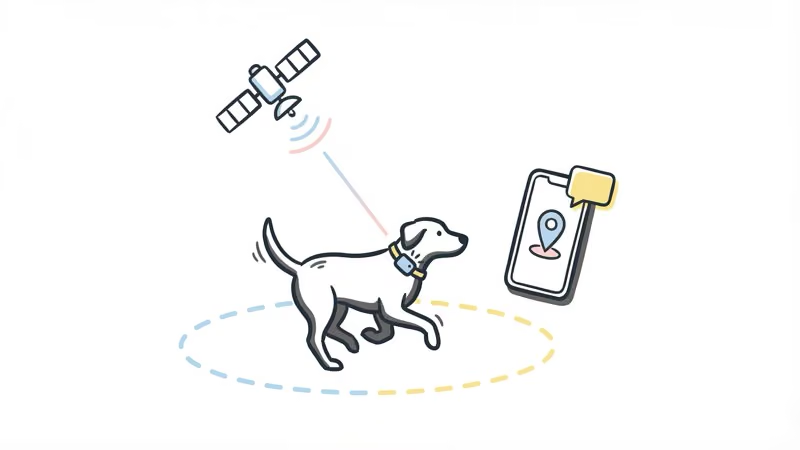
Both collars need cellular coverage to send GPS data. Neither will track your dog in areas without cell service, like deep wilderness or underground.
For a comparison of Fi against another GPS-focused pet tracker, check our AirTag vs Fi collar breakdown.
Battery Life: Different Trade-Offs
Battery life depends entirely on how you use these trackers.
Fi Series 3 claims up to 3 months on a single charge in standard mode, where it checks location periodically. In Lost Dog Mode with live tracking, that drops to about 2 days. Most real-world users report 4-8 weeks between charges with typical daily use.
FitBark GPS (2nd Gen) lasts 3-5 weeks with GPS active. Without GPS (activity tracking only), the original FitBark 2 lasted up to 6 months. The 2nd Gen GPS model uses more power because of the cellular radio.
Fi wins on raw battery numbers, partly because it relies heavily on Wi-Fi and Bluetooth when at home to reduce cellular usage. FitBark’s battery is more consistent regardless of connectivity.
Both come with charging bases. FitBark’s plugs into the wall. Fi has a magnetic charging dock.
Size, Weight, and Fit
This could be the deciding factor if you have a small dog.
FitBark GPS weighs just 16 grams and clips onto any existing collar up to 1.5 inches wide. Your dog keeps their favorite collar. You barely notice the tracker is there. It works for dogs as small as 5 lbs.
Fi Series 3 is a complete collar replacement weighing 28g (the tracker module alone). It comes in four sizes for necks 11.5 to 34.5 inches. Minimum dog weight: 10 lbs. The collar itself is well-built with a stainless steel body, but it’s a collar, not an add-on.
If you have a Chihuahua, Yorkie, or any dog under 10 lbs, FitBark is your only option here. For medium to large breeds, either works fine.
For more on tracking small dogs, see our best AirTag dog collar guide.
Pricing and 2-Year Total Cost
Both require subscriptions for GPS features. Here’s what you’ll actually pay.
FitBark GPS Pricing
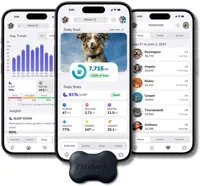
- Detailed health and behavior tracking with vet-grade scoring
- Only 16g, clips to any collar
- Works for dogs as small as 5 lbs
- Lower device cost ($69.95) and subscription ($5.95-$9.95/mo)
- Tri-carrier LTE-M (Verizon, AT&T, T-Mobile)
- Only one geofence zone at a time
- Slower escape alert delivery (minutes vs seconds)
- Shorter battery with GPS active (3-5 weeks)
- No LED light for nighttime visibility
Fi Series 3 Pricing
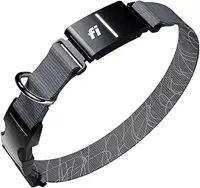
- Excellent real-time GPS with Lost Dog Mode (updates every few seconds)
- Multiple geofence zones (home, dog park, etc.)
- Built-in LED light for nighttime
- IP68 water resistance (submersible to 1.5m)
- Up to 3-month battery in standard mode
- Full collar replacement, not a clip-on
- Doesn't fit dogs under 10 lbs
- Higher total cost ($505+ over 2 years)
- Basic activity tracking (steps and distance only)
2-Year Total Cost Comparison
| Cost item | FitBark GPS | Fi Series 3 |
|---|---|---|
| Device | $69.95 | $149.00 |
| Subscription (Year 1) | $95.40 ($7.95/mo annual) | $168.00 ($14/mo 2-yr plan) |
| Subscription (Year 2) | $95.40 | $168.00 |
| 2-year total | $260.75 | $485.00 |
| Monthly, no commitment | $309.75 ($69.95 + 24 x $9.95) | $605.00 ($149 + 24 x $19) |
FitBark costs about half of what Fi does over two years. That gap is significant enough to influence the decision for many dog owners.
Geofencing and Alerts
Fi lets you create multiple geofenced safe zones and delivers escape alerts within about 60 seconds. You can set different zones for home, work, the dog park, even a friend’s yard. The collar vibrates as a warning when your dog approaches the boundary.
FitBark supports one geofenced zone at a time. Changing zones means editing the existing one. Alert delivery takes a few minutes in some cases. For a dog that’s contained in your backyard 95% of the time, this is fine. For multi-location households or dogs that travel with you, Fi’s multi-zone approach is clearly better.
App Experience
Both apps are free on iOS and Android. From my testing and reviewing hundreds of user reports:
FitBark’s app is more stable and intuitive. The health dashboard gives you a clear daily score, and the historical trends are easy to read. The community feature lets you compare your dog’s activity with breed averages. App Store reviews are consistently positive.
Fi’s app is functional but has more reports of bugs, GPS accuracy glitches, and connectivity issues. It does offer Apple Watch integration, which FitBark doesn’t. The GPS map view works well when the connection is solid.
Neither app is perfect, but FitBark’s track record with reliability is stronger based on user reviews across both platforms.
Water Resistance
Fi Series 3 is rated IP68 according to Fi’s product specs, meaning it handles submersion up to 1.5 meters for 30 minutes. FitBark GPS (2nd Gen) is rated IP67, which covers submersion to 1 meter for 30 minutes.
For practical purposes, both handle rain, mud, puddles, and the occasional swim. If your dog regularly dives into lakes or pools, Fi’s IP68 rating gives you a bit more margin. For typical use, IP67 is more than enough.
Which One Should You Choose?
- Your dog's health data matters as much as location
- You have a small dog under 10 lbs
- You want to keep your current collar
- You want the lower total cost ($260-$310 over 2 years)
- Your vet wants activity and sleep data for diagnosis
- GPS escape alerts are your primary concern
- You need multiple geofence zones
- You want the longest battery life between charges
- Your dog is a medium to large breed (10+ lbs)
- You want Apple Watch integration
For most dog owners who want both tracking and health data, FitBark is the better overall value. It costs less, fits more dogs, and gives you health insights that Fi simply doesn’t offer.
But if your dog is an escape artist and you need the fastest possible alerts with live tracking, Fi is worth the premium. Its Lost Dog Mode and multi-zone geofencing are designed for exactly that scenario.
For a broader look at pet tracking options, see our best GPS trackers for pets roundup or our FitBark vs Whistle comparison.
Bottom Line
Buy FitBark GPS if your dog’s health is the priority and you don’t want to spend $500+ over two years. Buy Fi Series 3 if fast escape alerts and live GPS tracking are worth the higher cost. For dogs under 10 lbs, FitBark is your only real option between these two.
FAQ
Does FitBark require a subscription for GPS?
Yes. GPS, cellular location, and escape alerts all require an active subscription. Activity and health tracking (steps, sleep, BarkPoints) work without a subscription. Plans range from $9.95/month (no commitment) down to $5.95/month on a 3-year plan.
Can I use Fi collar with Android?
Yes. The Fi app works on both iOS and Android. Fi also supports Apple Watch, but there's no Android smartwatch integration.
Is FitBark GPS accurate enough to find a lost dog?
FitBark uses GPS and LTE-M to locate your dog, but it's not as responsive as Fi for active escape scenarios. FitBark's strength is ongoing health monitoring with periodic location checks. For urgent lost-dog situations, Fi's Lost Dog Mode with live updates every few seconds is more effective.
How long does Fi Series 3 battery last in Lost Dog Mode?
About 2 days. Lost Dog Mode activates live tracking with updates every few seconds, which drains the battery fast. In standard mode, Fi lasts up to 3 months. Most owners report 4-8 weeks with normal daily use.
Can FitBark detect health problems in dogs?
It can flag changes that correlate with health issues. FitBark tracks sleep quality, activity levels, and behavior patterns using breed-specific baselines. A sudden drop in activity or disrupted sleep can indicate pain, illness, or anxiety. It's not a diagnostic tool, but it gives your vet useful data.
Do both collars work without Wi-Fi?
Yes. Both use GPS satellites and cellular LTE-M networks for location tracking, which work independently of Wi-Fi. They use Wi-Fi and Bluetooth at home primarily to save battery and sync data faster.
Which is better for a puppy?
FitBark, for two reasons. It weighs only 16g (versus Fi's 28g tracker module), and it fits dogs from 5 lbs. A growing puppy will also need collar size changes, and FitBark clips onto whatever collar you're using. Fi requires buying new collar bands as your puppy grows.