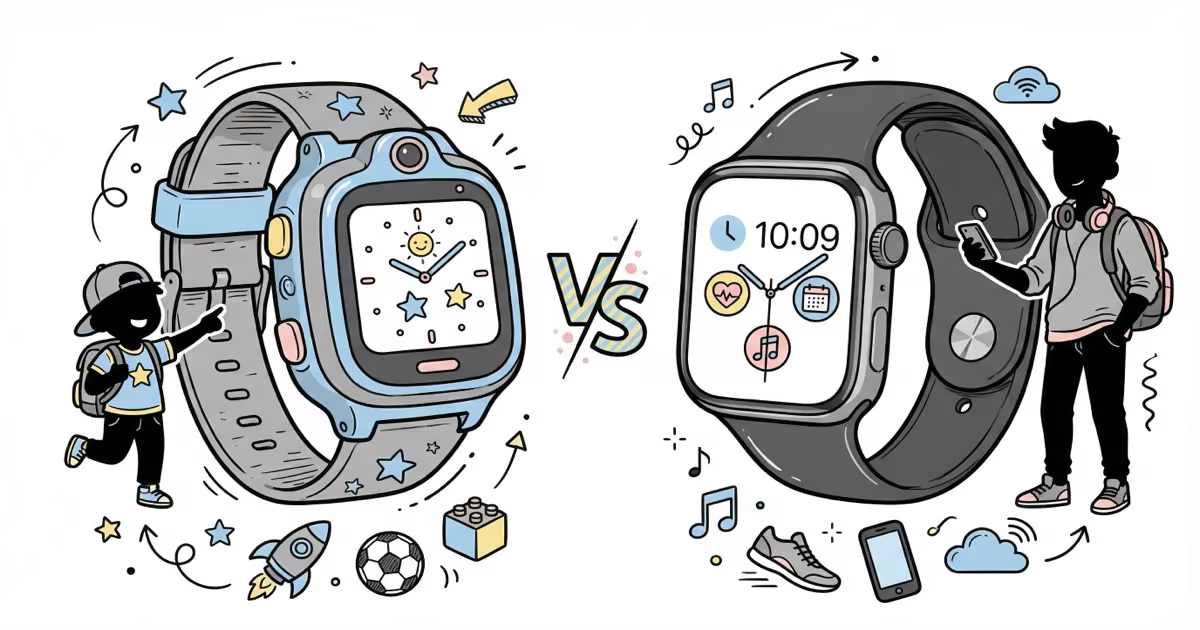
Get the Gabb Watch if your child is under 12 and you want zero internet access, strict contact controls, and a rugged build. Get the Apple Watch with Family Setup if your kid is a teen who needs apps, precise GPS, and a device that grows with them.
These two watches solve different problems. The Gabb Watch is a kids’ safety watch that blocks social media and internet access entirely. The Apple Watch is a full smartwatch with parental restrictions layered on top. The right choice depends on your child’s age, maturity, and how much digital freedom you’re comfortable giving them.
- Gabb Watch targets ages 5-12 with no internet, no app store, and parent-approved contacts only.
- Apple Watch with Family Setup works for ages 12+ and transitions into a full smartwatch as kids mature.
- Gabb Watch costs $99-$150 plus $10-$15/month for cellular; Apple Watch SE starts at $249 plus $10/month.
- Apple Watch GPS accuracy is significantly better, using built-in GPS vs Gabb's cell tower triangulation.
- Both watches offer location tracking, geofencing, and emergency SOS calling.
Gabb Watch vs Apple Watch: How They Actually Differ
The core difference is philosophy. Gabb built a watch that removes features to keep kids safe. Apple built a watch that restricts features through parental controls. That distinction matters more than any spec comparison.
With a Gabb Watch, your child can't browse the internet. Period. No workarounds, no settings to toggle. There's no app store, no social media, no messaging with strangers. It's a phone on the wrist with training wheels that don't come off.
The Apple Watch takes the opposite approach. It's a full-featured smartwatch where you decide what to lock down. Apple's Family Setup lets you manage contacts, screen time, and app access. But the underlying capability is always there, waiting to be unlocked.
| Feature | Gabb Watch 3 | Apple Watch SE (2024) |
|---|---|---|
| Best Age Range | 5-12 years | 12+ years |
| Internet Access | ✗ None | ⚠ Restricted via Family Setup |
| App Store | ✗ No | ✓ Yes (parent-approved) |
| GPS Tracking | ⚠ Cell tower + Wi-Fi | ✓ Built-in GPS |
| Water Resistance | Splash-proof (IP54) | ✓ Swimproof (WR50) |
| Battery Life | 1-2 days | 18-24 hours |
| Device Price | $99-$150 | From $249 |
| Monthly Plan | $10-$15/mo | ~$10/mo (carrier) |
| Messaging | Pre-set texts + voice notes | Full text, email, voice |
| Emergency SOS | ✓ Yes | ✓ Yes |
Parental Controls and Safety
This is where the watches diverge most.
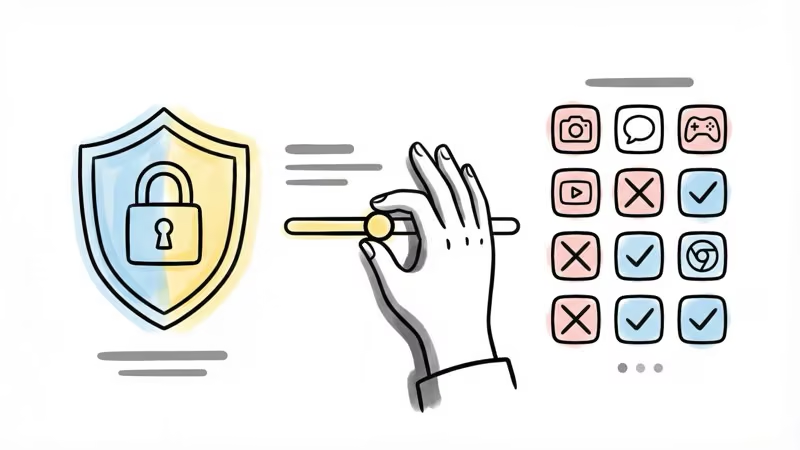
The Gabb Watch gives parents total control by default. You approve every contact. Your kid can call and text only the people you've added through the Gabb app. There's no web browser, no social media apps, no way for a stranger to reach your child through the device. For parents of younger kids, that peace of mind is worth the trade-off in features.
The Apple Watch with Family Setup offers granular but adjustable controls. You manage contacts, set screen time limits, approve app downloads, and restrict communication. Apple's Communication Safety features can blur sensitive images in Messages automatically. The advantage? As your child matures, you loosen restrictions gradually instead of buying a new device.
I've talked with parents who switched from Gabb to Apple Watch around age 13. The common reason: kids hit middle school and needed group chats, school apps, and more independence. Gabb's locked-down approach works well until it doesn't.
- Your child is under 12
- You want zero internet access on the device
- You prefer a "walled garden" where nothing slips through
- Durability matters more than features
- Your child is 12+ or approaching middle school
- You want precise GPS location tracking
- Your family already uses iPhones
- You want a device that grows with your teen
Location Tracking Accuracy
If knowing exactly where your child is matters to you, the Apple Watch wins this one clearly.
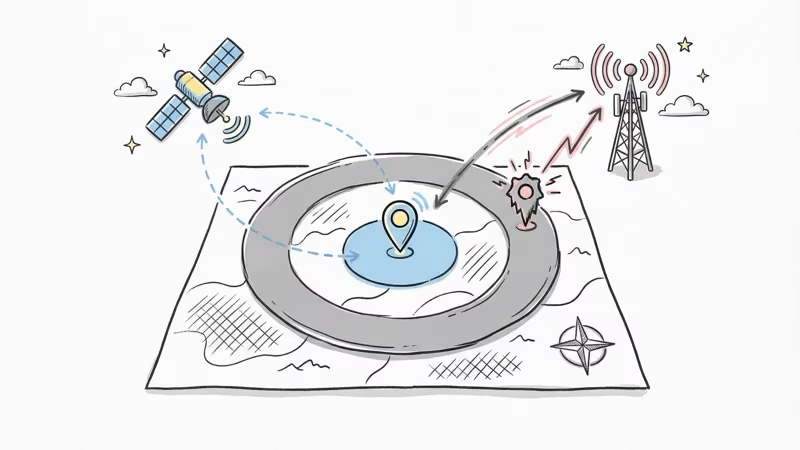
The Apple Watch uses built-in GPS, Wi-Fi positioning, and cellular data for real-time location tracking. In our testing with Apple Watch SE, location accuracy was consistently within 5-10 meters in urban areas. If you want to understand how GPS accuracy compares across devices, we've tested that extensively. The watch works independently of a paired iPhone when cellular is enabled, so your child doesn't need to carry a phone.
The Gabb Watch relies on cell tower triangulation and Wi-Fi for location. That means accuracy varies widely. In a city with dense cell coverage, you might get within a few hundred meters. In suburban or rural areas, the location can be off by half a mile or more. It's enough to know your kid is at school, but not enough to find them in a crowded mall.
Both watches support geofencing. You set a boundary (like your neighborhood or the school campus), and get alerts when your child enters or leaves. Both also have emergency SOS features that share location with emergency services. For families also considering tracking elderly parents, these same features work across age groups.
Design, Durability, and Comfort
Kids are rough on gear. The Gabb Watch was designed for that.
It has a plastic body with a silicone band that survives drops, playground scuffles, and the general chaos of elementary school life. The trade-off is that it looks like a kid's watch. Your 14-year-old won't want to wear it. It's splash-proof (IP54 rated), so hand-washing and rain are fine, but don't take it swimming.
The Apple Watch uses aluminum (or steel/titanium on higher-end models) with interchangeable bands. It looks like a real watch, which matters to older kids. It's also swimproof to 50 meters (WR50), so swim team practice isn't a problem. The downside? Aluminum scratches more easily than Gabb's plastic, and replacing a cracked Apple Watch screen costs $200+.
Messaging and Communication
Gabb keeps messaging locked down tight. Your child can send pre-set text messages (think "I'm here" or "Pick me up") and voice notes to parent-approved contacts only. No free-form typing, no emoji avalanches, no group chats with classmates. It's intentionally limited.
The Apple Watch opens up full communication. Kids can send and receive text messages, make phone calls, send voice messages, and even use email. With Family Setup, you control who they can communicate with, but the messaging experience itself is the same as any adult Apple Watch user gets.
For younger kids, Gabb's approach reduces the "I need to respond to 47 messages" anxiety that comes with open messaging. For teens, Apple Watch's full communication suite is closer to what they need for school coordination and social life.
Apps, Games, and Features
The Gabb Watch has no app store. What you see is what you get: calls, messages, alarms, stopwatch, calculator, and basic step tracking. A few pre-installed games reward responsibility through achievement systems. That's it.
The Apple Watch opens up the full App Store (with parental approval for each download). That means access to educational apps, fitness tracking, Apple Music, Apple Pay for lunch money, and Siri for homework questions. It's a lot more capability, which is either an advantage or a distraction depending on your kid.
One parent I spoke with put it well: "The Gabb Watch is a tool. The Apple Watch is a computer." Both have their place. If you're also exploring GPS trackers for other family members or pets, the same technology trade-offs apply.
Battery Life
The Gabb Watch lasts 1-2 days on a charge with typical use. Less screen time and fewer features mean less drain. For a kid who forgets to charge things, that extra buffer helps.
The Apple Watch SE runs for 18-24 hours, according to Apple's official specs. Daily charging is non-negotiable. If your child forgets to charge it overnight, it's dead by lunch. That's the biggest practical complaint I hear from parents who chose Apple Watch for younger kids.
Price and Total Cost
The Gabb Watch is the more budget-friendly option upfront and over time.
| Cost | Gabb Watch 3 | Apple Watch SE (GPS + Cellular) |
|---|---|---|
| Device | $99-$150 | $299 |
| Monthly Plan | $10-$15/mo | ~$10/mo |
| 2-Year Total | $339-$510 | $539 |
Keep in mind: the Apple Watch SE holds resale value better. A used Apple Watch SE sells for $100-$150 after two years. A used Gabb Watch is worth very little.
- No internet access or social media exposure
- Rugged, drop-resistant plastic build
- 1-2 day battery life
- Lower total cost over 2 years
- Parent-approved contacts only
- Location tracking uses cell towers, not GPS (less accurate)
- Only splash-proof, not swimproof
- No app store or expandable features
- Kids outgrow it by middle school
- Precise built-in GPS tracking (5-10 meter accuracy)
- Swimproof to 50 meters
- Full App Store with parental approval
- Grows with your child as restrictions are loosened
- Strong resale value
- 18-24 hour battery requires daily charging
- Higher upfront cost ($249-$299)
- Internet access exists even with restrictions
- Aluminum body scratches, screen repair costs $200+
Who Should Buy Which Watch?
After comparing these watches across every category, here's how I'd break it down by scenario.
Your child is 5-10 and you want basic calling/texting: Get the Gabb Watch. No contest. The locked-down environment is exactly what younger kids need, and the rugged build will survive recess.
Your child is 11-12 and entering middle school: This is the gray zone. If your kid is responsible and your family uses iPhones, the Apple Watch with Family Setup makes sense. If you're not ready for any internet access, stick with Gabb for one more year.
Your teen is 13+ and needs real communication tools: Apple Watch. Group chats, school apps, and social coordination are part of teen life. The Gabb Watch will feel like a toy at this age.
If location accuracy is your top priority regardless of age, the Apple Watch is the only serious choice. Gabb's cell tower-based tracking is too imprecise for real peace of mind. For related comparisons, see our AirTag vs GPS tracker breakdown which covers the technology differences in depth.
Bottom Line
Buy the Gabb Watch for younger kids who need a safe way to call home. Buy the Apple Watch for teens who need a real smartwatch with guardrails. The Gabb Watch is a better safety device. The Apple Watch is a better long-term investment. Most families end up getting both at different stages.
Frequently Asked Questions
What age is appropriate for an Apple Watch?
Most parents find 12-13 to be the sweet spot. By that age, kids can navigate the interface responsibly and benefit from features like school apps and group messaging. Apple's Family Setup lets you restrict features until they're ready for more independence.
Can I control who contacts my child on the Gabb Watch?
Yes. Parents add and approve every contact through the Gabb companion app. Your child can only call and message contacts you've specifically authorized. There's no way for unknown numbers to reach them.
Does the Apple Watch work without a paired iPhone?
With Family Setup and a cellular plan, yes. Your child doesn't need their own iPhone. You manage their Apple Watch from your iPhone. The watch handles calls, messages, location sharing, and apps independently over cellular.
How accurate is the Gabb Watch location tracking?
Gabb uses cell tower triangulation and Wi-Fi, not GPS. In urban areas with good coverage, expect accuracy within a few hundred meters. In suburban or rural areas, the location can be off by half a mile. It tells you the general area, not the exact spot.
Is the Gabb Watch waterproof?
Splash-proof, not waterproof. It handles hand-washing and light rain (IP54 rating), but don't submerge it. The Apple Watch is swimproof to 50 meters, making it the better choice for kids in swim lessons or water sports.
Can my child download apps on the Gabb Watch?
No. The Gabb Watch has no app store. It comes with a fixed set of features: calling, messaging, alarms, stopwatch, calculator, and a few basic games. That's by design, not a limitation.
Which watch is safer for younger kids regarding internet access?
The Gabb Watch. It has zero internet connectivity, which means no exposure to social media, web browsing, or online strangers. The Apple Watch can restrict internet access through Screen Time and Family Setup, but the underlying capability still exists. For kids under 12, Gabb's approach is more foolproof.