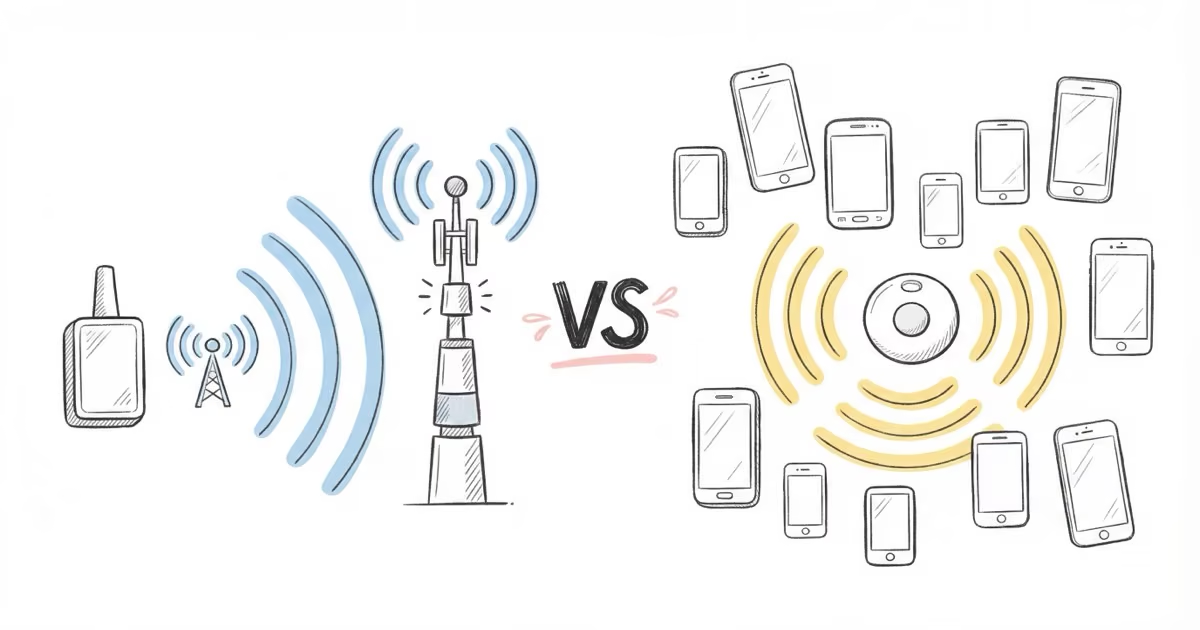
These two trackers solve different problems, and picking the wrong one will leave you frustrated. Invoxia is a GPS tracker. AirTag is a Bluetooth finder. That distinction matters more than any spec comparison.
I’ve used both — an Invoxia in my car for three months, and AirTags on my keys and backpack for over two years. The differences are obvious in daily use, even if the marketing makes them sound similar.
Key Takeaways
- Invoxia uses 4G LTE-M cellular for real-time GPS tracking anywhere with cell coverage; AirTag uses Bluetooth and piggybacks on Apple's billion-device Find My network.
- Invoxia sends theft alerts and geofence notifications proactively; AirTag has no motion alerts and only updates location when an Apple device passes nearby.
- AirTag costs $29 with no subscription; Invoxia costs about $70 plus a data plan ($40/year after the included 1-2 year term).
- AirTag battery (CR2032) lasts about a year and costs $1 to replace; Invoxia's rechargeable battery lasts up to 4 months per charge.
- AirTag only works with Apple devices; Invoxia works with both iOS and Android.
How Each Tracker Works
Invoxia: Cellular GPS
Invoxia connects to 4G LTE-M networks and transmits its GPS coordinates to Invoxia’s servers. You see the location in the app no matter where you are — across town or across the country.
It combines GPS (outdoor), Wi-Fi positioning (indoor), and cell tower triangulation (fallback) for location fixes. When it detects motion, it wakes up and sends an update. When stationary, it conserves power with less frequent check-ins.
The key advantage: it doesn’t depend on other people’s devices. If your car gets stolen and driven to a rural area with zero iPhones nearby, Invoxia still tracks it. All it needs is LTE-M cell coverage.
For the full breakdown, read our Invoxia GPS tracker review.
AirTag: Bluetooth Proximity
AirTag doesn’t have GPS. Not one chip. It broadcasts a Bluetooth signal that nearby Apple devices — iPhones, iPads, Macs — pick up silently and forward to Apple’s servers. You see the location in the Find My app.
This works surprisingly well in cities and suburbs where iPhones are everywhere. In my testing, an AirTag left at a coffee shop updated its location within minutes. But the same AirTag left at a trailhead parking lot in a rural area? No update for four hours until another hiker with an iPhone walked past.
If you have an iPhone 15 or later (or iPhone 11-14 with U1 chip), you also get Precision Finding — directional arrows that guide you to the exact AirTag when you’re within about 30 feet.
Head-to-Head Comparison
| Feature | Invoxia GPS Tracker | Apple AirTag |
|---|---|---|
| Tracking technology | GPS + LTE-M cellular | Bluetooth + Find My network |
| Range | Anywhere with cell coverage | Depends on nearby Apple devices |
| Location accuracy | 30-150 feet | 33 feet (crowd-dependent) |
| Real-time tracking | Yes, 30-second updates available | No, passive crowd-sourced updates |
| Motion alerts | Yes | No |
| Geofencing | Yes | No |
| Battery life | Up to 4 months (rechargeable) | ~1 year (replaceable CR2032) |
| Water resistance | Splash-resistant (no IP rating) | IP67 |
| Compatibility | iOS + Android | iOS only |
| Device price | ~$70 | $29 (1-pack) / $99 (4-pack) |
| Ongoing cost | ~$40/year after included term | $0 (battery ~$1/year) |
| Size | 4 x 1 x 0.4 in, 1.05 oz | 1.26 in diameter, 0.39 oz |
Where Invoxia Wins
Theft Protection
This is Invoxia’s primary strength. Motion alerts, geofence notifications, and real-time GPS tracking make it an active anti-theft device.
When I parked my car with the Invoxia inside and someone moved it, I got a push notification within 90 seconds. I could open the app and watch the tracker’s location update in near real-time. That’s the kind of information that helps police recover stolen property.
AirTag has nothing comparable. It doesn’t alert you when it moves. If someone steals your bike with an AirTag on it, you might not notice the location change for hours, and only if another iPhone user happens to pass near the stolen bike.

Works Without Apple
Invoxia’s app runs on both iOS and Android. In a household where one person has an iPhone and another has a Samsung, everyone can monitor the same tracker. AirTag is iPhone-only — Android users can’t track with it at all.
Active Monitoring Features
Geofencing lets you draw a zone on the map and get alerted when the tracker enters or exits. Journey alerts tell you when a stationary tracker starts moving. Tilt detection senses if equipment falls over. These features make Invoxia useful for fleet management, equipment monitoring, and parental oversight in ways AirTag can’t match.
Where AirTag Wins
Cost
This isn’t close. An AirTag is $29 once. No subscription, no renewal, no data plan. A CR2032 battery costs about $1/year. Two-year total: roughly $31.
Invoxia is about $70 for the hardware. The 1-2 year data plan is included, but after that you pay ~$40/year. Two-year total: around $110 minimum.
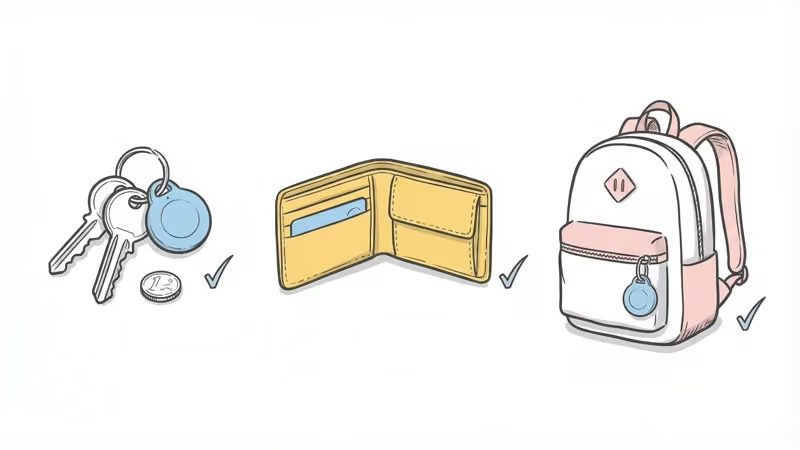
If you’re tracking multiple items — keys, bags, jackets — the AirTag 4-pack at $99 is hard to beat on value.
Battery Simplicity
AirTag’s CR2032 lasts about a year. Pop it out, drop in a new one, done. No charging cables, no remembering to plug it in.
Invoxia’s rechargeable battery lasts up to 4 months but realistically closer to 6 weeks with alerts active. That means regular charging cycles. If you forget, the tracker goes dark.
Size and Ease of Use
AirTag is a 1.26-inch disc weighing 0.39 oz. It fits in a wallet, clips onto a keyring, slips into any pocket. Invoxia is roughly the size of a USB drive — still small, but noticeably larger.
Setup is also simpler with AirTag. Hold it near your iPhone, tap a button, done. Invoxia requires downloading an app, creating an account, and pairing via Bluetooth — not difficult, but more steps.
Find My Network Density
In any reasonably populated area, Apple’s Find My network is enormous. Over a billion active Apple devices act as silent relays. For everyday lost-item scenarios — keys in a restaurant, bag left at the gym — this network provides fast, reliable location updates without any subscription cost.
Who Should Buy Which
- You're protecting a vehicle, motorcycle, or bike from theft
- You need real-time tracking in rural or low-density areas
- Motion alerts and geofencing are must-haves
- You use Android or need cross-platform compatibility
- You're tracking high-value equipment or assets
- You lose keys, bags, or wallets regularly
- You want the cheapest option with zero ongoing cost
- You're fully in the Apple ecosystem
- You need to track multiple items (4-pack value)
- You want something you can attach and forget about for a year
For everyday item tracking, AirTag is the better buy for most people. For active theft protection and real-time monitoring, Invoxia is the right tool.
Can You Use Both Together?
Yes, and it’s actually a smart combination. Put an Invoxia in your car for active anti-theft monitoring with real-time alerts. Attach AirTags to your keys, bag, and wallet for daily lost-item recovery. Each covers the gap the other can’t fill.
The Invoxia gives you proactive security — you’ll know the moment something moves that shouldn’t. The AirTags handle the “where did I leave my keys” moments that happen three times a week. Total cost for both: about $170/year. That’s less than most people spend on replacement keys.
A Note on AirTag Safety
Apple has faced criticism over AirTags being used for unwanted tracking. Current models include anti-stalking measures — iPhones alert their owners if an unknown AirTag is detected traveling with them, and the AirTag itself beeps after being separated from its owner for a period. For more on this topic, see our coverage of AirTag stalking concerns and Apple’s official safety guide.
Invoxia trackers don’t have equivalent anti-stalking measures, which is worth noting if you’re concerned about tracking device misuse.
Bottom Line
Buy the Invoxia if someone might steal your stuff. Buy an AirTag if you keep losing your stuff. They’re fundamentally different tools despite both being called “trackers.” Invoxia’s cellular GPS works independently and sends active alerts; AirTag piggybacks on iPhones and passively reports location. For most consumers, an AirTag at $29 with zero subscription covers 90% of tracking needs. The Invoxia earns its higher price when real-time theft protection matters.
FAQ
Is the Invoxia GPS tracker better than an AirTag?
For theft protection, yes. Invoxia provides real-time GPS tracking, motion alerts, and geofencing that AirTag lacks entirely. For everyday lost-item finding, AirTag is simpler, cheaper, and requires zero maintenance. They solve different problems.
Can an AirTag track a stolen car?
Sometimes, but unreliably. AirTag only updates its location when an iPhone user walks or drives near it. A stolen car driven to an area with few iPhones may not update for hours or days. Invoxia's cellular GPS tracks continuously regardless of nearby devices.
Does Invoxia work without a phone nearby?
Yes. Invoxia transmits location data over 4G LTE-M cellular networks, so it works anywhere with cell coverage regardless of whether your phone is nearby. You can check its location from anywhere in the world through the app.
Do AirTags work with Android?
No. AirTags require an iPhone running iOS 14.5 or later for setup and tracking. Android phones cannot set up, track, or interact with AirTags. If you use Android, consider a Tile tracker or the Invoxia GPS tracker instead.
How much does it cost to use Invoxia per year?
The hardware costs about $70 and includes 1-2 years of LTE-M data. After the included period, renewal is approximately $40/year. There's no monthly billing option. Over two years, total cost is around $110 compared to AirTag's $31.
Can you use both Invoxia and AirTag together?
Yes, and it's a practical setup. Use Invoxia for vehicle or asset theft protection with active alerts, and AirTags for everyday items like keys and bags. Each covers scenarios the other can't handle well.
Which tracker has better battery life?
AirTag lasts about 1 year on a replaceable CR2032 coin battery. Invoxia lasts up to 4 months on a rechargeable battery, though heavy use with alerts drops that to around 6 weeks. AirTag wins on battery convenience since there's nothing to charge.