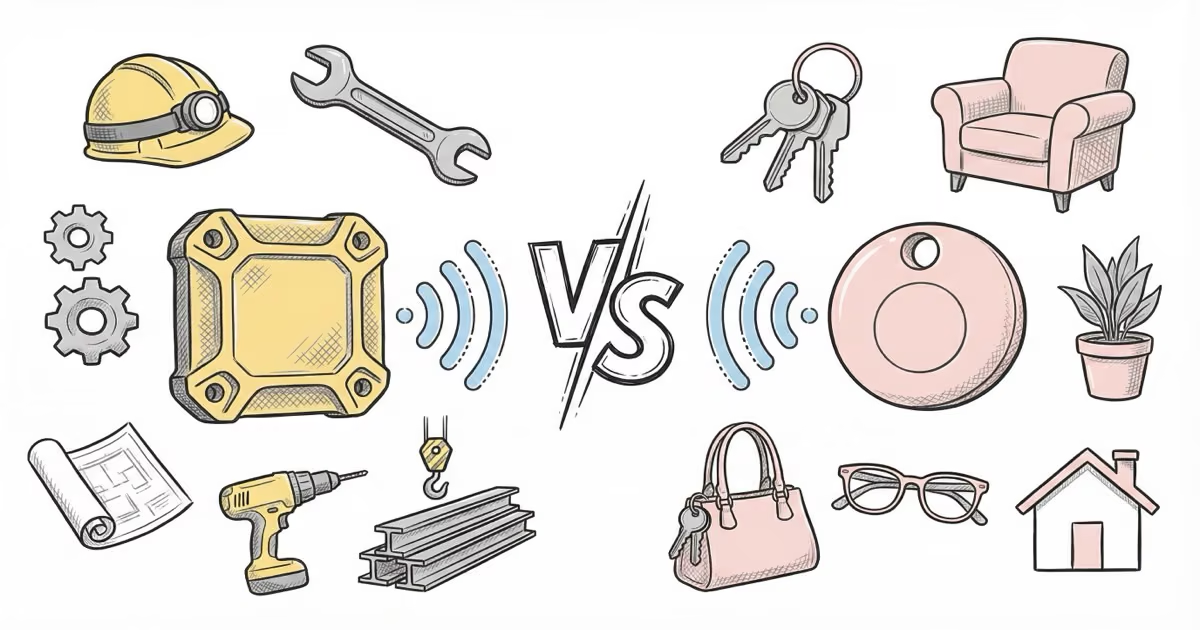
The Milwaukee TICK and Tile solve the same problem — finding misplaced stuff — but they’re built for completely different people. TICK is designed for a contractor who drops tools off truck beds onto concrete. Tile is designed for someone who loses their keys in the couch cushions. That difference in design philosophy affects everything from durability to network coverage.
- TICK uses screw-lock mounting and IP67 housing for construction sites. Tile uses adhesive and is built for indoor use.
- Tile Pro's 400-foot range more than triples the TICK's 100-foot Bluetooth range.
- TICK's CR2032 battery is replaceable. Tile Mate 2024 has a sealed 3-year battery -- no swapping, but also no replacing.
- Tile's crowdsourced network is vastly larger than Milwaukee's One-Key user base.
- Both trackers work without subscriptions for basic find-my-stuff features.
Head-to-Head Comparison
| Feature | Milwaukee TICK | Tile Pro 2024 | Tile Mate 2024 |
|---|---|---|---|
| Price | ~$10-26 | $35 | $25 |
| Bluetooth range | 100 ft | 400 ft | 250 ft |
| Water/dust rating | IP67 | IP67 | IP67 |
| Battery | CR2032, ~1 year, replaceable | CR2032, ~1 year, replaceable | Sealed, ~3 years |
| Speaker volume | 90+ dB | Up to 112 dB | 88 dB |
| Dimensions | 2.13 x 1.88 x 0.49 in | 1.6 x 1.6 x 0.3 in | 1.4 x 1.4 x 0.24 in |
| Mounting | Screw lock, zip ties, magnets | Keyring hole | Keyring hole |
| Network | One-Key users | Tile + Life360 network | Tile + Life360 network |
| Subscription | None ever | Optional ($30-100/yr) | Optional ($30-100/yr) |
Durability: TICK Wins for Job Sites
This isn’t close. The TICK was designed to survive repeated drops onto concrete, prolonged vibration from power tools, and temperature swings from freezing garages to sun-baked truck beds. The screw-lock mounting doesn’t budge even when bolted to equipment that shakes violently.
Tile trackers have IP67 water resistance — matching the TICK on paper — but the housing is consumer-grade plastic. Fine for a keychain in the rain. Not built for a table saw that falls off a tailgate. Tile’s adhesive backing can peel off vibrating equipment.
We’ve seen a TICK survive an accidental trip through a washing machine. Tile would probably survive too (IP67), but the adhesive mount would be done.
For indoor tracking — home, office, bags — Tile’s lighter, thinner profile is actually an advantage. You don’t need screw-lock mounting on a laptop bag.
Range: Tile Has the Edge
TICK’s ~100-foot Bluetooth range is adequate for a single job site but limited for finding tools across a larger property.
Tile Pro 2024 reaches up to 400 feet — four times the TICK’s range. Even the entry-level Tile Mate covers 250 feet. In a warehouse, parking lot, or multi-building job site, that extra range matters.
The real range comparison, though, is about crowdsourced networks. When your tracker is out of your phone’s Bluetooth range, both systems rely on other users’ phones detecting the signal:
- TICK: Detected by phones running Milwaukee’s One-Key app. This is mostly contractors and Milwaukee tool owners
- Tile: Detected by phones running Tile or Life360 — a much larger user base that includes millions of general consumers
If you leave a Tile at a coffee shop, there’s a decent chance someone walks by with the Tile app. If you leave a TICK at a coffee shop, you’re relying on a Milwaukee contractor walking past. The network size gap is significant for recovery of truly lost items.

Battery: Different Strategies
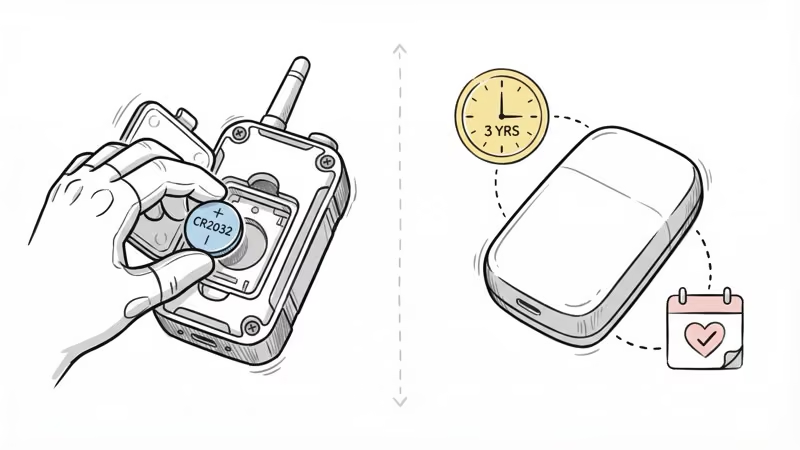
Both TICK and Tile Pro use replaceable CR2032 batteries lasting about a year. A 4-pack costs roughly $5. No meaningful difference there.
The Tile Mate 2024 changed the game with a sealed 3-year battery. You can’t replace it, but you also don’t need to for three years. After that, the device is done. Tile offers a re:replaceable recycling program where you get a discount on a new one.
For contractors tracking dozens of items, replacing 50 CR2032 batteries once a year is a minor chore. The sealed Tile Mate approach trades long-term flexibility for years of zero maintenance.
Speaker and Finding Features
Tile Pro’s 112 dB speaker is noticeably louder than the TICK’s 90+ dB. On a noisy construction site, that volume difference can mean hearing your tracker ring versus not. The TICK does have a speaker, but it’s designed more for notification than for locating buried items under sawdust.
Tile also offers reverse finding — double-press the Tile button to ring your phone. Useful when you’ve set your phone down somewhere on the site. TICK doesn’t offer this.
With a Tile Premium subscription ($30/yr), you get smart alerts when you walk away from a tagged item, and a 30-day location history. TICK includes its full feature set for free, but that set is more limited.
Subscription Costs
| Plan | Milwaukee TICK | Tile |
|---|---|---|
| Basic tracking | Free forever | Free |
| Smart alerts | Not available | $29.99/yr (Premium) |
| Location history | Basic (in app) | 30-day (Premium) |
| Item sharing | Team sharing (free) | Unlimited (Premium) |
| Extended warranty | 1 year standard | 3-year (Premium Protect, $99.99/yr) |
TICK’s advantage is simplicity: everything is free, no upsells. You’ll never see a prompt to upgrade. Tile’s free tier covers basic finding, but the premium features — especially smart alerts and longer location history — genuinely add value for users tracking many items.
Who Should Buy Which
Choose Milwaukee TICK if
- You work construction, trades, or agriculture
- Tools get exposed to drops, vibration, and weather daily
- You're already in the Milwaukee One-Key ecosystem
- You need screw-lock mounting that won't detach
- Zero subscription fees matters to you
Choose Tile if
- You need longer Bluetooth range (up to 400 ft)
- Recovery depends on a large crowdsourced network
- You want a speaker loud enough to find tools by sound
- Your tracking needs include personal items (keys, bags, wallet)
- You want reverse finding to ring your phone
Product Links
For a broader comparison, see how both stack up against Apple’s option in our AirTag vs Milwaukee TICK and AirTag vs Tile comparisons. If your Tile stops responding, check our Tile tracker troubleshooting guide. For a deep dive on the TICK alone, read our full Milwaukee TICK review.
Bottom Line
For contractors and tradespeople who need a tracker that survives real job site abuse, the Milwaukee TICK at $10-26 is the obvious pick. It mounts with screws, laughs at dust and water, and costs nothing to run. For everyone else — DIYers, home users, anyone who might lose a tool at someone else’s house — Tile’s larger network and longer range give you better odds of actually getting your stuff back. The best tracker is the one whose network covers the places you lose things.
FAQ
What are the main differences between Milwaukee TICK and Tile?
TICK is built for construction with screw-lock mounting and reinforced housing. Tile is lighter, has longer Bluetooth range (up to 400 ft vs. 100 ft), and connects to a much larger crowdsourced network. TICK's app is always free. Tile offers optional premium plans with extra features.
Which Bluetooth tracker has the longest range?
Tile Pro 2024 reaches up to 400 feet, more than quadrupling the TICK's 100-foot range. Tile Mate covers 250 feet. For locating tools in large warehouses or multi-building sites, Tile's range advantage is significant.
Can you replace the battery in a Milwaukee TICK?
Yes. The TICK uses a standard CR2032 coin cell. Twist off the back cap and swap in a fresh battery. Costs under $1. Tile Pro also uses a replaceable CR2032, but the Tile Mate 2024 has a sealed 3-year battery that cannot be replaced.
Is there a subscription fee for either tracker?
Basic tracking is free on both. Milwaukee One-Key has no premium tier at all -- every feature is included. Tile offers optional Premium ($29.99/yr) with smart alerts, location history, and unlimited device sharing. Neither requires a subscription to function.
Which is more waterproof and durable?
Both carry IP67 ratings, meaning they handle submersion to 1 meter for 30 minutes. The practical difference is build quality. TICK's housing is reinforced for drops onto concrete and prolonged vibration. Tile is splash-resistant for daily life but not built for sustained construction site abuse.
Do both trackers work with Android phones?
Yes. Milwaukee One-Key and the Tile app both support Android 8.1+ and iOS. No platform restrictions on either tracker. Both apps are free to download from Google Play and the App Store.
Should I consider an AirTag instead of TICK or Tile?
If you use an iPhone, AirTag's Find My network (2 billion+ devices) dwarfs both One-Key and Tile networks. AirTag also has UWB precision finding. But it lacks the TICK's construction durability and Tile's Android compatibility without workarounds. See our AirTag vs TICK and AirTag vs Tile comparisons.