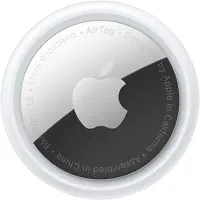
AirTag is a consumer Bluetooth tracker for personal items; RFID is an enterprise technology for warehouse / retail inventory. They solve different problems.
Comparing AirTag vs RFID is less about which is better and more about understanding two fundamentally different approaches to tracking. AirTag is a single consumer product. RFID is an entire family of technologies used across dozens of industries, from hospital supply rooms to highway toll booths. The overlap between them is surprisingly small once you understand how each one actually works.
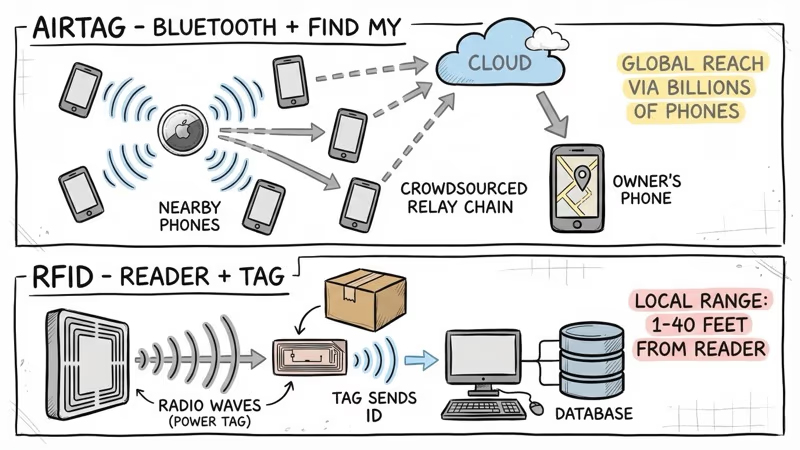
- AirTag uses Bluetooth Low Energy and Ultra Wideband to report location through Apple’s crowdsourced Find My network; RFID tags transmit a stored ID to a nearby reader using radio waves
- AirTag tracks items globally with no range limit (via Find My); passive RFID works only within 1-40 feet of a dedicated reader
- A single AirTag costs $29 with no subscription; passive RFID tags cost $0.05-0.25 each but require readers that start around $500
- AirTag runs on a CR2032 battery lasting about 1 year; most RFID tags have no battery at all and last indefinitely
- AirTag is built for consumers finding personal items; RFID is built for organizations scanning inventory at scale
AirTag vs RFID: Head-to-Head Overview
⇄ Head-to-head
Apple AirTag 2 vs Passive UHF RFID
- +Bluetooth + longer-range UWB Precision Finding
- +Find My network of 1B+ Apple devices reports location globally
- +$29 one-time, no subscription, uses existing iPhone infrastructure
- +IP67 waterproof + anti-stalking alerts built in
- +Can surface a checked bag as Apple devices pass nearby in dense airports
- +Tag cost as low as $0.05, scales to thousands of items cheaply
- +No battery in passive tags, lasts 5-20+ years
- +Reader scans hundreds of tags per second in fixed range
- +Per-item cost drops to pennies with infrastructure in place
- +Standardized for warehouse / retail / hospital workflows
- −CR2032 battery needs replacement ~yearly
- −iPhone required (iOS 16.6+)
- −Goes silent in rural / low iPhone-density areas
- −One tag tracks one item, doesn't scale to thousands
- −Requires $500-$5,000+ per reader plus software ($50K-$200K full deployment)
- −Range limited to 1-40 ft for passive (no global coverage)
- −Not consumer-friendly: needs trained operators and infrastructure
- −Tells you WHEN an item crossed a checkpoint, not WHERE it's on a map
- −Most basic tags broadcast unencrypted IDs
- ·Track personal items like keys, wallets, or bags
- ·Locate a lost item on a map from anywhere
- ·Find something hidden in your house with directional arrows
- ·Track a vehicle without a monthly subscription
- ·Attach a tracker to luggage for air travel
- ·Scan thousands of inventory items per hour
- ·Automate warehouse check-in and check-out
- ·Control building access with badges
- ·Track medical equipment across hospital floors
- ·Verify product authenticity in a supply chain
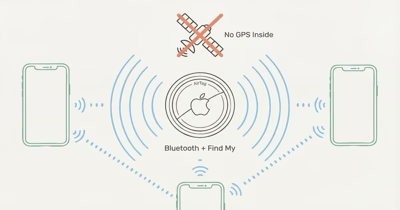
The AirTag is a coin-sized Bluetooth tracker that communicates through Apple’s Find My network. When any of the over a billion active Apple devices worldwide passes within Bluetooth range of your AirTag, that device anonymously relays the tag’s location to your Find My app. You see a map pin. The relay device’s owner never knows it happened.
Apple’s January 2026 press release announced that the AirTag 2’s Precision Finding range extends up to 50% farther than the original, and the speaker got 50% louder for the play-sound feature. You can also use Precision Finding from an Apple Watch Series 9 or later, which matters when you left your phone at the hotel.
Under the hood, two layers make this work: Bluetooth Low Energy handles the crowdsourced location relay, and Ultra Wideband provides precise directional guidance when you’re close. The AirTag itself doesn’t have GPS or cellular capability, and it depends entirely on other Apple devices being nearby to report its position.
How RFID Technology Works
RFID stands for Radio Frequency Identification. It isn’t a single product but a technology category that spans everything from the anti-theft stickers on retail clothing to the E-ZPass transponder on your windshield. The common thread: a tag carries stored data, and a reader picks up that data using radio waves.
Every RFID system has three components. The tag contains a microchip and antenna programmed with a unique identifier. The reader emits radio waves to power the tag and receive its data. And the software interprets that data, matching tag IDs to inventory records, employee databases, or shipment manifests.
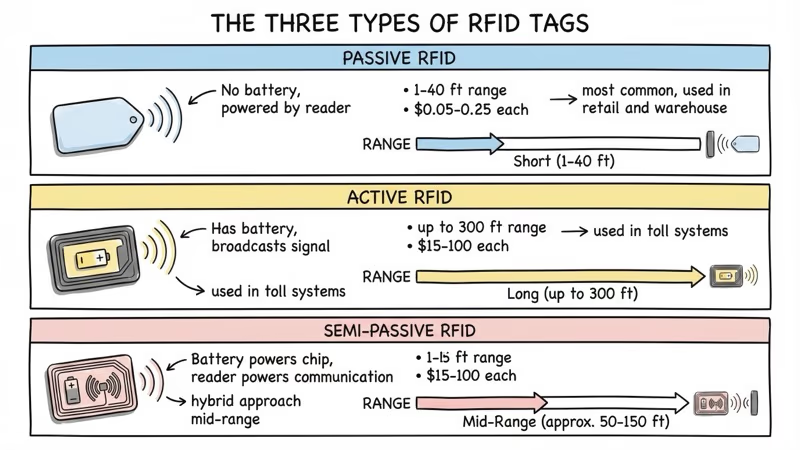
RFID tags split into three categories based on how they get power:
- Passive tags have no battery. They draw energy from the reader’s radio waves. Range: typically 1-40 feet depending on frequency. Cost: $0.05-0.25 per tag. These are by far the most common.
- Active tags have their own battery and broadcast continuously. Range: up to 300 feet. Cost: $15-100+ per tag. Used in toll systems and large-scale asset tracking.
- Semi-passive tags have a battery to power internal circuits but still rely on the reader for communication. They sit between passive and active in both range and cost.
RFID frequencies also vary. Low Frequency (125-134 kHz) works at close range for access badges. High Frequency (13.56 MHz) powers NFC-based contactless payments. Ultra High Frequency (860-960 MHz) handles the warehouse and retail scanning that most people picture when they hear “RFID.” Each frequency band has different range, speed, and interference characteristics, which is part of why comparing RFID to a single Bluetooth tracker is an oversimplification.
The widget above lays out the fundamental split. AirTag is a consumer device that uses infrastructure already deployed (iPhones). RFID is an enterprise system that requires its own dedicated readers and software. Neither one is a substitute for the other in most practical scenarios.
How Far Can Each Technology Reach?
AirTag’s effective range is theoretically unlimited — as long as an Apple device passes near your tagged item, you get a location update. For an AirTag in a checked bag, major airports provide far more relay opportunities than low-traffic areas because Apple devices are everywhere.
In a city, that can mean useful updates as people move nearby; in a remote area with no Apple devices around, you get nothing until someone with an iPhone walks by.
Within Precision Finding range (extended on the AirTag 2), the Ultra Wideband radio provides directional arrows and a distance reading on your iPhone screen. This is what lets you find keys wedged behind a couch cushion.
RFID has a fixed, deterministic range. A passive UHF reader typically detects tags within 20-40 feet in ideal conditions. Interference from metal, liquid, or other tags can reduce that. Active RFID tags can reach 300 feet, but those cost 100 times more per unit.
The accuracy model is also different. AirTag tells you where an item is on a map. RFID tells you whether an item passed through a checkpoint. A warehouse RFID gate can confirm that a pallet moved from Zone A to Zone B, but it can’t tell you the pallet’s current GPS coordinates.
Cost and Infrastructure
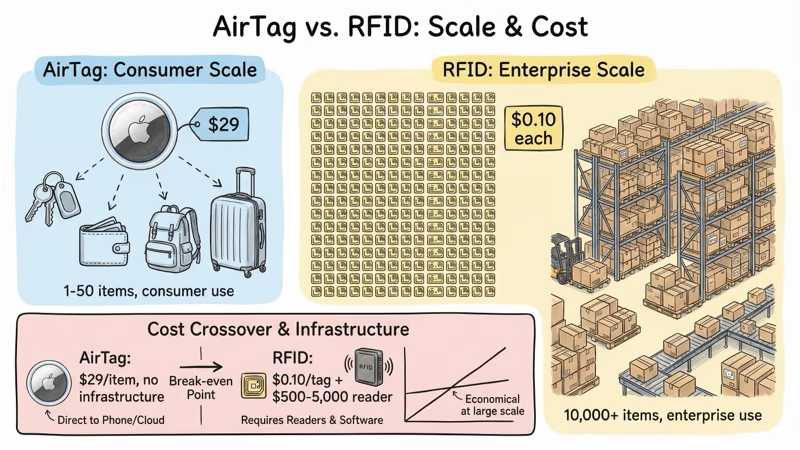
For a consumer tracking one backpack, AirTag wins on cost by a wide margin. You spend $29 (or $24.75 each in a 4-pack), download Find My, and you’re tracking — no subscription fees, no additional hardware, and battery replacement costs under $3 per year.
For an organization tracking 10,000 products, the math flips entirely. At $0.10 per passive RFID tag, that entire inventory costs $1,000 in tags. An AirTag deployment at the same scale would cost $290,000 and require iPhones nearby to work. You would also need 10,000 Apple accounts, which makes no operational sense.
RFID’s hidden cost is the infrastructure. According to Atlas RFID Store’s pricing data, a single commercial RFID reader with antennas runs $500-5,000 depending on capability, and a mid-size warehouse might need 10-20 reader stations.
Software licensing adds another layer, and the total system cost can reach $50,000-200,000 for a full deployment — but per-item tracking cost drops to pennies.
Use Cases: Where Each Technology Belongs
See the Verdict tab in the head-to-head widget for each technology’s “Choose this if…” checklist. The TL;DR: AirTag for personal item tracking with map view; RFID for enterprise inventory scanning at checkpoints.
The two technologies occasionally overlap. Some travelers attach both an AirTag (for live location) and an RFID-embedded luggage tag (for airline baggage handling systems) to the same suitcase. Airlines already use RFID in baggage sorting at major airports like those implementing IATA’s Resolution 753 — the AirTag gives you personal visibility, while the RFID tag keeps the airline’s system running.
AirTag vs NFC: A Common Mix-Up
People often confuse RFID with NFC, and NFC with AirTag. Here is the distinction. NFC (Near Field Communication) is a subset of RFID that operates at 13.56 MHz with a range of about 2 inches. It’s the technology behind contactless payments, transit cards, and smart labels like Dynotag.
AirTag does have an NFC chip built in — if you tap a found AirTag in Lost Mode against any NFC-enabled smartphone, including Android phones, it opens a web page showing the owner’s contact info.
But that NFC interaction is a secondary feature. The primary tracking relies on Bluetooth and the Find My network, not radio frequency scanning.
So when someone asks whether AirTag “uses RFID,” the accurate answer is: it contains an NFC chip (which is a type of RFID), but its core tracking mechanism is Bluetooth, not RFID in the way most people mean the term.
Security and Privacy
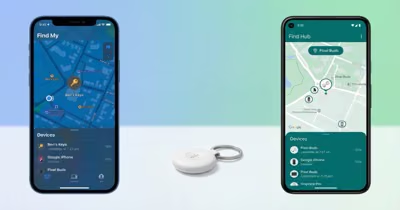
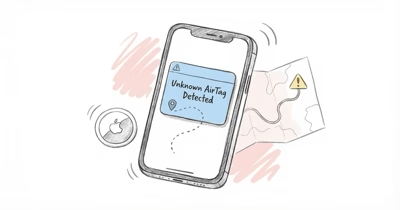
AirTag communications are end-to-end encrypted through Apple’s Find My protocol — no one, including Apple, can see your tag’s location except you. The system also includes anti-stalking protections: if an unknown AirTag travels with you, your iPhone alerts you, and Android users can detect unwanted AirTags through the cross-platform detection standard Apple developed with Google.
The RAIN RFID Alliance reported that over 40 billion UHF RFID tags were sold globally in 2025 alone. RFID security varies enormously by implementation: basic passive tags broadcast their ID to any compatible reader with no encryption, which is fine for tracking boxes in a warehouse but not for securing personal data.
Higher-security RFID systems (like those in passports and credit cards) use AES-128 encryption and mutual authentication between tag and reader — the security depends entirely on how the system was designed.
For personal item tracking, AirTag’s privacy protections are more mature and standardized than anything in the general RFID world. For enterprise asset management, RFID security can be configured to match the sensitivity of the data being tracked.
Can RFID Replace AirTag (or Vice Versa)?
No, and that is the most important point. These technologies aren’t competing with each other.
You can’t stick an RFID tag on your keys and expect to find them when lost. Without a reader within range, a passive RFID tag does nothing. It sits there silently. You would need to walk around your house with a handheld RFID scanner, which costs $300+ and defeats the purpose of a $29 key finder.
You also can’t use AirTags to manage warehouse inventory. Scanning items one at a time through Bluetooth is absurdly slow compared to an RFID reader that processes hundreds of tags per second through a dock door. The labor cost alone would make it unworkable.
If you’re a consumer who lost something, you want a Bluetooth tracker like AirTag. If you’re a business tracking thousands of assets in a fixed location, you want an RFID system. The question isn’t which is better. It’s which problem you’re solving.
Bottom Line
AirTag and RFID solve different problems with different technology at different scales. AirTag is a $29 consumer tracker that uses over a billion Apple devices to find your lost belongings anywhere in the world, while RFID is an industrial technology that scans hundreds of tagged items per second at distances up to 40 feet.
For personal item tracking, AirTag is the clear choice; for commercial inventory management, RFID remains the industry standard. The two are complementary, not competing.
FAQ
Does AirTag use RFID technology?
AirTag contains an NFC chip, which is technically a subset of RFID operating at 13.56 MHz. However, the AirTag’s primary tracking relies on Bluetooth Low Energy and the Find My network, not radio frequency scanning. The NFC chip only activates when someone taps a found AirTag against their phone to see the owner’s contact information in Lost Mode.
Can I use RFID tags to find lost personal items?
Not practically. Passive RFID tags require a dedicated reader within 1-40 feet to be detected. You would need to carry a handheld RFID scanner and walk within range of the tag. For lost item recovery, a Bluetooth tracker like AirTag is far more effective because it uses the global network of Apple devices as readers, covering virtually every populated area.
How much does an RFID system cost compared to AirTag?
A single AirTag costs $29 with no additional hardware. A passive RFID tag costs $0.05-0.25, but you also need readers ($500-5,000 each) and software. For tracking 1-50 personal items, AirTag is dramatically cheaper. For tracking 10,000+ items in a warehouse, RFID costs pennies per unit and is the only practical option.
What is the range difference between AirTag and RFID?
AirTag has two ranges: Precision Finding works at an extended range using Ultra Wideband, and the Find My network provides global coverage wherever Apple devices exist. Passive RFID tags work within 1-40 feet of a dedicated reader. Active RFID tags with built-in batteries can reach up to 300 feet but cost significantly more per unit.
Do RFID tags need batteries?
Most RFID tags are passive, meaning they’ve no battery. They draw power from the radio waves emitted by the reader. This is why they can last 5-20 years with zero maintenance. Active RFID tags do contain batteries and can broadcast continuously, but they’re less common and cost $15-100 each.
Is RFID more accurate than AirTag for tracking?
It depends on what you mean by accuracy. AirTag provides location on a map with directional guidance for finding a specific item. RFID confirms whether a tagged item passed through a specific checkpoint. RFID can tell you an item moved from Zone A to Zone B. AirTag can tell you the item is behind the couch in your living room. They measure different things.
Can I use AirTag and RFID together?
Yes, and some frequent travelers already do. Airlines use RFID tags in baggage handling systems to sort and route luggage through conveyor belts. Passengers attach an AirTag to the same bag for personal visibility through Find My. The RFID handles automated sorting at the airport. The AirTag lets you track your bag on a map in real time. The two systems operate independently and complement each other well.