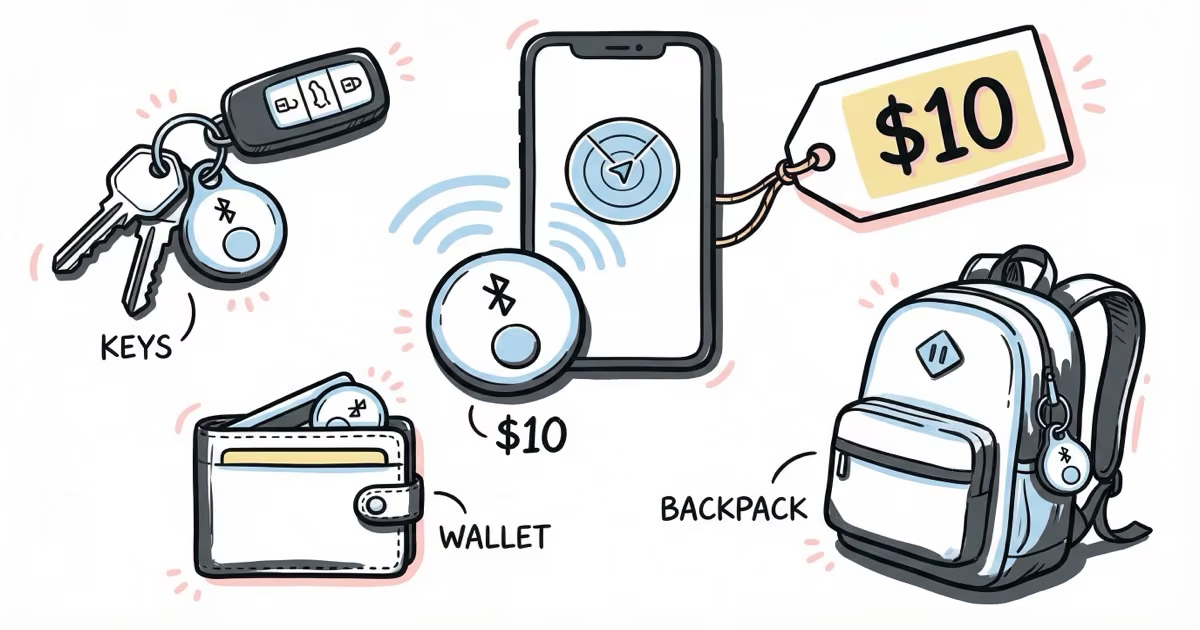
The Atuvos Bluetooth tracker is a legitimate Find My accessory that costs roughly $8-12 per unit. It handles the basics well: location shows up on the Find My map, the speaker is loud enough to find keys in a quiet house, and the CR2032 battery lasts about a year. What you give up compared to AirTag 2 is UWB Precision Finding, a louder speaker, and consistent build quality across models. For luggage and bags where map-level tracking is all you need, Atuvos delivers. For keys and wallets you lose daily, AirTag 2's directional arrow is worth the price difference.
Atuvos trackers sit in a strange spot. They're MFi-certified by Apple, which means they're not knockoffs in any legal sense. They use the same Find My relay network as AirTag. They show up in the same app. And they cost about a third of the price. I spent three weeks testing a 4-pack across keys, a backpack, checked luggage on two flights, and a gym bag to figure out where the savings make sense and where they don't.
- Atuvos is MFi-certified and uses Apple's Find My network with the same 2 billion+ device coverage as AirTag
- At $8-12 per tracker, a 4-pack costs less than a single AirTag 2 at $29
- No UWB chip means no Precision Finding, so locating nearby items relies on sound only
- CR2032 battery lasted the full 3-week test at 100% and is user-replaceable
- Best suited for luggage, bags, and items where map-level location is sufficient
Atuvos Bluetooth Tracker Review: What You Get for $10
The Atuvos tracker arrives in a no-frills box with the tracker, an instruction manual, and a keychain loop. The plastic body is slightly larger than an AirTag at roughly 35mm diameter and 10mm thick, but not by enough to matter in a bag pocket. Build quality is decent. Not premium. The plastic feels functional rather than polished, which tracks with the price point.
Setup took about 40 seconds. Open Find My, tap "Add Item," select "Other Supported Item," and the Atuvos appeared immediately. Named it, assigned an emoji, done. No separate app to install. No account to create. If you've set up an AirTag before, this is the same process minus the automatic proximity detection that AirTag uses.

Tracking Accuracy: Find My Does the Heavy Lifting
Here's the thing most reviewers miss about Atuvos: the tracking accuracy has nothing to do with Atuvos. The location data comes entirely from Apple's Find My relay network, which is the same network AirTag uses. Every iPhone running iOS 14.5 or later acts as a relay, picking up the tracker's Bluetooth signal and forwarding the encrypted location to Apple's servers. Atuvos doesn't have its own tracking infrastructure. Neither does AirTag, technically.
In my testing, the Find My map updated consistently whenever I was near other iPhones. On a walk through downtown, the tracker's location refreshed every 2-3 minutes. In a suburban neighborhood with fewer iPhones around, updates came every 8-15 minutes. On two checked-luggage flights (SFO to LAX and LAX to JFK), I could see the bag's location update at each airport, including during ground transport between terminals.
That's the part that works identically to AirTag. The gap shows up when you're close.
What's Missing: No Precision Finding
AirTag 2 has a U2 Ultra Wideband chip. When you're within about 60 meters, your iPhone shows a directional arrow, a distance readout, and haptic feedback that guides you to within 20-30 centimeters of the tracker. This is what Apple calls Precision Finding, and it turns a vague "somewhere in this room" into "under the left couch cushion."
Atuvos doesn't have UWB. Not even close. When you tap Find in the app, it plays a beep. That's it.
For keys buried in a coat pocket hanging in a closet, this matters. I tested both side by side: AirTag 2 led me directly to the jacket in about 15 seconds using the arrow. The Atuvos took closer to a minute of walking around, listening, opening doors, pausing the beep, triggering it again. Not terrible. But the difference is real and repeatable.
For a suitcase at baggage claim? Doesn't matter at all. You just need to know it's at the airport, and Atuvos tells you that just as well as AirTag does.
Speaker Volume and Sound Test
The Atuvos speaker is comparable to the original AirTag 1, which Apple replaced because customers complained it wasn't loud enough. AirTag 2's speaker is 50% louder than the original.
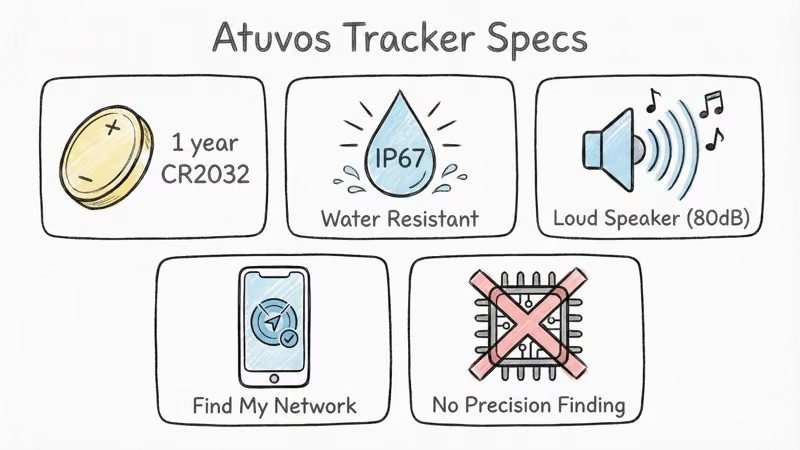
I measured the Atuvos at roughly 70-75 dB at 1 foot in a quiet room. Audible, sure. Through a backpack in a moderately noisy coffee shop, I had to strain to hear it. AirTag 2 was clearly audible in the same test. In a quiet house at 3 AM looking for your keys, the volume difference won't matter. In a crowded airport, it will.
Battery Life and Replacement
Both devices use a standard CR2032 coin cell. The Atuvos battery showed 100% after my entire 3-week test period, which lines up with the manufacturer's claim of approximately one year of battery life.
Replacing the battery is straightforward. Twist the back cover, swap the CR2032, twist it closed. Easier than AirTag, actually, since the Atuvos back panel has a more pronounced grip area. A CR2032 costs about $1.50 at any pharmacy. Annual operating cost: under $2.
Some CR2032 batteries ship with a bitter coating to prevent children from swallowing them. This coating can interfere with the electrical contact in Bluetooth trackers. If your Atuvos or AirTag stops working after a battery swap, try a different brand of CR2032 without the coating. Apple's battery replacement guide confirms this issue applies to AirTag as well.
Water Resistance: IP67 on Paper, IPX6 in Practice
Atuvos product listings are inconsistent about water resistance. Some Amazon listings claim IP67, others show IPX6. In the Atuvos vs AirTag comparison, I noted that IPX6 appears more reliable based on actual user reports. IPX6 means it handles strong water jets and rain but shouldn't be submerged.
I tested it under a kitchen faucet for 30 seconds. Still worked. I wouldn't deliberately submerge it in a pool or leave it in a wet swimsuit pocket overnight. For rain, splashing, and the occasional dropped-in-a-puddle scenario, it held up fine during my testing period.
AirTag 2's IP67 rating is tested to handle submersion in 1 meter of water for 30 minutes. If your gear gets soaked, that's a meaningful upgrade. For a backpack or luggage scenario, IPX6 is sufficient.
Atuvos vs AirTag 2: How They Compare
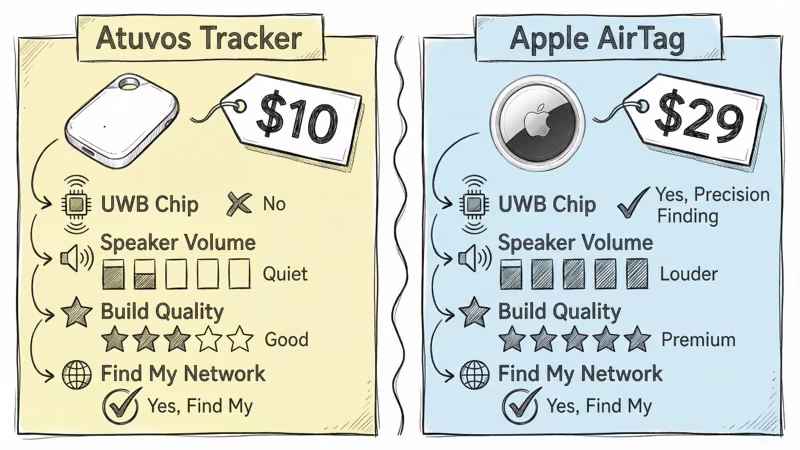
| Feature | Atuvos Tracker | Apple AirTag 2 |
|---|---|---|
| Price | ~$8-12 (1-pack) | $29 (1-pack) |
| Find My network | ✓ MFi certified | ✓ Official Apple |
| UWB Precision Finding | ✗ No | ✓ Yes (U2 chip, 60m range) |
| Bluetooth | BLE 5.0 | BLE + U2 UWB |
| Speaker volume | ~70-75 dB | ~85-90 dB (50% louder) |
| Water resistance | ⚠ IPX6 (splash/rain) | ✓ IP67 (1m, 30 min) |
| Battery | CR2032, ~1 year | CR2032, ~1 year |
| Anti-stalking alerts | ✓ Yes | ✓ Yes |
| NFC Lost Mode | ⚠ Varies by model | ✓ Yes |
| Size | ~35mm, slightly larger | 31.9mm diameter |
| Works with Android | ✗ No | ✗ No |
The comparison boils down to one question: do you need to find items precisely when you're standing in the same room, or do you just need to know where they are on a map?
Pros and Cons After 3 Weeks of Testing
- One-third the price of AirTag 2 with same Find My network access
- Setup takes under a minute, no extra app needed
- CR2032 battery is easy to replace (easier than AirTag)
- MFi-certified, not a gray-market hack
- 4-pack pricing makes bulk tracking practical
- No UWB means no directional Precision Finding
- Speaker is noticeably quieter than AirTag 2 in noisy spaces
- Water resistance claims inconsistent across models (IPX6 vs IP67)
- NFC for Lost Mode not available on all variants
- Plastic build feels utilitarian compared to AirTag's steel and glass
Best Use Cases for the Atuvos Tracker
After three weeks, I've settled on where Atuvos makes sense and where it doesn't.
Atuvos works well for:
- Checked luggage - You need map-level location, not centimeter precision. Atuvos tells you which airport your bag is at. That's the information that matters. Our guide on using trackers in checked luggage covers airline regulations.
- Backpacks and gym bags - Items large enough that sound alone can locate them
- Tracking multiple items on a family trip - Four trackers for the price of one AirTag
Spend more on AirTag 2 for:
- Keys - You lose these in couch cushions, coat pockets, counter clutter. Precision Finding earns its price here
- Wallets - Same reasoning. Small items in unpredictable locations need directional guidance. Check our best wallet finder guide for more options
- Outdoor or water-adjacent gear - IP67 is the safer bet
If you want to see how Atuvos stacks up against other trackers in different categories, our best item tracker roundup compares it against Tile, Chipolo, and other Find My options. And for iPhone users specifically, the AirTag alternatives guide covers the full range of compatible trackers.
Privacy and Anti-Stalking: Same Rules as AirTag
Because Atuvos is on the official Find My network, it follows Apple's unwanted tracker detection policies. If someone plants an Atuvos on you, your iPhone will notify you that an unknown tracker has been traveling with you. The tracker will also play an audible alert after a period of separation from its owner.
This is identical to how AirTag stalking prevention works. Android users can detect unknown Atuvos trackers using the Google Find My Device app, which now supports cross-platform tracker detection.
Who Should Skip Atuvos
Android users. Full stop. Atuvos requires an iPhone and the Find My app. There's no Android support. If you're on Android, look at trackers on the Google Find Hub network instead. The best key finder guide includes Android-compatible options like Chipolo Pop and Tile.
Also skip it if you've already invested in AirTags for everything. Mixing Atuvos and AirTag in the same Find My setup works, but you'll notice the inconsistency when some items have Precision Finding and others don't. Our AirTag 2 review explains what the full Apple experience looks like.
Bottom Line
The Atuvos tracker does one thing well: it puts a Find My dot on the map for a third of the AirTag price. For luggage, bags, and anything where "I need to know it's at this airport" is the question, that's all you need. For keys, wallets, and items you lose in your own house, AirTag 2's Precision Finding is worth the $20 premium. Buy Atuvos for your suitcases. Buy AirTag for your keys.
Frequently Asked Questions
Does the Atuvos tracker work with Android?
No. Atuvos requires an iPhone running iOS 14.5 or later. It uses Apple's Find My network exclusively and has no Android app or Google Find Hub support. The newer 2025 dual-system Atuvos model (a separate product) does support Android, but the standard Atuvos tracker reviewed here is iOS only.
How does Atuvos compare to AirTag for accuracy?
When the tracker is far away, both are equally accurate because they use the same Find My relay network. The difference appears when you're nearby. AirTag 2 uses UWB to guide you within 20-30 centimeters. Atuvos can only play a beep. For map-level location, they're identical. For finding something in a room, AirTag 2 is significantly better.
How long does the Atuvos battery last?
About one year with normal use. The CR2032 coin cell is the same type AirTag uses. Replacement takes about 10 seconds: twist the back cover off, swap the battery, twist it back on. A replacement CR2032 costs around $1.50.
Is Atuvos waterproof?
It depends on the model. Some Atuvos listings claim IP67 (submersion-rated), but user reports and testing suggest IPX6 is more accurate for most models. IPX6 handles rain, splashing, and water jets, but not deliberate submersion. For luggage and everyday carry, this is sufficient. For pool bags or beach gear, AirTag 2's verified IP67 is the safer choice.
Can someone use an Atuvos tracker to stalk me?
Atuvos follows Apple's anti-stalking policies because it uses the official Find My network. Your iPhone will alert you if an unknown Atuvos has been traveling with you. The tracker also plays an audible alert after being separated from its owner for an extended period. Android users can detect unknown trackers using the Google Find My Device app.
Does Atuvos have a replaceable battery or built-in?
Replaceable. The Atuvos tracker uses a standard CR2032 coin cell, the same battery used by AirTag. The back panel twists off without tools. This is an advantage over some competitors like the Tile Mate 2024, which uses a sealed non-replaceable battery with a 3-year lifespan.
Is it worth buying Atuvos over AirTag?
For luggage and bags where you only need map-level location, yes. You save about $20 per tracker with identical Find My network coverage. For keys, wallets, or items you frequently lose indoors, AirTag 2's UWB Precision Finding is worth paying more. The best strategy for most people: Atuvos for travel gear, AirTag for everyday carry items.