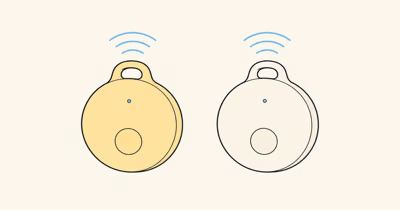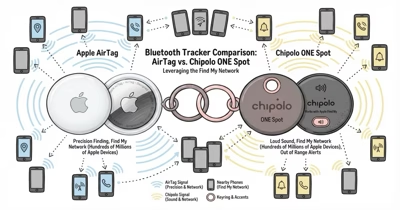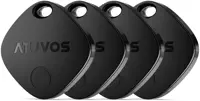
Your phone decides this one. The Atuvos works only with Apple Find My on iPhone, so iPhone owners pick Atuvos; the Chipolo ONE Point works only with Google Find My Device on Android, so Android owners pick the ONE Point. The phone in your pocket picks the tag, so neither one works on the other’s phone. Among iPhone budget tags, Atuvos wins on its $13.75-per-tag 4-pack price and IP67 water resistance (vendor listings vary between IP67 and IPX6). On Android, the ONE Point is discontinued and Chipolo now points buyers to the dual-network Chipolo POP.
These two budget trackers look almost identical and the names differ by one word, which is exactly why buyers confuse them. But they live on different networks. Chipolo’s own product page states that the ONE Point “can only be used on Android devices” and “works exclusively with Google’s Find My Device app.” The Atuvos, by contrast, is an Apple Find My tag for iPhone. So the real first question is not price or waterproofing — it’s which phone you carry.
- Different networks: Atuvos is Apple Find My (iPhone only); Chipolo ONE Point is Google Find My Device (Android only) — not cross-shoppable on one phone
- iPhone budget winner: among Apple Find My tags, Atuvos beats the ONE Point on price and waterproofing
- 4-pack math: Atuvos $13.75 per tag vs the ONE Point’s $25 per tag — a 45% delta once you buy in bulk
- Water resistance: Atuvos IP67 (submersible), Chipolo ONE Point IPX5 (splash-resistant) — meaningful for bag and keychain use
- ONE Point is discontinued — Chipolo now steers buyers to the dual-network Chipolo POP, and neither tag has UWB Precision Finding
The Network Split: iPhone vs Android
This is the difference that decides everything else. The Atuvos pairs to the iPhone’s Find My app and joins Apple’s billion-plus-device network, so it relays through any nearby iPhone but is useless to an Android owner. The Chipolo ONE Point does the mirror opposite: it pairs to Google’s Find My Device app and relays through nearby Android phones, and it can’t be added to an iPhone or to Apple Find My at all.
Google’s Find My Device support page states that its crowdsourced network draws on over 1 billion Android devices to locate tags anonymously, mirroring Apple’s model on the opposite platform.
Both networks are large, anonymized crowd-finding pools, so coverage is comparable once you’re on the right platform. The catch is that you can only join one of them, set by the phone in your pocket. An iPhone household buys Atuvos; an Android household buys the ONE Point. If your home mixes both phones, neither single-platform tag is ideal — a dual-network Chipolo POP lets you pick a network at setup instead.
For another low-cost iPhone finder in this tier, see our budget tag alternatives before buying.
⇄ Head-to-head
Atuvos vs Chipolo ONE Point
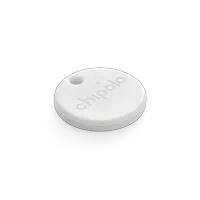
- +$13.75 per tag at the 4-pack tier (cheapest Find My entry)
- +IP67 rating survives rain and accidental submersion
- +Louder speaker than Chipolo ONE Point for indoor finding
- +Replaceable CR2032, no subscription
- +Same Find My network access as AirTag
- +Native Google Find My Device tracker for Android phones
- +Lightest in the sub-$30 tier at 8 g
- +Brand track record since 2013 across multiple tracking eras
- +Replaceable CR2032 with consistent 12-month battery reporting
- +Tighter build quality than no-name alternatives
- −Newer brand; long-term support is unproven
- −Slightly heavier than Chipolo at ~9 g with keyring
- −iPhone only; no Android compatibility
- −No UWB Precision Finding (only AirTag has that under $35)
- −Android only; no Apple Find My or iPhone support
- −Discontinued -- Chipolo points buyers to the dual-network POP
- −IPX5 splash rating won't survive submersion
- −Quieter speaker than Atuvos
You're buying multiple tags at once, your tag will see rain or moisture, and you want the cheapest Find My option per tag.
You're an Android user who wants a lightweight, brand-name Google Find My Device tag -- though the newer dual-network Chipolo POP is now the safer buy.
The Atuvos 4-pack lists at $55 on Amazon for bulk-tag buyers on iPhone, with the same Apple Find My network access as a single-unit purchase.
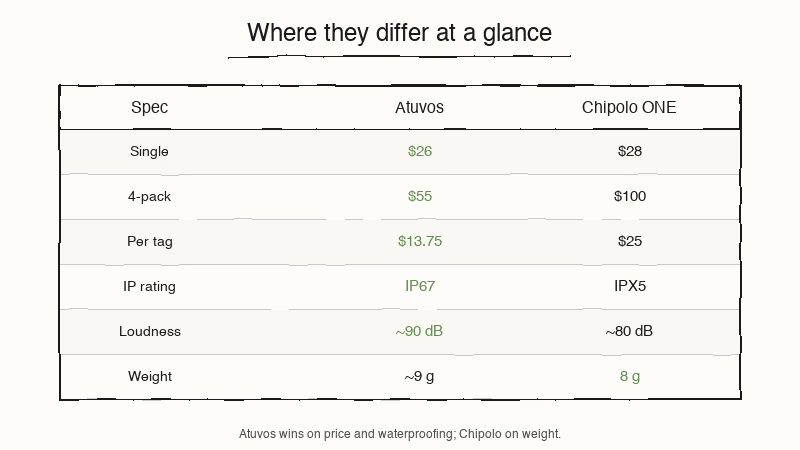
Read across that table and the headline is the network split. The Atuvos is the iPhone pick and the ONE Point is the Android pick — they don’t compete on one phone. Once you’re on the right platform, the spec differences below decide whether a given tag is worth it, but only the Atuvos is a current, in-production buy; the ONE Point is discontinued.
How Do They Differ Where It Actually Matters?
The four-pack economics deserve the closest look. At $55 for four Atuvos units, you’re paying $13.75 per tag. Chipolo’s four-pack at $100 comes to $25 per tag, which is within a dollar of the single-unit price.
That gap widens with volume.
Apple’s own AirTag four-pack, by comparison, runs $99 or about $25 per tag. If you’re tagging keys, wallet, backpack, and laptop bag in one purchase, Atuvos is the clear value pick. A single-tag buyer barely notices the $2 gap.
Water Resistance: IP67 vs IPX5
Water resistance is the other real difference.
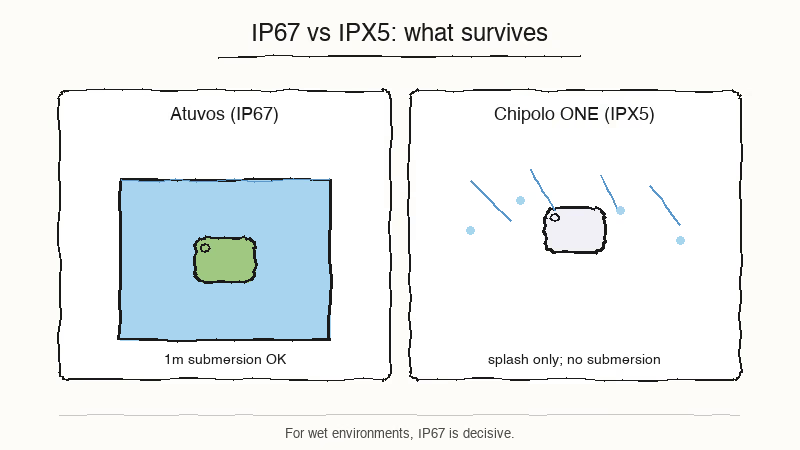
Atuvos carries an IP67 rating, which the IEC ingress-protection standard states that the device gets full protection against dust plus submersion up to 1 meter for 30 minutes. Chipolo ONE Point’s IPX5 rating only protects against sustained water jets, not immersion. For a tag living in a pocket through rain or a kid’s backpack that sees the occasional puddle, the IP67 spec materially changes what survives. For a tag sitting in a leather wallet indoors, neither rating matters much.
Speaker Loudness
Speaker loudness favors Atuvos too. The Atuvos Bluetooth tracker review explains why the Atuvos is the easier pick if indoor ring volume matters. That can matter when you’re trying to hear a tag through a closed door rather than across an open room.
Brand Track Record and Long-Term Support
Chipolo’s meaningful edge is brand age.
Chipolo has sold trackers since 2013 and survived multiple ecosystem transitions across both Apple and Google networks, shipping millions of units. Atuvos is newer, having launched its first Apple Find My trackers only in recent years, so there’s no multi-year record of firmware updates or honored warranties to weigh against Chipolo’s decade-plus history.
The caveat: the ONE Point itself is now discontinued, so Chipolo’s track record applies more to its current POP than to this specific tag.
If a company disappearing in three years worries you, that’s a real consideration; if you treat trackers as disposable after a battery cycle or two, it matters less.
Which Should You Actually Buy?
For these two, the choice is made before you compare a single spec: it’s set by your phone.
Here’s the split that captures roughly 90% of buyer intent.
If you own an iPhone, the ONE Point is off the table entirely (it’s Android-only), so the real contest is Atuvos versus AirTag. Among budget Apple Find My tags, Atuvos is the value pick thanks to its 4-pack economics and IP67 rating.
If you own an Android phone, the Atuvos is off the table, and the ONE Point is the lightweight Google Find My Device option. Since it’s discontinued, though, most Android buyers are better served by the in-production, dual-network Chipolo POP.
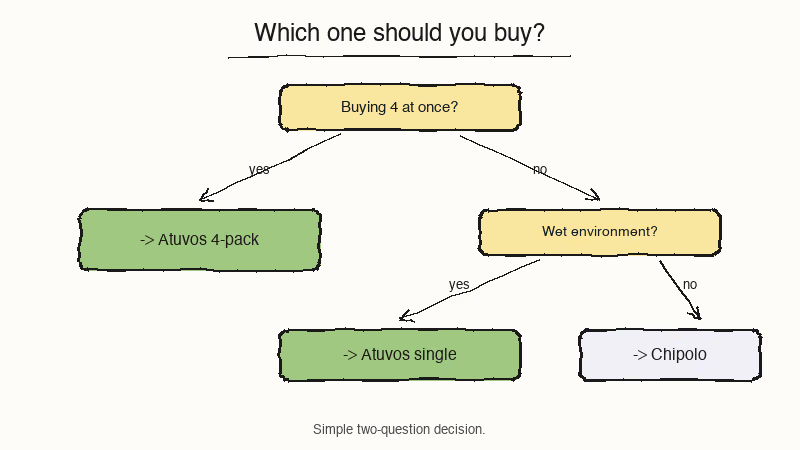
Both bets are reasonable at this price. If you’re still undecided between them and AirTag, our best cheap Bluetooth tracker roundup frames the broader $25-and-under tier.
For the overall landscape of AirTag alternatives, see our AirTag alternatives guide.
Bottom Line
There is no single winner here because the two tags serve different phones. iPhone owners should buy the Atuvos — it’s the cheapest in-production Apple Find My tag with real submersion protection. Android owners can use the Chipolo ONE Point for Google Find My Device, but because it’s discontinued, the dual-network Chipolo POP is the safer current buy. Neither tag offers the UWB Precision Finding that AirTag holds as its exclusive advantage at this tier.
FAQ
Are Atuvos and Chipolo ONE Point on the same network?
No, and this is the most important thing to know. The Atuvos is “Works with Apple Find My” certified and appears in the Items tab of the Find My app on iPhone. The Chipolo ONE Point works exclusively with Google’s Find My Device app and can only be used on Android devices. They run on completely different crowd-finding networks and can’t be paired to the same phone.
Which one is better for a keychain that gets wet?
Atuvos. Its IP67 rating covers 30 minutes of submersion at 1 meter, so a tag that goes through rain, a puddle, or a quick accidental dunk will almost certainly survive. Chipolo ONE Point’s IPX5 rating protects against splashes and sprays but not immersion; a full dunk is a real risk to the device.
How much cheaper is Atuvos at the 4-pack price?
Roughly 45% cheaper per tag. The Atuvos 4-pack lists at $55, which works out to $13.75 per tag. Chipolo ONE Point’s 4-pack at $100 is $25 per tag, nearly the single-unit price. If you’re tagging multiple items at once, that gap is the single strongest reason to pick Atuvos.
Which one works with Android, and which with iPhone?
They split cleanly. The Chipolo ONE Point is Android only, running on Google Find My Device, so iPhone users can’t pair it. The Atuvos is iPhone only, running on Apple Find My, so Android users can’t pair it. If you want a tag that works on either platform, our best Bluetooth tracker for Android guide and the dual-network Chipolo POP are better starting points.
Which one is louder when you make it ring?
Atuvos. Its ring is the easier one to pick out indoors, for example through a closed door, while the quieter Chipolo ONE Point is more likely to get buried under room noise. The gap matters less outdoors, where ambient noise and distance dominate.
How long do the batteries last in each one?
Both rate the CR2032 coin cell at roughly 12 months under typical use. Actual runtime varies with ring use and nearby phone traffic (iPhones for the Atuvos, Android phones for the ONE Point). Both batteries are user-replaceable, so the long-term cost of ownership is essentially zero beyond a small annual replacement cell.
Can I use both an Atuvos and a Chipolo ONE Point in one app?
Not in the same app, because they live on different networks. The Atuvos appears only in Apple’s Find My app on iPhone, while the ONE Point appears only in Google’s Find My Device app on Android. You’d need both an iPhone and an Android phone, each running its own tracking app, to use the two tags at once. If you want multiple budget tags in a single app, stick to one platform and one brand.