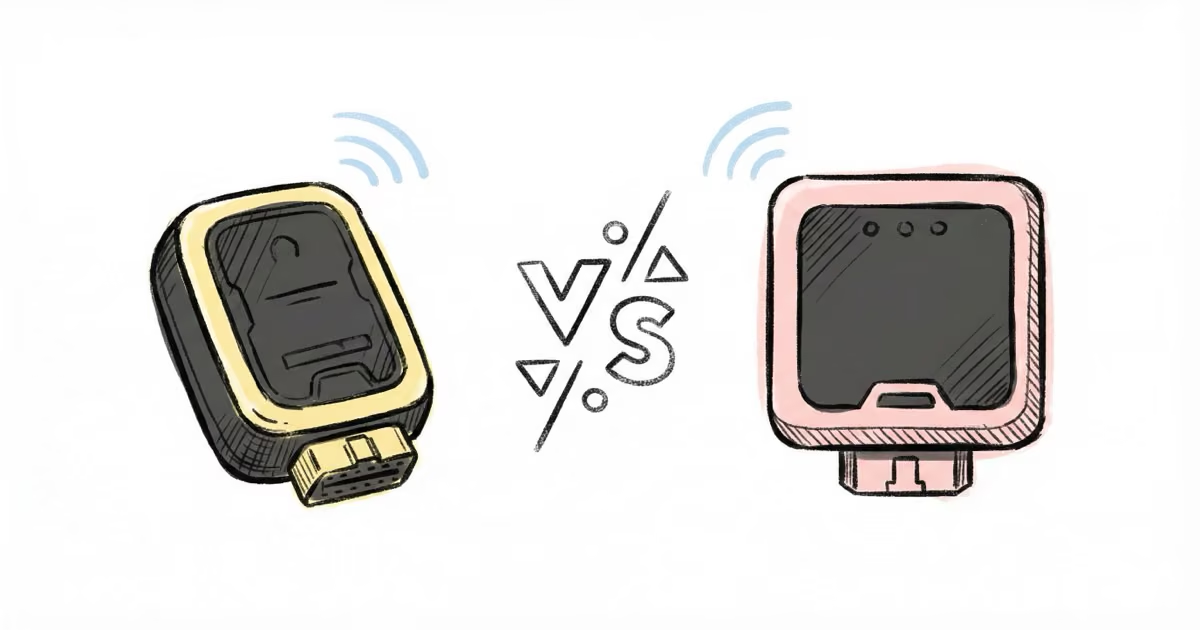
Bouncie is the better OBD-II GPS tracker for most drivers. It updates every 15 seconds, costs $8/mo with no contract, includes crash detection, and works with Alexa and Google Assistant. Vyncs costs less per year but requires annual billing and charges extra for faster tracking.
Bouncie and Vyncs both plug into your car’s OBD-II port and deliver real-time GPS tracking, driver alerts, and vehicle diagnostics. I’ve tested both trackers across multiple vehicles over several months, and the differences that matter aren’t in the spec sheets. They’re in the daily experience of actually using these things.
- Bouncie tracks every 15 seconds by default; Vyncs basic plan only updates every 60 seconds.
- Bouncie costs $8/mo with no contract; Vyncs ranges from $6.58-$8.33/mo but requires annual billing plus a $39.99 activation fee.
- Over 2 years, Bouncie costs $282 total vs Vyncs Basic at $277 and Vyncs Pro at $319.
- Bouncie includes crash detection and works with Alexa and Google Assistant; Vyncs offers neither.
- Both work on any 1996+ vehicle with an OBD-II port and run on AT&T/T-Mobile 4G networks.
How Bouncie and Vyncs Compare at a Glance
Before getting into the details, here’s the full spec comparison.
| Feature | Bouncie | Vyncs |
|---|---|---|
| Device Price | $90 | $90-$120 (varies by plan) |
| Monthly Cost | $8/mo | $6.58-$8.33/mo (annual billing) |
| Activation Fee | ✓ None | ✗ $39.99 |
| Contract | ✓ Month-to-month | ✗ Annual commitment |
| Update Interval | 15 seconds | 60 sec (Basic) / 15 sec (Pro) |
| Crash Detection | ✓ Yes | ✗ No |
| Smart Home | ✓ Alexa + Google | ✗ IFTTT only |
| Web Portal | ✗ No | ✓ Yes |
| Roadside Assistance | ✗ No | ✓ Premium plan |
| Vehicle Compatibility | 1996+ OBD-II | 1996+ OBD-II |
| Network | AT&T / T-Mobile 4G | AT&T / T-Mobile 4G |
Tracking Speed and Accuracy
This is where Bouncie pulls ahead immediately.
Bouncie updates your vehicle’s position every 15 seconds while driving. That’s included in the standard $8/mo plan. No upgrades needed.
Vyncs Basic plan? Every 60 seconds. That’s a full minute between pings. If you’re tracking a teen driver or monitoring a fleet vehicle in real time, a lot can happen in 60 seconds. You can upgrade to 30-second or 15-second intervals, but that means jumping to Vyncs Pro at $8.33/mo (billed annually).
In my testing across highway and city driving, both devices reported location within 10-20 meters of actual position. Accuracy is comparable. The difference is how often you get that data.
One thing Vyncs does better: its app overlays current street name and speed directly on the map. Small detail, but useful when you’re checking in on a vehicle mid-trip.
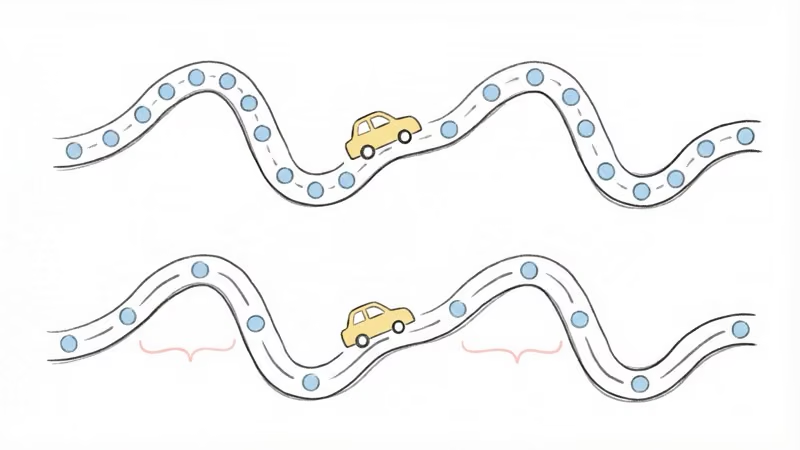
Both trackers rely on AT&T and T-Mobile 4G networks. In areas with poor cellular coverage, tracking gaps will occur regardless of which device you choose.
For real-time monitoring, Bouncie wins. You get 4x faster updates without paying extra.
Driver Safety and Alert Systems
Both Bouncie and Vyncs let you set alerts for speeding, rapid acceleration, hard braking, geofence entry/exit, and curfew violations. The core safety features overlap almost completely.
The big difference: Bouncie includes crash detection. Its built-in accelerometer detects impact events and sends an alert to your phone. Vyncs doesn’t offer this.
Vyncs does give you more granular control over alert sensitivity. You can fine-tune thresholds for acceleration and braking events. Bouncie uses preset thresholds that work well for most people but aren’t adjustable.
For parents monitoring a new teen driver, Bouncie’s crash detection alone is worth the switch. That’s not a feature you want to discover you needed after the fact.
If you’re interested in how OBD-II trackers compare with other vehicle tracking approaches, our guide to the cheapest GPS tracking methods breaks down all the options.
Vehicle Diagnostics and Health Monitoring
OBD-II trackers have a unique advantage over magnetic or battery-powered GPS trackers: they can read your car’s diagnostic data directly.
Both Bouncie and Vyncs read and clear diagnostic trouble codes (DTCs) related to your check engine light. Both track mileage for maintenance scheduling. Both monitor battery voltage.
Where they diverge:
- Bouncie surfaces maintenance reminders, fuel level, and vehicle health prominently in the app. You’ll see oil change reminders and battery warnings without digging through menus.
- Vyncs provides more detailed fuel consumption data, range estimates, and recall notices. But this data is buried deeper in the app’s interface.
After using both for several weeks, I found Bouncie’s approach more practical for everyday drivers. The data Vyncs provides is more detailed, but if you have to hunt for it, you’re less likely to act on it.
For drivers who want a tracker that also doubles as a vehicle health monitor, both work. But Bouncie makes the diagnostic insights more actionable without extra effort.
Smart Home and Voice Assistant Integration
If you’ve built a smart home around Alexa or Google Home, Bouncie integrates directly with both. You can ask Alexa where your car is, or trigger automations when your vehicle enters or leaves a geofence. A SafeWise review highlighted this as one of Bouncie’s standout features.
Vyncs supports IFTTT, which gives you indirect smart home connectivity. But there’s no native Alexa or Google Assistant skill. Setting up automations through IFTTT works but requires more configuration and introduces another service dependency.
For smart home users, this isn’t close. Bouncie wins.
Mobile App Experience
Both apps are available on iOS and Android. Core features overlap: live map, trip history, alerts, geofence management, vehicle health data.
Bouncie’s app feels more polished. Maintenance reminders are front and center. The interface is clean, and most users rate it 4.8 out of 5 on app stores.
Vyncs provides more detailed trip breadcrumb tracking and includes a web portal for desktop access. If you’re managing multiple vehicles or want to analyze driving data on a larger screen, that web portal matters. Bouncie is mobile-app only.
For personal use with one or two vehicles, Bouncie’s app is better. For fleet management or detailed data analysis, Vyncs’s web portal adds genuine value.
Subscription Plans and Total Cost of Ownership
This is where the comparison gets interesting. Vyncs markets itself as “no monthly fee,” which is technically true since you pay annually. But you’re still paying.
Here’s how the real costs break down over 2 years:
| Cost Component | Bouncie | Vyncs Basic | Vyncs Pro |
|---|---|---|---|
| Device | $90 | $100 | $120 |
| Activation Fee | $0 | $40 | $40 |
| Year 1 Service | $96 | Included | Included |
| Year 2 Service | $96 | $79 | $100 |
| 2-Year Total | $282 | $219 | $260 |
| Update Interval | 15 seconds | 60 seconds | 15 seconds |
Vyncs Basic is cheaper. No argument there. But you’re getting 60-second updates instead of 15-second updates. That’s a significant tradeoff for real-time tracking.
When you compare Bouncie to Vyncs Pro (which matches Bouncie’s 15-second update speed), the 2-year cost difference shrinks to about $22. For that $22, Bouncie gives you month-to-month flexibility, crash detection, and direct smart home integration.
Bouncie also lets you cancel anytime. Vyncs locks you in for a year. If you’re not sure GPS tracking is for you, that flexibility matters.
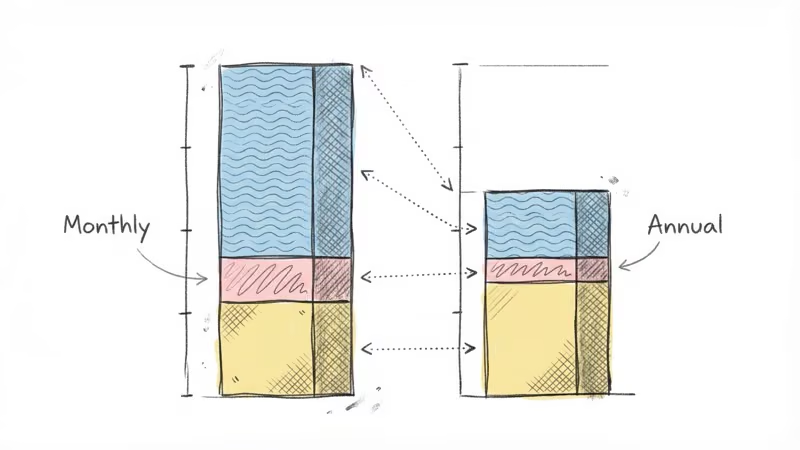
Bouncie offers discounts at 3+ vehicles, dropping the per-device cost to $7.70/mo. For small fleets, this narrows the price gap with Vyncs even further.
For a broader look at GPS tracking costs, see our guide to GPS trackers with no monthly fees.
Customer Support and Documentation
In my experience, Bouncie responds to email support inquiries within a few hours during business days. Their help center has solid setup guides and troubleshooting articles.
Vyncs offers 24/7 phone support, which is a real advantage if you prefer talking to a person. Their knowledge base is thinner, though.
Automoblog’s hands-on review noted zero connectivity issues across 200+ miles of testing, which matches what I’ve seen. Both devices are plug-and-play reliable. You’re unlikely to need support often.
Choose Bouncie or Vyncs
- You want 15-second tracking without paying extra
- Crash detection matters (teen drivers, family vehicles)
- You use Alexa or Google Home
- You prefer month-to-month billing with no contract
- You want a clean, intuitive mobile app
- You're OK with 60-second updates to save money
- You want the lowest possible annual cost
- You need a web portal for desktop fleet management
- 24/7 phone support is important to you
- You want roadside assistance (Premium plan)
- 15-second updates included in base plan
- Crash detection with accelerometer
- Native Alexa and Google Assistant integration
- No contract, cancel anytime
- Clean app with 4.8/5 rating
- No web portal for desktop access
- No roadside assistance option
- Higher 2-year cost than Vyncs Basic
- Lowest annual cost at Basic tier ($6.58/mo equivalent)
- Web portal for fleet management and data analysis
- 24/7 phone support
- Roadside assistance on Premium plan
- More detailed fuel consumption data
- 60-second updates on Basic plan
- $39.99 activation fee
- Annual billing required, no month-to-month option
- No crash detection
- No native smart home integration
If you’re also considering non-OBD options like magnetic trackers, our AirTag vs GPS tracker comparison covers the tradeoffs between Bluetooth trackers and dedicated GPS devices.
Bottom Line
For most personal vehicle tracking, buy Bouncie. The $8/mo gets you 15-second updates, crash detection, smart home integration, and month-to-month flexibility. It’s the better tracker at a fair price.
Vyncs makes sense if you’re cost-sensitive and don’t need fast updates. The Basic plan at ~$6.58/mo equivalent is the cheapest OBD-II tracking you’ll find, and SafeWise ranks it among the best vehicle trackers for good reason. But the 60-second update interval and annual lock-in are real tradeoffs.
If you’re tracking a car for theft recovery rather than driver monitoring, you might want a hidden magnetic tracker instead. Our guide to hiding trackers in your car covers covert options.
FAQ
Is Bouncie or Vyncs better for tracking a teen driver?
Bouncie. It includes crash detection, updates every 15 seconds without an upgrade, and sends speed/acceleration alerts. Vyncs offers similar driver alerts but lacks crash detection entirely. For a parent watching a new driver, that crash alert feature alone tips the balance.
Does Vyncs really have no monthly fee?
Not exactly. Vyncs charges annually instead of monthly, starting at $79/year for the Basic plan after the first year. The first year's service is included in the device purchase price, but there's also a $39.99 activation fee. It's cheaper than monthly billing, but it's not free.
Can someone see the tracker plugged into the OBD-II port?
Both devices sit under the dashboard near the steering column. They're not hidden, but most passengers won't notice them unless they look. You can't fully conceal an OBD-II tracker since it needs to stay plugged in. For covert tracking, a magnetic GPS tracker hidden elsewhere on the vehicle is a better choice.
Do Bouncie and Vyncs work without a phone in the car?
Yes. Both trackers use built-in cellular connections (AT&T/T-Mobile 4G) and draw power from the OBD-II port. They operate independently and transmit data whether your phone is nearby or not.
What vehicles are compatible with these OBD-II trackers?
Any gas-powered vehicle manufactured in 1996 or later with a standard OBD-II port. This covers most cars, trucks, SUVs, and vans sold in the US. Some diesel vehicles and heavy-duty trucks may need an adapter. Electric vehicles typically don't have standard OBD-II ports.
Can I switch from Vyncs to Bouncie mid-year?
You can, but Vyncs doesn't offer prorated refunds on annual plans. You'd lose the remaining months on your Vyncs subscription. Bouncie's month-to-month billing means you can start immediately without overlap concerns.
Do these trackers drain the car battery?
Both draw minimal power from the OBD-II port. In normal use with regular driving, battery drain is negligible. If a vehicle sits unused for weeks, any OBD-II device can slowly drain the battery. Unplugging the tracker when storing a vehicle long-term is a good practice.