The Family1st GPS tracker is a compact 4G LTE tracking device that costs $29.95 upfront with plans starting at $21.95 per month. It's rated for up to 14 days of battery on a single charge, and its U-Blox GPS chipset targets open-sky accuracy of a few meters. It works well for vehicle tracking, monitoring elderly family members, and keeping tabs on teens. The app is functional but visually dated, and a subscription is required for all remote tracking features.
The Family1st GPS tracker sits in a crowded market of portable tracking devices, all promising real-time location updates and long battery life. This review breaks down its specs, subscription tiers, battery rating, and where the tracker falls short compared to pricier competitors.
- Device costs $29.95 with monthly plans from $21.95 (60-second updates) to $38.95 (5-second updates)
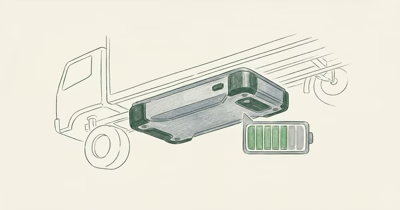
- Battery is rated for up to 14 days of active tracking on a 600 mAh cell, with actual life depending on update frequency. Family1st states the tracker supports 4G LTE-M on T-Mobile and AT&T networks
- U-Blox GPS chipset targets consumer GPS accuracy outdoors, with coarser Wi-Fi fallback positioning indoors
- Includes magnetic weatherproof case, SOS button, geofence alerts, and lifetime limited warranty
- Requires active paid subscription for all remote tracking features; no free tier available
What You Get in the Box
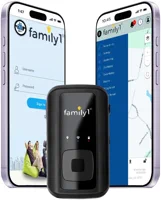
The package includes the GPS tracker, a magnetic weatherproof mounting case, a micro-USB charging cable, and a quick-start guide. The tracker comes with a pre-installed SIM card, so you skip the hassle of sourcing and configuring one yourself. The device measures 2.8" x 1.8" x 1.1" and weighs just 3.6 oz, small enough to tuck under a car bumper or slip into a backpack pocket.
For the theft-recovery use case, the National Insurance Crime Bureau tracks how often stolen vehicles are recovered.
Build quality feels solid for the price point. The plastic housing has a matte finish that resists fingerprints, and the included magnetic case snaps firmly onto metal surfaces. Compared to the Tracki GPS tracker, which is physically smaller, the Family1st device trades compactness for a larger battery.
Family1st GPS Tracker Setup and First Use
Setup is an account, app, charge, power-on, and first-fix process rather than one-tap pairing. Here are the steps:
- Create an account at the Family1st activation page and enter the 15-character IMEI number printed on the device
- Download the Family1st Pro app on iOS or Android and log in with your account credentials
- Charge the tracker fully using the included micro-USB cable
- Power on by long-pressing the side button until the LED flashes red and blue, indicating GPS acquisition
- Wait for a GPS fix outdoors. The companion app then shows live location, and you can set geofence alerts for boundary crossings
- Confirm the status in the app shows "online" with a green indicator
Once connected, the tracker starts sending location pings at whatever interval your subscription plan allows. Bulkier battery-first units like the LandAirSea 54 make a different trade-off.
How the Family1st Tracker Works
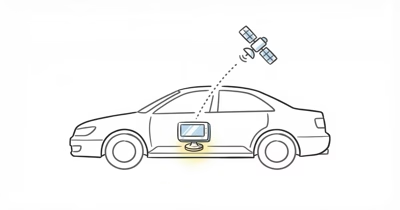
The Family1st GPS tracker combines satellite positioning with 4G LTE cellular data to determine and transmit its location. Outdoors, the U-Blox GPS chipset works in the consumer GPS accuracy ballpark. Indoors, it falls back to Wi-Fi network triangulation, which is coarser and should be treated as building-level context rather than room-level certainty.
For reference, the U.S. government's official GPS accuracy page states that GPS-enabled devices are typically accurate to within a 4.9 m (16 ft) radius under open sky, which is the ballpark a dedicated GPS chip like the Family1st's works in.
Location data travels over 4G LTE networks to Family1st servers, where the app and web portal pull updates. According to Family1st's platform documentation, the system supports adjustable update intervals from 5 seconds to 60 seconds depending on your plan tier. The built-in SIM handles all cellular connectivity, and coverage spans the United States, Canada, and Mexico.
The tracker also stores location data internally when cellular signal drops. Once it reconnects, stored points sync to the server so you don't lose tracking history during brief dead zones.
GPS Accuracy by Environment
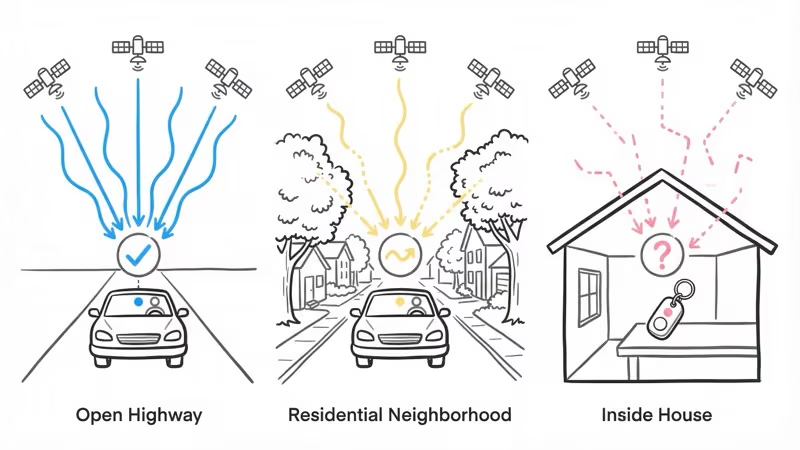
How tightly any GPS tracker follows real position depends on your plan's update interval and the surroundings:
Highway driving: With a clear sky view, GPS plots a clean lane-level route. On the slower 60-second Basic interval, fast curves can fall between pings.
Residential neighborhoods: Trees and two-story buildings reduce satellite visibility, so a GPS path can lag in pockets, though the overall route shape stays accurate.
Indoor tracking: Indoors the tracker leans on Wi-Fi positioning, which is coarser and can jump between rooms -- usable for confirming someone is home, not for room-level certainty.
Parked: Parked under open sky, a GPS position holds steady; cheaper trackers are more prone to phantom drift.
SafeWise reported that the tracker handles open-sky conditions well and degrades predictably when satellite visibility drops -- the same open-sky-good, obstruction-sensitive pattern any consumer GPS chip shows.
Does the Battery Life Match the Claims?
Family1st rates the tracker for up to 14 days of active tracking and up to 30 days in battery-saving mode. Real-world life depends heavily on the update interval: a 5-second Elite plan drains the 600 mAh cell far faster than the 60-second Basic plan, and frequent motion alerts add to the load.
The 600 mAh Li-Polymer battery is modest by GPS tracker standards. The Bouncie GPS tracker sidesteps battery concerns entirely by plugging into your car's OBD-II port, but that means it only works for vehicles. For a portable tracker, the rated two-week active window is reasonable at slower update intervals, though heavy real-time use will mean recharging every few days.
Charging uses micro-USB. If you plan to use this for continuous vehicle monitoring, running a USB cable to the tracker for constant power makes more sense than relying on the battery alone.
Subscription Plans and Pricing
Every remote tracking feature on the Family1st tracker requires an active paid subscription. No free tier exists. Here are the current plan options:
| Plan | Monthly Cost | Update Interval |
|---|---|---|
| Basic | $21.95/mo | Every 60 seconds |
| Plus | $28.95/mo | Every 30 seconds |
| Elite | $38.95/mo | Every 5 seconds |
All plans include geofence alerts, speed notifications, tracking history reports, and email/SMS alerts. There are no activation fees, no contracts, and no cancellation penalties. You can switch between plans, though changes take 1-2 billing cycles to apply. Annual prepayment drops the monthly cost to around $15.95/mo, which brings the yearly expense to roughly $191.
For vehicle tracking and asset monitoring, the Basic plan at 60-second intervals provides enough granularity. If you're tracking a child or elderly family member who might wander, the Elite plan's 5-second updates are worth the extra cost for faster response, though our top kid-tracking picks cover wearables built for that job. For context, the SpyTec GPS tracker charges similar monthly rates but includes a slightly more polished app interface.
The Family1st Pro App
The Family1st Pro app (iOS and Android) handles all monitoring, alerts, and device settings. It works, but the interface looks like it was last redesigned around 2019. Maps load without issues, and location pins update reliably at whatever interval your plan supports.
Core app features include:
- Live map tracking with zoom, pan, and satellite/street view toggle
- Geofence creation using circular or polygon shapes with entry/exit alerts
- Tracking history showing routes, stops, duration, distance, and top speed by day or date range
- Speed alerts that trigger when the tracker exceeds a threshold you set
- Battery level monitoring with low-battery push notifications
- SOS alert display showing exact coordinates when the physical SOS button is pressed
What the app lacks: trip replay animation (you get static route lines, not a moving playback), driver behavior scoring, and any kind of crash detection. If those features matter to you, the Bouncie tracker offers all three through its OBD-II connection. Our Bouncie vs. Family1st comparison breaks down the full cost and feature differences between these two trackers.
Water Resistance and Durability
The Family1st tracker carries an IPX5 water resistance rating. That means it handles rain, splashes, and pressurized water jets from any direction without damage. It doesn't survive submersion.
At IPX5, leaving the tracker mounted on a car bumper through heavy rain should not cause issues. The magnetic case adds another layer of weather protection for exterior vehicle mounting.
For cold weather, the tracker is rated down to -22 F (-30 C).
In extreme cold near 0 F, cellular connectivity can become intermittent and battery drain accelerates. If you live in a region with harsh winters, expect reduced battery life below 10 F.
Best Use Cases for the Family1st Tracker
The Family1st GPS tracker works across several tracking scenarios, though it fits some better than others:
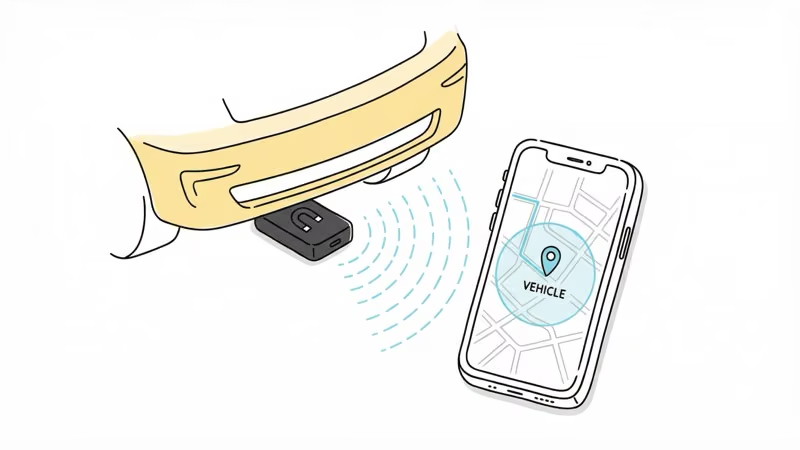
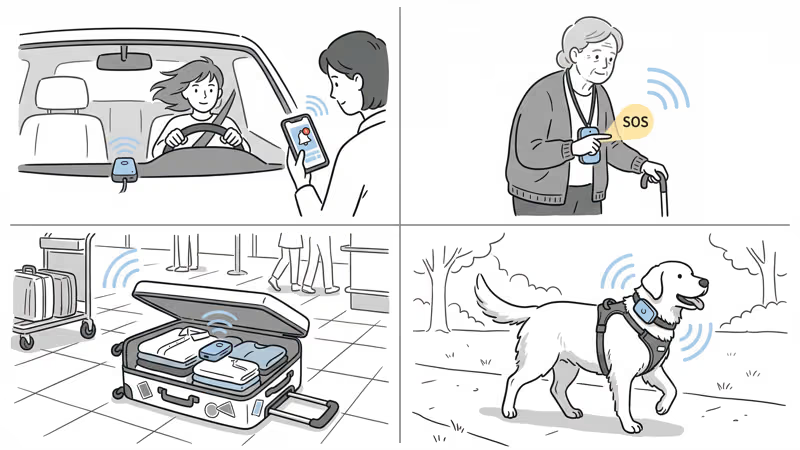
Vehicle tracking: This is the strongest use case. Mount the magnetic case under a bumper or inside a wheel well. With a wired USB power source, you get continuous tracking without battery concerns.
Ideal for monitoring teen drivers or keeping tabs on a fleet vehicle. The magnetic mount also makes it practical for catalytic converter protection when positioned near the exhaust system.
For parents of new drivers specifically, our best GPS tracker for teen drivers guide covers the top options, and the NHTSA teen driving resource center explains why speed and curfew monitoring can matter during the first years behind the wheel.
For more options, see our guide to GPS car trackers with no monthly fees. For motorcycle-specific tracking, our motorcycle GPS tracker comparison covers options better suited to two-wheeled vehicles.
Elderly family members: The SOS button and geofence alerts make this a reasonable option for monitoring adults with memory conditions. The device fits in a coat pocket or purse. For dedicated senior tracking devices, GPS trackers designed for elderly users offer features like fall detection that this tracker lacks.
Pet tracking: Attaching the tracker to a large dog's collar is possible with cable ties, but the 3.6 oz weight makes it impractical for small dogs or cats. Dedicated GPS pet trackers offer lighter, collar-integrated designs.
Luggage and asset tracking: Toss the tracker inside a suitcase or toolbox for theft protection and travel monitoring. The battery-saving mode extends standby to weeks when the device isn't in motion.
Family1st GPS Tracker Pros and Cons
- Low device cost at $29.95 with no activation fees
- 4G LTE coverage across USA, Canada, and Mexico
- Adjustable update intervals from 5 to 60 seconds
- Magnetic weatherproof case included for vehicle mounting
- SOS panic button for emergency alerts
- Lifetime limited warranty on hardware
- No contracts or cancellation fees
- App interface is visually outdated
- No trip replay or animated route playback
- No crash detection or driver behavior scoring
- Monthly subscription required for all tracking features
- 600 mAh battery is smaller than several competitors
- Too heavy for small pet collars
How Does Family1st Compare to Other GPS Trackers?
| Feature | Family1st | Tracki | LandAirSea 54 | Bouncie |
|---|---|---|---|---|
| Device price | $29.95 | $19.95 | $29.95 | $89.99 |
| Monthly plan (lowest) | $21.95 | $19.95 | $19.95 | $9.65 |
| Update interval | 5-60 sec | 10-60 sec | 3 sec-3 min | 15 sec |
| Battery life | Up to 14 days | Up to 5 days | Up to 14 days | N/A (OBD-II) |
| Water resistance | IPX5 | IPX5 | IPX7 | N/A (interior) |
| SOS button | Yes | Yes | No | No |
| Crash detection | No | No | No | Yes |
The Family1st tracker lands in the middle of this group. It costs more per month than the Bluetooth trackers that avoid subscriptions entirely, but the trade-off is real GPS with nationwide cellular coverage. For vehicle-only tracking where cost matters most, Bouncie's $9.65/mo plan is hard to beat if you don't need portability.
Bottom Line
The Family1st GPS tracker delivers reliable real-time tracking in a compact package at a fair price. The $29.95 device cost and $21.95/mo Basic plan make it one of the more accessible entry points into GPS tracking.
Battery life is reasonable for light daily use, and location accuracy is solid outdoors. The app needs a visual overhaul, and power users will miss trip replay and driver analytics.
But for simple vehicle tracking, monitoring elderly family members, or securing high-value assets, it covers the fundamentals without overcomplicating things. The lifetime warranty and 30-day money-back guarantee reduce the risk of trying it out.
FAQ
Does the Family1st GPS tracker require a monthly subscription?
Yes. All remote tracking features, including live location, geofence alerts, and tracking history, require an active paid plan. Plans start at $21.95 per month for 60-second updates. Without a subscription, you can't view the tracker's location remotely through the app or web portal.
How long does the Family1st tracker battery last?
Family1st rates the battery at up to 14 days with active tracking. Real-world life depends on the update interval -- the 60-second Basic plan lasts far longer than the 5-second Elite plan, and frequent motion alerts shorten it. Battery-saving mode can extend standby to several weeks when the device is stationary.
Is the Family1st tracker waterproof?
The tracker has an IPX5 water resistance rating. It handles rain, splashes, and pressurized water jets without damage, but it isn't rated for submersion. The included magnetic weatherproof case adds extra protection for exterior vehicle mounting in wet conditions.
Can I use the Family1st tracker without cellular coverage?
The tracker relies on 4G LTE networks to transmit location data. In areas without cellular coverage, it can't send real-time updates. However, it stores location points internally and syncs them once it reconnects to a cellular network. It won't work in remote areas with zero cell service.
Does Family1st offer an annual subscription plan?
Yes. Paying annually reduces the monthly cost to approximately $15.95 per month, which works out to about $191 per year. This represents a significant discount compared to the $21.95 monthly rate on the Basic plan. No long-term contract is required either way.
How accurate is the Family1st GPS tracker?
Under open sky, accuracy should be in the same broad range as other consumer GPS devices. Trees, buildings, and indoor Wi-Fi triangulation make the result looser, so treat indoor pins as approximate context rather than room-level certainty.
What is included with the Family1st GPS tracker?
The package includes the GPS tracker with a pre-installed SIM card, a magnetic weatherproof mounting case, a micro-USB charging cable, and a setup guide. No additional accessories need to be purchased for basic vehicle or personal tracking use.