It costs $29 for the device plus $19.95 to $34.95 per month with no annual contract. Battery life depends on update frequency, and it carries an IP67 waterproof rating. Best suited for parents monitoring teen drivers, fleet managers, and private investigators who need discreet vehicle surveillance.
The SpaceHawk GPS tracker is a compact, magnet-mount tracking device built for covert vehicle monitoring.
It uses GPS satellites and 4G LTE cellular to send location data to your phone or computer in near real time. If you need to track a car, truck, or trailer without anyone knowing, this is one of the more accessible options on the market right now.
- SpaceHawk costs $29 upfront plus $19.95 to $34.95/month with no annual contract or cancellation fees.
- Real-time GPS updates range from every 10 seconds (Pro Plan) to every 2 minutes (Basic Plan).
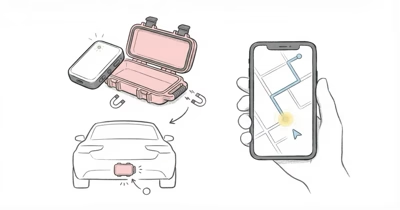
- The built-in magnet attaches to any metal vehicle surface in seconds, with an IP67 waterproof rating for external mounting.
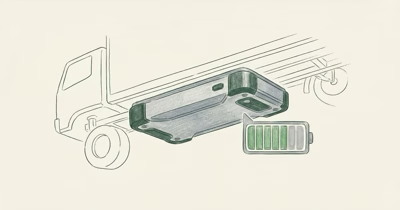
- Battery life depends on update frequency, with faster pings requiring more frequent charging.
- Tracking history is stored for 12 months, with smart alerts for speeding, geofence exits, and unauthorized trips.
What Is the SpaceHawk GPS Tracker?
The SpaceHawk is a small, magnet-mounted GPS tracking device designed primarily for vehicles.
At 2.2 x 2.2 inches, it fits in the palm of your hand. You stick it under a car bumper, inside a wheel well, or anywhere with enough metal surface for the magnets to grip.
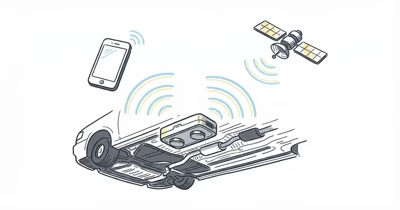
It transmits its GPS coordinates over the cellular network to SpaceHawk’s servers. You then view the data through their mobile app (iOS and Android) or a web portal. The whole thing is designed and assembled in the USA. The U.S. government’s official GPS accuracy data confirms that GPS-enabled devices are typically accurate to within about 5 meters under open sky.
Unlike Bluetooth trackers like AirTag, SpaceHawk doesn’t rely on nearby phones. It has its own cellular connection, so it works independently anywhere with cell coverage.
How Does SpaceHawk Work?
The tracking process is simple:
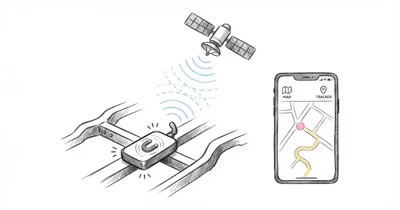
- Magnetic attachment — strong built-in magnets hold the device to any vehicle exterior. No wires, no tools.
- GPS positioning — the device communicates with GPS satellites to pinpoint location.
- Cellular transmission — 4G LTE sends those coordinates to SpaceHawk’s cloud servers at intervals you choose.
- App/web access — you pull up live location, trip history, speed data, and geofence alerts from your phone or browser.
The device enters sleep mode when the vehicle isn’t moving, which extends battery life. When it detects motion, tracking resumes automatically.
Key Features Worth Noting
Update frequency matters. On the Pro Plan, SpaceHawk delivers location pings every 10 seconds, close enough to live tracking to follow a vehicle in motion.
The Basic Plan drops to every 2 minutes. That cadence is fine for confirming general whereabouts, but it won’t capture every turn, and a fast-moving vehicle can cover a surprising distance between two pings.
12 months of historical data. Most vehicle GPS trackers store 30 to 90 days.
SpaceHawk keeps a full year, which is useful if you are building out a pattern of movement, documenting a custody dispute, or gathering a paper trail of where a vehicle has been over many months.
Smart alerts pull their weight. You can set notifications for speeding over a threshold, leaving a geofenced area, starting a trip outside expected hours, or low battery.
Alerts hit your phone via push notification, email, or text.
The IP67 waterproof rating is genuine — the standard certifies submersion in 1 meter of water for 30 minutes. An IP67 device mounted under a bumper handles daily rain, snow, road spray, and car washes without signal degradation.
The mobile apps on both iOS and Android are functional rather than polished, with map views and route replay as the core workflow.
Who Should Buy the SpaceHawk?
This tracker makes sense for specific situations:
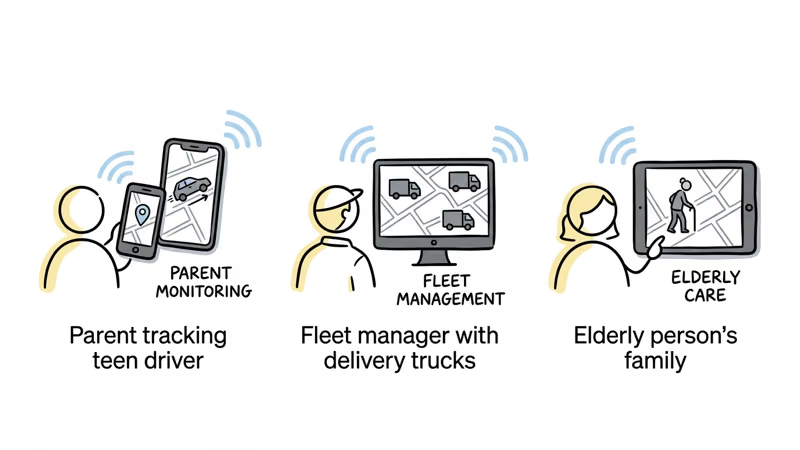
Parents of teen drivers. You’ll see every route, every speed, every stop. Set a geofence around school and home, and get alerts if the car goes somewhere unexpected. It’s less about distrust and more about building safe habits — though your teen might disagree. For a full comparison of trackers built for this use case, see our teen driver GPS tracker comparison.
Private investigators and legal cases. The 12-month history, discreet form factor, and IP67 rating make it a practical surveillance tool.
Check your local laws on consent before using it this way.
Small fleet managers. If you’re running 5 to 50 vehicles for deliveries, contracting, or rentals, SpaceHawk gives you driver accountability at a fraction of enterprise fleet management pricing.
Equipment and asset tracking. Attach it to trailers, boats, construction equipment, or anything else that moves and has a metal surface.
It’s not ideal for pet tracking or personal carry. The magnet-mount design is purpose-built for vehicles and metal assets.
SpaceHawk Pricing Breakdown
The cost structure has two parts:
Hardware: $29 for the device itself, which includes the first month of service.
Monthly plans (no contract):
| Plan | Update Interval | Price/Month |
|---|---|---|
| Basic | Every 2 minutes | $19.95 |
| Standard | Every 60 seconds | $24.95 |
| Pro | Every 10 seconds | $34.95 |
No activation fees, no overages, no roaming charges within the US and Canada. You can switch plans, pause service, or cancel any month.

Total first-year cost on the Basic Plan runs about $249 ($29 device + $219.45 for 11 months). That’s competitive against trackers like Tracki and LandAirSea 54, which charge similar monthly rates but often with slower update intervals on base plans.
Setup Takes Under 5 Minutes
Getting started is fast:
-
Create an account on the SpaceHawk website or app.
-
Activate the device by entering its serial number in your account.
-
Select a service plan based on how frequently you need updates.
-
Charge the device fully before mounting it.
-
Attach it to the vehicle’s undercarriage or another hidden metal surface.
That’s it. No SIM card to install, no firmware to update, no pairing process. The device comes pre-configured.
How SpaceHawk Compares to Competitors
SpaceHawk isn’t the only magnetic vehicle tracker available. Here’s how it stacks up against two popular alternatives:
| Feature | SpaceHawk | LandAirSea 54 | Tracki |
|---|---|---|---|
| Device price | $29 | ~$30 | ~$20 |
| Monthly fee | $19.95-$34.95 | $19.95-$49.95 | $19.95 |
| Update interval | 10 sec - 2 min | 3 sec - 3 min | 60 sec |
| Battery life | Depends on update frequency | Shorter with faster updates | Depends on update frequency |
| Waterproof | IP67 | IP67 | IPX4 (splash only) |
| History storage | 12 months | 12 months | 1 year |
| Contract | None | None | None |
SpaceHawk and LandAirSea 54 are closest in capability. LandAirSea’s product page states that the 54 can update as often as every 3 seconds on its top-tier plan. The LandAirSea 54 offers faster peak updates but drains battery faster as a result. Tracki is more portable but only splash-resistant, which makes external vehicle mounting riskier.
For purely covert vehicle tracking with a balance of battery life and update speed, SpaceHawk holds its own.
Limitations to Know About
US and Canada only. SpaceHawk doesn’t work internationally as of 2026.
If you need global coverage, look at GPS trackers with broader network support, and check the carrier footprint before you buy.
Battery needs periodic recharging. That means physically retrieving the device, charging it, and reattaching it, so the mounting spot needs to stay reachable without turning every charge into a teardown.
If the tracked vehicle is parked in a secure garage you don’t have access to, this becomes a problem.
GPS accuracy follows normal consumer-GPS limits. The U.S. government’s GPS accuracy reference above puts open-sky performance around the 5-meter class, but don’t expect building-floor precision. Urban canyons, parking garages, and tunnels will cause signal drops.
The app works but isn’t polished. It gets the job done for viewing maps and replaying routes. But the interface feels dated compared to apps from Bouncie or SpyTec. Functional, not elegant.
No Bluetooth or Wi-Fi emission. SpaceHawk uses passive GPS, which makes it harder to detect electronically.
That’s a feature for covert use, but it also means no proximity-based “find my device” feature if you forget where you placed it.
Is SpaceHawk Legal to Use
This depends entirely on your jurisdiction and situation.
In most US states, you can legally track a vehicle you own — your car, your company fleet vehicles, your teen’s car that’s registered in your name. The National Insurance Crime Bureau’s vehicle theft data tracks national theft and recovery trends.
Tracking someone else’s vehicle without their knowledge is illegal in many jurisdictions. The Department of Justice’s electronic surveillance manual states that interception of electronic communications is restricted under the federal Electronic Communications Privacy Act and parallel state laws. The FTC’s consumer guidance on covert tracking flags secret location monitoring without consent as a serious privacy and safety risk. If you’re considering using SpaceHawk for surveillance, consult a lawyer first.
SpaceHawk’s marketing leans into “covert tracking” language, but that doesn’t mean all uses are legal. Know the rules before you attach.
Bottom Line
SpaceHawk is a solid, no-frills magnetic GPS tracker for vehicles. The $29 entry price and flexible monthly plans make it low-risk to try, and the IP67 waterproofing plus rechargeable battery are useful for external mounting. It won’t win any design awards, and the app could use a refresh. But if you need discreet, real-time vehicle tracking without a contract, it delivers exactly that.
FAQ
How long does the SpaceHawk battery last on a single charge?
It depends on your plan's update frequency. The Pro Plan (10-second updates) drains faster than Basic (2-minute updates). Sleep mode kicks in automatically when the vehicle is parked, which helps stretch runtime.
Can the SpaceHawk GPS tracker be detected?
It's very difficult to detect. SpaceHawk uses passive GPS reception and cellular transmission only -- no Bluetooth or Wi-Fi signals that a standard RF detector would pick up. A professional-grade GPS detector could potentially find the cellular signal, but casual searches won't.
Does SpaceHawk require a monthly subscription?
Yes. Like all cellular GPS trackers, it needs a data plan to transmit location data. Plans start at $19.95/month with no contract. You can cancel any time without fees, and service can be paused if a vehicle will be unused.
How accurate is SpaceHawk's location tracking?
Under open sky, consumer GPS commonly performs in the 5-meter class cited by the U.S. government's GPS accuracy reference. Accuracy degrades in parking garages, dense urban areas, and near tall buildings. It's not survey-grade, but it's enough for vehicle route tracking.
Can I move SpaceHawk between different vehicles?
Yes. The magnetic mount pops off and reattaches in seconds. No re-pairing or reconfiguration needed. The tracker continues reporting to your same account regardless of which vehicle it's on.
Does SpaceHawk work outside the United States?
It works in the US and Canada. International coverage isn't available as of 2026. If you need to track vehicles across borders, consider a tracker with global SIM support like Tracki or LandAirSea with their international plans.
Is it legal to put a GPS tracker on someone's car?
It depends on ownership and jurisdiction. Tracking a vehicle you own (your car, your company fleet, your minor child's car) is generally legal in most US states. Tracking someone else's vehicle without consent may violate federal and state wiretapping or stalking laws. Always check local regulations or consult a lawyer before use.