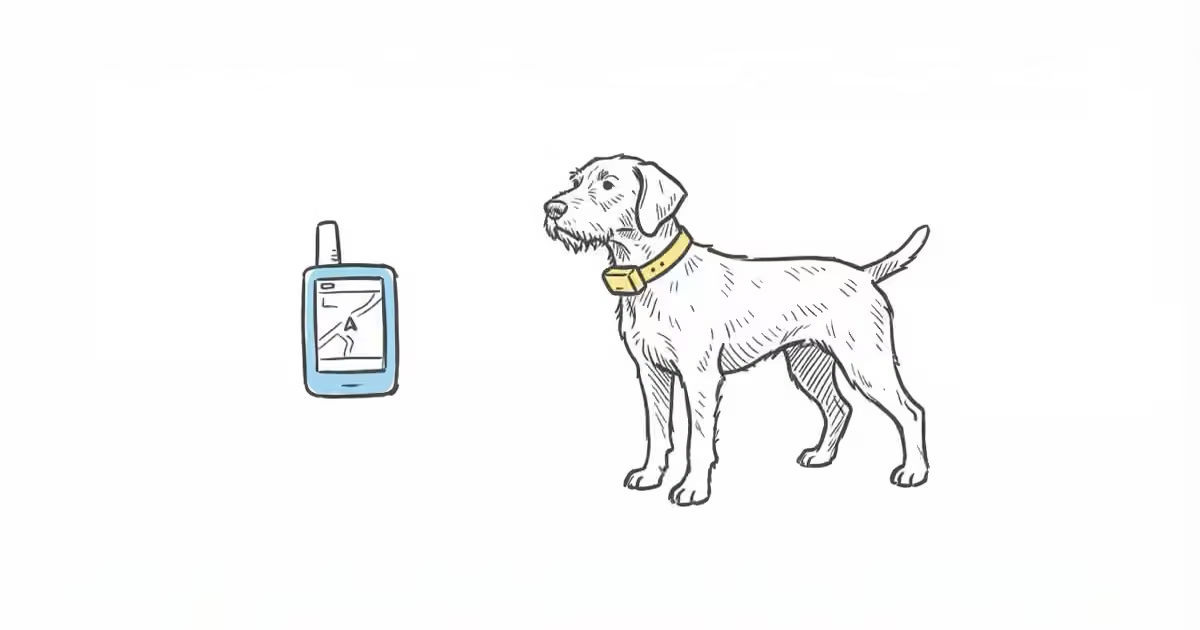
The Garmin Alpha 10 is the smallest and lightest handheld dog tracker Garmin makes. At 5.6 oz, it tracks up to 20 dogs at a 9-mile range with 2.5-second updates, lasts 40 hours per charge, and requires no cellular subscription. It lacks onboard maps but pairs with the Garmin Explore app on your phone for satellite imagery. For most upland bird hunters and field trialers who want reliable tracking without bulk, it hits the right balance of features and price at $399.99.
The Garmin Alpha 10 sits at the entry point of Garmin’s dog tracking lineup, but “entry” is misleading. This 5.6 oz handheld does what matters most: it tells you exactly where your dogs are, how far away they are, and which direction to walk. No monthly fees. No cellular plan. Just GPS.
- At 5.6 oz and 2.6" x 1.6" x 1.1", the Alpha 10 is Garmin's smallest dog tracking handheld with a 40-hour rechargeable battery.
- Tracks up to 20 dogs simultaneously at up to 9 miles with location updates every 2.5 seconds.
- No onboard maps, but pairs with the Garmin Explore app for BirdsEye satellite imagery on your smartphone.
- Includes tone, vibration, and 18 levels of static stimulation for training when paired with compatible collars.
- Priced at $399.99 (handheld only), it costs roughly half of the Alpha 200i but requires separate collar purchase ($199-$299).
Garmin Alpha 10 Specs and What You Get in the Box
The Alpha 10 ships with the handheld unit and an AC charging cradle. That’s it. No collar included, which catches some first-time buyers off guard. You’ll need a compatible Garmin GPS collar (TT 15 Mini, TT 15, TT 25, T 5, T 5X, or T 20) sold separately.
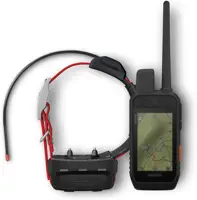
Here are the full specs from Garmin’s official product page:
| Spec | Value |
|---|---|
| Weight | 5.6 oz (handheld only) |
| Dimensions | 2.6" x 1.6" x 1.1" (3.94" with antenna) |
| Display | 1" diagonal, 128 x 128 pixels, high-contrast |
| Battery | Rechargeable lithium-ion, up to 40 hours |
| Charge time | 4 hours |
| Water rating | IPX7 (1 meter for 30 minutes) |
| Radio frequency | MURS (VHF) |
| GPS accuracy | Within 9 meters (29.5 ft) |
| Tracking range | Up to 9 miles (line of sight) |
| Dogs tracked | Up to 20 simultaneously |
| Update rate | Every 2.5 seconds per dog |
| Stimulation | Tone, vibration, static (1-18 levels) |
| Compatible collars | TT 25, T 20, TT 15X, TT 15, T 5X, T 5 |
| Onboard maps | No (pairs with Garmin Explore app) |
| Subscription | None required |
One thing worth calling out: the Alpha 10 uses MURS VHF radio, not cellular. Your dogs don’t need cell coverage. This is standalone GPS that communicates directly between the handheld and the collar via radio frequency. No dead zones in the backcountry like you’d get with a cellular-based tracker.
Display and Interface: Small but Functional
The 1-inch screen won’t win any beauty contests. It’s a high-contrast monochrome display, closer to a basic Garmin eTrex than the full-color touchscreen on the Alpha 200i.
But here’s what it does well: it shows a directional arrow pointing toward each dog and exact yardage below it. That’s the information you actually need when your pointer disappears over a ridge. Updates hit every 2.5 seconds, so you can tell whether a dog is holding point or still running.
The joystick control is a smart choice for a hunting device. I used it with heavy gloves during late-season hunts without issues. Push up, down, left, right to navigate menus. Press in to select. No touchscreen to fumble with when your fingers are cold and wet.
Icons show battery level, GPS signal strength, and tracking status. Nothing fancy. Everything functional.
How Garmin Alpha 10 Tracking Works in the Field
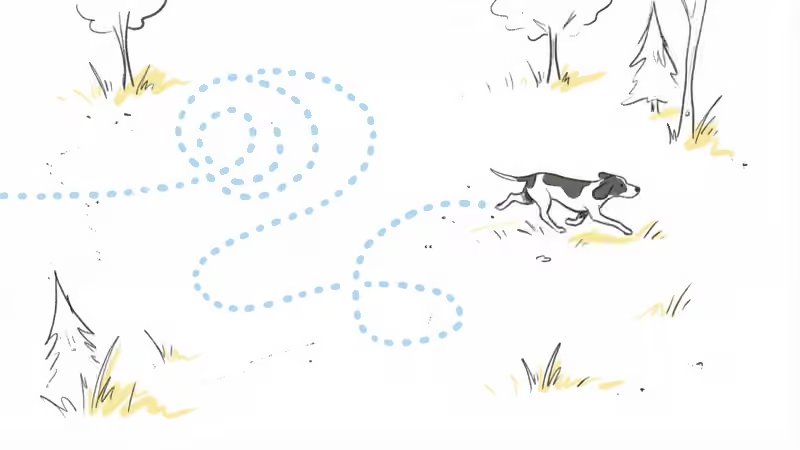
The Alpha 10 doesn’t use cell towers or Wi-Fi. It communicates directly with the GPS collar on your dog via VHF radio. The collar acquires satellite position, then transmits that location to the handheld every 2.5 seconds.
In open terrain with line of sight, I’ve gotten solid readings out to 4-5 miles. Garmin rates it at 9 miles, which is possible in flat, open country. In timber and rolling hills, expect 1-3 miles of reliable range. Heavy tree canopy and deep valleys cut into the signal, same as any VHF-based system.
Compared to some of the consumer GPS pet trackers I’ve tested, the Alpha 10’s signal acquisition is faster and more consistent. The Garmin collars lock onto satellites quickly, usually within 30-60 seconds of powering on. Outdoor Life’s hands-on review confirms the same experience with signal reliability.
No subscription fees. The Alpha 10 uses direct radio communication between the handheld and collar. There's no cellular network involved, which means no monthly plan, no SIM card, and no coverage gaps in remote hunting areas.
Battery Life: The Alpha 10's Biggest Advantage
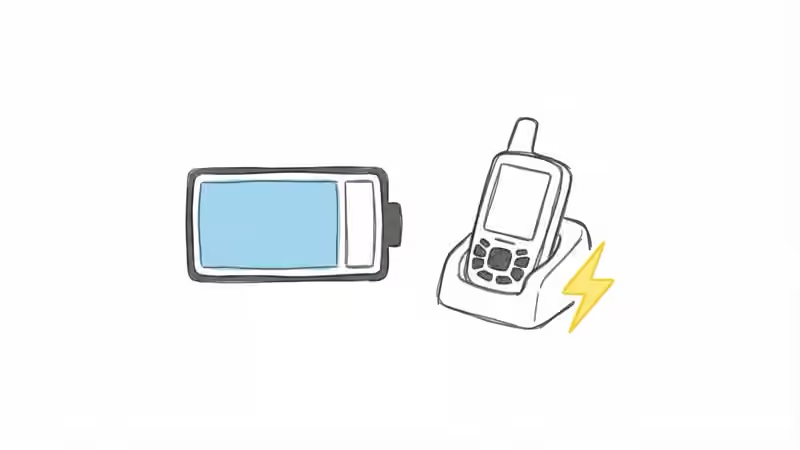
Garmin claims 40 hours. That’s not marketing fluff. I’ve consistently gotten 3-4 full days of heavy tracking before needing to recharge. During a 3-day quail hunt in West Texas, I tracked two dogs for 6-8 hours each day and still had battery left.
Compare that to the Alpha 100, which tops out at 20 hours. Or the Alpha 200i at 16 hours. The Alpha 10 doubles or triples those numbers.
The 4-hour recharge is quick enough to top up overnight between hunts. And the standby mode preserves battery when you’re taking a break or dogs are kenneled, while still broadcasting location data.
For multi-day trips where you can’t plug in, this battery life alone might justify choosing the Alpha 10 over its bigger siblings.
Training Features: Basic but Effective
The Alpha 10 has one dedicated training button. You can assign tone, vibration, or static stimulation per collar, and there are 18 levels of continuous or momentary static.
That’s fewer options than the Alpha 100’s three training buttons, and significantly less than the Alpha 200i’s touchscreen training interface. But for most handlers, one button covers it.
I used it primarily for reinforcing “whoa” and recall commands during early-season training. The stimulation is consistent across levels, and the 18-level range lets you dial in the right intensity for each dog. My younger pointer needed level 4 for attention. My older dog responds to tone alone.
Training collars sold separately. The Alpha 10 training features only work when paired with compatible Garmin collars that support stimulation (TT 15, TT 15 Mini, TT 25). The T 5 and T 5X are tracking-only collars and won't receive training commands.
Mapping Via the Garmin Explore App
The Alpha 10 has no onboard maps. This is the biggest trade-off versus the Alpha 100 and 200i. The handheld screen shows direction and distance, but no terrain, no property lines, no satellite imagery.
The workaround: pair it with the Garmin Explore app on your smartphone via Bluetooth. This gives you BirdsEye satellite maps with your dogs overlaid in real time.
I found this setup surprisingly useful. Seeing dogs on actual terrain maps helped me understand their casting patterns much better than direction-and-distance alone. You can review previous routes and track history, which is helpful for analyzing a dog’s ground coverage after a hunt.
The downside: your phone needs to be charged too. And if you’re in an area with no cell service, you’ll need to download maps ahead of time for offline use. This adds a step that the Alpha 200i’s preloaded TOPO maps don’t require.
Garmin Alpha 10 vs. Alpha 100 vs. Alpha 200i
This is the comparison most hunters want. Here’s how they stack up:
| Feature | Alpha 10 | Alpha 100 | Alpha 200i |
|---|---|---|---|
| Price (handheld) | $399.99 | $549.99 | $799.99 |
| Weight | 5.6 oz | 9.7 oz | 13.9 oz |
| Battery life | 40 hours | 20 hours | 16 hours |
| Display | 1" monochrome | 3" color touchscreen | 3.6" color touchscreen |
| Onboard maps | No | TOPO preloaded | TOPO preloaded |
| Dogs tracked | 20 | 20 | Up to 100 |
| Training buttons | 1 | 3 | Touchscreen |
| Bark detection | No | Yes | Yes |
| InReach satellite | No | No | Yes |
| Subscription | None | None | Optional (InReach) |
Buy the Alpha 10 if you hunt mostly within 5 miles, want maximum battery life, and don’t need onboard maps. It’s the best choice for single-dog upland hunters and anyone who wants a lightweight backup handheld.
Step up to the Alpha 100 if you need onboard mapping, bark detection, or multi-button training control. The color touchscreen is a significant upgrade for field trial handlers who track multiple dogs and need quick visual reference.
Go with the Alpha 200i if you run large packs (up to 100 dogs), hunt in truly remote areas where satellite SOS matters, or need the most advanced training interface. The InReach integration is the real differentiator for backcountry hunters.
Who Should Buy the Garmin Alpha 10
The Alpha 10 makes sense for specific types of dog owners:
Upland bird hunters tracking 1-3 dogs over moderate terrain. The range and battery life handle full days in the field, and the compact size clips easily to a vest.
Field trial handlers who need a lightweight tracking device. The Alpha 10 weighs roughly half of the Alpha 200i, which matters after 8 hours on your hip.
Backup handheld users who already own an Alpha 100 or 200i. Use the big unit for mapping and give the Alpha 10 to your hunting partner so they can monitor dogs too.
Hound hunters running multiple dogs. Tracking 20 dogs at once with 2.5-second updates covers most hound packs.
The Alpha 10 is not the right fit if you need onboard maps for navigation, if you train with multiple collar commands simultaneously, or if you hunt in areas remote enough to need satellite SOS. For those use cases, look at the Alpha 300 or the Alpha 200i.
Garmin Alpha 10 vs. Astro 430
The Astro 430 is the other “entry” Garmin handheld, but it’s tracking-only. No training features. Here’s the quick comparison, which is covered more deeply in our Astro vs. Alpha comparison:
| Feature | Alpha 10 | Astro 430 |
|---|---|---|
| Training | Tone + vibration + static | Tracking only |
| Battery life | 40 hours | 15 hours |
| Dogs tracked | 20 | 10 |
| Range | 9 miles | 7 miles |
| Display | 128 x 128 px | 96 x 64 px |
| Smartphone pairing | Garmin Explore app | No |
The Alpha 10 wins on every spec except price. If you only need tracking and never use stimulation, the Astro 430 saves money. But the battery life gap alone (40 vs. 15 hours) makes the Alpha 10 hard to pass up.
Compatible Collars and Accessories
The Alpha 10 works with Garmin’s full collar lineup. Which one you need depends on your dog’s size:
- TT 15 Mini or T 5 Mini: for dogs under 30 lbs (beagles, terriers, small hounds)
- TT 15 or T 5: for dogs 30 lbs and up (labs, pointers, large hounds)
- TT 25 or T 20: Garmin’s newest collars with improved antenna and faster satellite lock
The “TT” collars support both tracking and training (tone/vibration/stimulation). The “T” collars are tracking only. Garmin’s getting started guide for the Alpha 10 covers collar pairing in detail. If you want training functionality, make sure you get a TT-series collar.
Collars run $199-$299 depending on the model, so budget $600-$700 total for the Alpha 10 plus your first collar. Additional collars for multi-dog setups are the same price per unit. For a broader look at what’s available, see our best GPS collars for hunting dogs roundup.
The Alpha 10 also pairs with:
- Garmin smartwatches (Instinct, Fenix, Tactix) for at-a-glance dog location on your wrist
- Garmin DriveTrack for in-vehicle dog monitoring
- Other Alpha/Astro handhelds for sharing dog data with hunting partners
- Lightest Garmin dog tracker at 5.6 oz, clips easily to vest or belt
- 40-hour battery life, 2-3x longer than Alpha 100 or 200i
- Tracks 20 dogs at up to 9 miles with 2.5-second updates
- No subscription or cellular plan required
- IPX7 waterproof, handles rain and wet brush
- Joystick works with heavy gloves in cold weather
- No onboard maps, must use phone app for satellite imagery
- 1-inch monochrome screen is hard to read for detailed information
- Only one training button vs. three on the Alpha 100
- No bark detection feature
- Collar not included, adding $199-$299 to total cost
- 9-meter GPS accuracy is less precise than consumer Bluetooth trackers in close range
Bottom Line
The Garmin Alpha 10 does one thing exceptionally well: it tracks dogs in the field without the bulk, battery anxiety, or complexity of Garmin’s premium handhelds. At $399.99, it’s not inexpensive, but it’s the most cost-effective entry into Garmin’s dedicated dog tracking ecosystem. Buy it if you want proven, subscription-free GPS dog tracking in the lightest package Garmin makes. Skip it if you need onboard maps or advanced multi-button training control.
FAQ
Does the Garmin Alpha 10 require a monthly subscription?
No. The Alpha 10 uses VHF radio to communicate directly with the GPS collar on your dog. There's no cellular network involved, no SIM card, and no recurring fees. You pay once for the handheld and once for each collar.
What collars work with the Garmin Alpha 10?
The Alpha 10 pairs with the TT 25, T 20, TT 15X, TT 15, T 5X, T 5, TT 15 Mini, and T 5 Mini. The "TT" series supports both tracking and training commands. The "T" series is tracking only. Collars are sold separately starting at $199.
Can the Alpha 10 show maps of where my dogs are?
Not on the handheld itself. The 1-inch screen shows direction and distance only. However, you can pair the Alpha 10 with the free Garmin Explore app on your smartphone to see your dogs on BirdsEye satellite maps in real time. Download maps before your trip for offline use in areas without cell service.
How far can the Garmin Alpha 10 track a dog?
Garmin rates it at 9 miles with line of sight. In real-world hunting conditions with trees and terrain, expect 1-3 miles of consistent tracking. Open fields and hilltop positions extend range significantly. Heavy timber and deep valleys reduce it.
Is the Garmin Alpha 10 waterproof?
The handheld is IPX7 rated, meaning it survives submersion in 1 meter of water for 30 minutes. Rain, puddles, and wet brush won't damage it. The GPS collars have their own water ratings. Check your specific collar model before waterfowl hunts or water training.
Can I use the Alpha 10 to track cats or other pets?
Technically yes, if you can fit a Garmin GPS collar on the animal. But the smallest collar (TT 15 Mini) is designed for dogs 15 lbs and up. For cats, a dedicated pet GPS tracker like Tractive or Fi is a better fit due to size and weight.
How does the Alpha 10 compare to phone-based GPS dog trackers?
Phone-based trackers like Fi and Tractive use cellular networks, which means monthly subscriptions ($5-$15/month) and no coverage in remote hunting areas. The Alpha 10 uses direct VHF radio with no dead zones in the backcountry. The trade-off is cost: the Alpha 10 system starts at $600+ while cellular trackers start under $100. For hunting in rural terrain, the Alpha 10 is far more reliable.