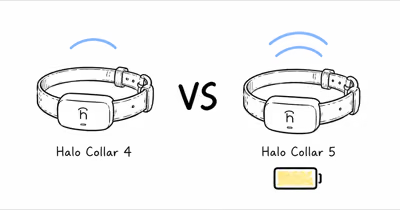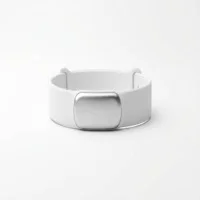
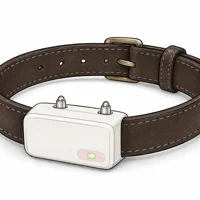
Halo is a GPS collar with custom boundaries on unlimited acreage + live tracking ($599+sub). PetSafe Stay+Play is RF-only, $279.95 no subscription, 3/4-acre max.
These two products solve the same problem differently. Halo uses satellite positioning. PetSafe uses radio signals from a base station. That difference shapes everything: price, coverage, flexibility, and what happens if your dog actually escapes.
- Halo Collar 4 starts at $599 with plans from $4.49/month; PetSafe Stay+Play costs $279.95 with zero recurring fees
- Halo covers unlimited acreage with GPS-drawn boundaries; PetSafe maxes out at 3/4 acre in a fixed circle
- Halo doubles as a live GPS tracker so you can find your dog if they escape; PetSafe has no tracking capability
- PetSafe works indoors and in dense tree cover where GPS signals struggle; Halo needs open sky for accuracy
- Both collars weigh under 2.5 oz and are rechargeable, but Halo offers 15 correction levels vs PetSafe’s 5
How Do These Two Systems Actually Work?
The core technology difference matters more than any spec sheet comparison.
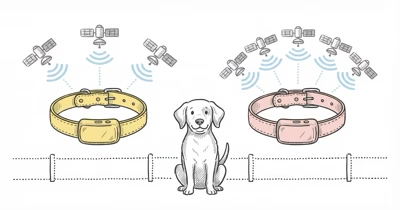
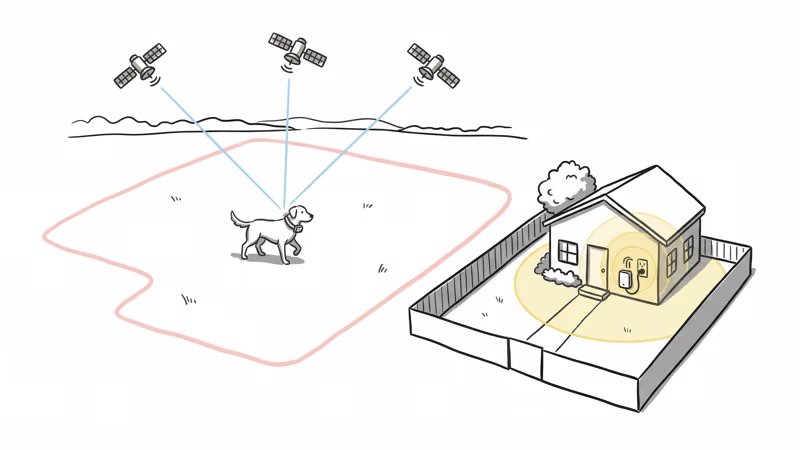
Halo Collar is a standalone GPS device your dog wears. It connects to GPS, GLONASS, and Galileo satellites plus LTE cellular networks.
You draw fence boundaries on the Halo app in any shape you want. Our Halo Collar review covers the full feature set. The collar knows its own position and triggers warnings when your dog approaches a boundary you’ve set. No base station needed.
PetSafe wireless fences work like a Wi-Fi router for your yard.
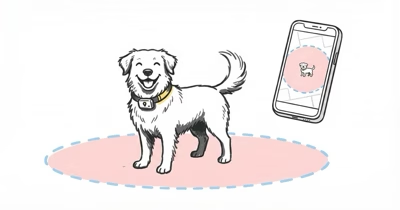
A transmitter plugged into an outlet broadcasts a radio signal in a circle. Your dog wears a receiver collar that picks up that signal. When they reach the edge of the broadcast range, they get a warning tone followed by a static correction. The boundary is always circular, always centered on the transmitter.
On large, open properties of an acre or more, GPS-based systems like Halo work best, since they rely on a clear view of the sky.
Halo’s GPS boundary accuracy depends on satellite view. Open sky gives GPS its best chance; tree lines, roof cover, and terrain reduce the quality of the fix.
Radio-based systems like PetSafe are more reliable in smaller yards with trees, buildings, or terrain that can interfere with satellite signals, because a radio boundary holds regardless of overhead obstructions that would weaken a GPS fix. The AKC’s GPS dog fence guide notes that satellite signals are affected by tree canopy, tall buildings, and the angle of satellites in the sky.
Halo Collar vs PetSafe Stay+Play: At a Glance
⇄ Head-to-head
Halo Collar 5 vs PetSafe Stay+Play
- +Unlimited acreage with GPS-drawn custom boundaries
- +Doubles as a live GPS tracker -- find your dog if they escape
- +Up to 20 fence zones, plus Keep Out Zones for pools/gardens
- +Cesar Millan video training built in
- +15 correction levels (tone / vibration / static)
- +Activity + sleep tracking
- +$279.95 one-time -- less than half Halo's first-year cost
- +Zero subscription fees
- +Works under heavy tree cover + buildings (RF, not GPS)
- +2-3 week battery per charge
- +15-minute plug-and-play setup
- +Cheaper additional collars ($189-$229 vs $599)
- −$599 device + $4.49-7/mo subscription required
- −GPS accuracy degrades under dense tree cover
- −~20-hour battery (vs PetSafe's 2-3 week collar)
- −Cellular dependency for real-time tracking
- −Max 3/4 acre coverage
- −Circular boundary only (no custom shapes)
- −No GPS tracking -- can't find dog if they escape the zone
- −5 correction levels (vs Halo's 15)
- −Power outage = boundary disappears
- ·Best for properties over 1 acre or irregular shapes
- ·Best when you need to track your dog OFF property
- ·Best for owners wanting activity + health monitoring
- ·Best for standard suburban yards under 3/4 acre
- ·Best for multi-dog households (cheaper additional collars)
- ·Best for wooded yards where GPS struggles
- ·Best for renters / travelers (transmitter is portable)
2-Year Total Cost of Ownership
This is where the real gap shows up.
| Cost Component | Halo Collar 4 | PetSafe Stay+Play |
|---|---|---|
| Device | $599 | $279.95 |
| Subscription (24 months) | $107.76 ($4.49/mo) | $0 |
| Additional collar | about $599 (second collar) | $189 - $229 |
| Total (1 dog, 2 years) | $706.76 | $279.95 |
| Total (2 dogs, 2 years) | about $1,306 | $469 - $509 |
For a single dog over two years, Halo costs roughly $427 more than PetSafe. That premium buys you GPS tracking, custom boundaries, and activity monitoring. Whether that’s worth it depends entirely on your property and your dog.
Where Halo Wins
Unlimited Coverage for Large Properties
If you have more than an acre, PetSafe is simply not an option. Halo’s GPS boundaries work on 5 acres, 50 acres, or 500 acres. You draw the fence on your phone, and the collar enforces it. No transmitter range limits.
Halo’s fence-size guidance puts the ceiling around 1,200 square miles, far beyond normal yards or ranch parcels.
Real-Time GPS Tracking
This is the feature PetSafe can’t match at any price. If your dog escapes, Halo shows you their live location on a map. PetSafe only tells you the dog left the zone. It can’t tell you where they went.
For dogs that are flight risks or live near busy roads, GPS tracking isn’t a nice-to-have. It’s the whole point.
Custom Boundary Shapes
PetSafe’s circle works fine for square yards. But most properties aren’t perfect circles.
Halo lets you trace your actual property line, exclude the garden, block off the driveway, and create up to 20 separate zones. You can also set “Keep Out Zones” for areas like pools or compost bins.
Built-In Training Program
Halo includes a full training program with videos from Cesar Millan.
PetSafe gives you a set of boundary flags and a manual. If you’ve never used an electronic containment system before, Halo’s structured guidance makes the introduction process less stressful for both you and your dog.
Where PetSafe Wins
Lower Cost, No Subscription
At $279.95 with zero monthly fees, PetSafe is less than half the first-year cost of Halo. For families who just need a basic yard boundary, the PetSafe Stay+Play does the job without the ongoing expense.
Additional PetSafe collars ($189-$229) are also far cheaper than buying a second Halo collar. Multi-dog households save significantly here.
Works Where GPS Doesn’t
GPS needs a clear view of the sky. Dense tree canopy, tall buildings, and covered patios can all degrade Halo’s accuracy. PetSafe’s radio signal doesn’t care about satellite coverage. It works in your basement, under a patio roof, or in a heavily wooded backyard.
According to GPS.gov, civilian GPS is accurate to about 4.9 meters under open sky. Under tree cover, that margin gets worse. PetSafe’s boundary is consistent regardless of overhead obstructions.
Simpler Setup
PetSafe setup is simpler. Plug in the transmitter, turn the dial to set your boundary radius, put the collar on your dog. Done.
Halo requires downloading the app, creating an account, walking your property perimeter to draw boundaries, configuring correction levels, and activating the cellular plan. It’s not difficult, but it takes longer and involves more steps.
No Cellular Dependency
PetSafe works during power outages (the collar’s battery keeps enforcing the boundary for hours).
Halo relies on cellular networks for tracking and some features. If cell service goes down or you’re in a dead zone, Halo’s GPS tracking stops working. The geofence corrections may still work via satellite, but you lose real-time monitoring. According to Halo’s support documentation, the collar stores up to 20 fence boundaries locally, so corrections continue even without cellular signal.
Training Tips for Either System
Regardless of which system you pick, the introduction process matters more than the hardware. Dogs don’t understand invisible boundaries intuitively. They’ve to learn them.
- Let your dog wear the collar turned off for 3-5 days first.
Get them used to the weight before adding corrections.
-
Start with tone-only mode. Both Halo and PetSafe support audio warnings without static correction. Use this for the first week.
-
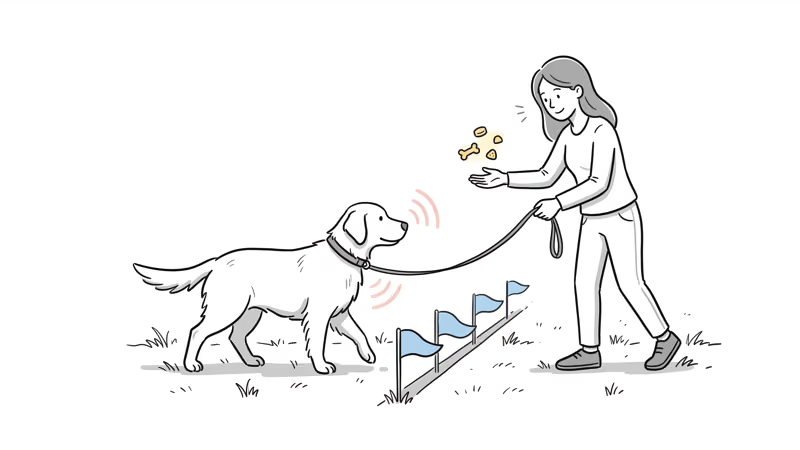
Walk the boundary on-leash at least twice daily during the first two weeks.
When the warning triggers, guide your dog back and reward them.
-
Use visual markers. PetSafe includes boundary flags. For Halo, place your own flags along the GPS boundary line.
-
Keep sessions short. 10-15 minutes, 3-4 times per day.
Don’t leave your dog unsupervised during the learning phase.
- Never force your dog through the boundary. This creates fear associations that undermine the whole system.
The Humane Society recommends that all boundary training be positive-reinforcement-based, with static corrections used only as a last resort at the lowest effective level.
Important: Wireless fences don’t keep other animals or people out of your yard. They’re containment systems, not security systems. Never leave your dog unsupervised outdoors relying solely on an invisible fence.
Which Dogs Are Good Candidates?
Not every dog is suited for a wireless fence. Here’s what tends to work and what doesn’t.
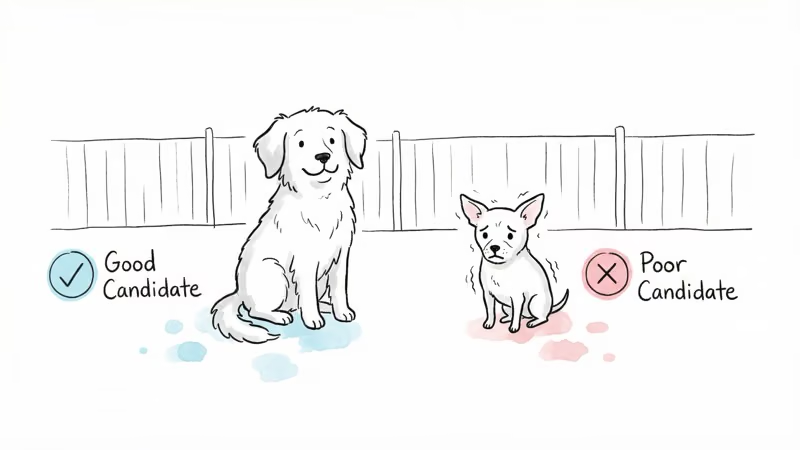
Good candidates:
- Dogs over 10 lbs who respond to correction cues
- Dogs with moderate energy who respect boundaries after training
- Dogs in yards where physical fencing isn’t practical (HOA restrictions, rental properties, large acreage)
- Dogs already comfortable with wearable tracking devices
Poor candidates:
- Dogs under 10 lbs (collar corrections may be inconsistent)
- Highly prey-driven breeds that will blast through any correction when chasing something
- Dogs with anxiety disorders (the correction can worsen anxiety)
- Aggressive dogs (the AVMA notes that electronic collars can increase frustration in aggressive dogs)
If you’re unsure, consult a trainer experienced with electronic containment before purchasing either system. A professional evaluation costs $50-$150 and can save you from buying a $600 collar your dog can’t use.
Bottom Line
For most suburban dog owners with a standard yard, PetSafe Stay+Play is the practical choice. It costs less than half of Halo, requires no subscription, and works reliably in the spaces most people actually have.
Pick Halo Collar if you need GPS tracking, custom boundaries on a large property, or you want the peace of mind of knowing exactly where your dog is at all times. The premium is steep, but for the right situation, it’s justified. If you’re deciding between Halo and other GPS smart collars like Fi, our comparison breaks down the differences.
Frequently Asked Questions
Can a dog run through a Halo or PetSafe wireless fence?
Yes, a motivated dog can push through either system. Halo and PetSafe both rely on a correction stimulus, and some dogs will tolerate it if they’re chasing a squirrel or another animal. Proper training reduces this risk, but no invisible fence is 100% escape-proof. Start with tone-only mode and gradually introduce the lowest effective correction level.
Does Halo Collar work without cell service?
Partially. The GPS geofence corrections use satellite positioning, which works independently of cell towers. But real-time tracking, app notifications, and remote updates all require an active cellular connection. In a dead zone, you’ll still get boundary corrections but won’t be able to monitor your dog from your phone.
How long do the batteries last on each system?
Halo Collar 4 lasts about 20 hours on a full charge with GPS active. PetSafe’s rechargeable collar runs 2-3 weeks per charge since it only needs to detect the RF signal. If battery life is a priority, PetSafe wins by a wide margin.
Can I use PetSafe wireless fence while traveling or camping?
Yes. The PetSafe transmitter is portable. Plug it into any outlet and it creates the same circular boundary. This makes it useful for RV trips, vacation rentals, or visiting family. Halo works anywhere with cellular coverage, no outlet required, which gives it an edge for true off-grid camping.
Are wireless dog fences safe for puppies?
Most manufacturers, including both Halo and PetSafe, recommend waiting until a dog is at least 6 months old and weighs over 10 lbs. Puppies under 6 months don’t have the cognitive development to understand boundary training, and the collar may be too heavy for very small breeds.
What happens if the power goes out with PetSafe?
The transmitter stops broadcasting, so the boundary disappears. Your dog’s collar won’t trigger any corrections. However, most trained dogs still respect the boundary from habit for a while. Halo doesn’t have this problem since it runs on battery and satellites. Consider a standalone GPS pet tracker as a backup if power outages are common in your area.
Can I combine a Halo Collar with a PetSafe fence?
Technically yes, but it’s not recommended. Running two separate correction systems can confuse your dog and create conflicting boundary signals. If PetSafe’s range isn’t enough, upgrade to Halo rather than layering both. If Halo’s GPS accuracy is spotty under tree cover, PetSafe is the better standalone choice for that environment.