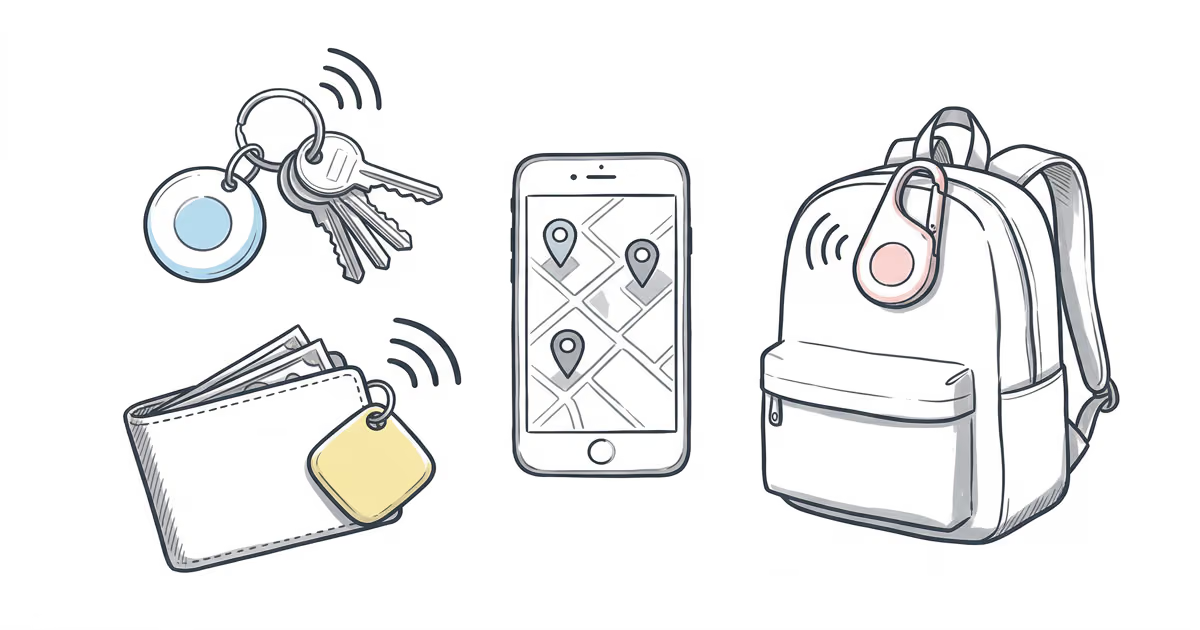
The Apple AirTag 2 is the best lost item tracker for iPhone users in 2026. For Android, the Samsung SmartTag 2 or Chipolo Pop are the top picks. All three use crowd-sourced networks to locate items beyond Bluetooth range, cost under $35, and last at least a year on a single battery.
Americans lose an average of 9 items per day according to a Tile-commissioned survey, spending roughly 2.5 days per year searching. A $29 lost item tracker eliminates most of that wasted time. But the market has changed fast. Products that dominated two years ago are discontinued or outdated, and the technology has split into two clear camps.
I've tracked the lost item tracker market for several years now. Here's what's actually worth buying in 2026.
- Apple AirTag 2 ($29) is the best tracker for iPhone users with Precision Finding via ultra-wideband.
- Samsung SmartTag 2 ($25) is the best option for Galaxy phone owners with AR directional guidance.
- Chipolo Pop ($28) works with both Apple Find My and Google Find Hub, making it the most versatile cross-platform choice.
- All modern trackers use crowd networks of billions of devices, not just direct Bluetooth range.
- No lost item tracker uses GPS. They all rely on Bluetooth and crowd-sourced networks to determine location.
How Lost Item Trackers Work
Lost item trackers don't contain GPS chips. None of them. This is the single biggest misconception in this product category.
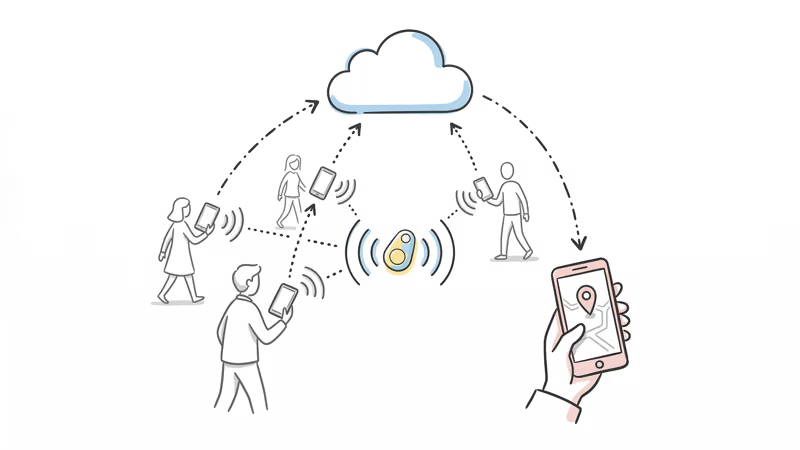
Instead, they use Bluetooth Low Energy (BLE) to communicate with nearby smartphones. When your tracker is within Bluetooth range (typically 30-120 meters depending on the model), your phone connects directly and shows its location. You can make the tracker play a sound to find it under couch cushions or buried in a bag.
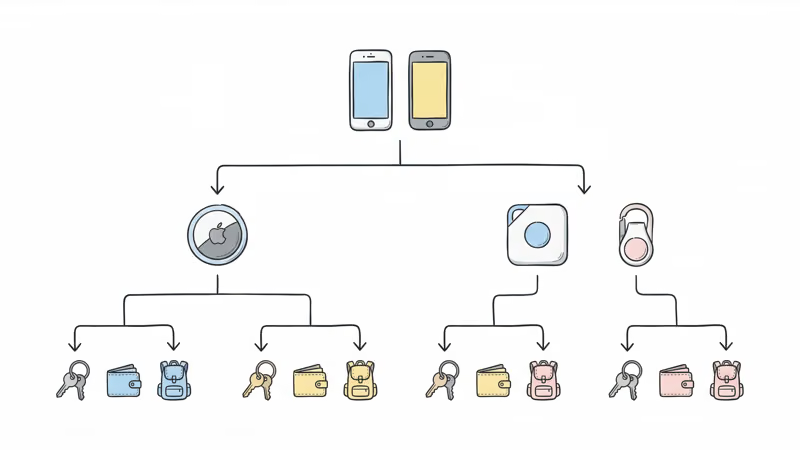
When the tracker is out of your Bluetooth range, that's where crowd networks take over. Every iPhone running iOS 14.5 or later acts as an anonymous relay for Apple's Find My network. If anyone's iPhone passes near your lost AirTag, it silently picks up the Bluetooth signal and reports the encrypted location back to Apple's servers. Samsung's SmartThings Find and Google's Find Hub work the same way for their respective ecosystems.
The practical difference between trackers comes down to three things: network size, precision finding technology, and ecosystem lock-in.
The 6 Best Lost Item Trackers for 2026
1. Apple AirTag 2
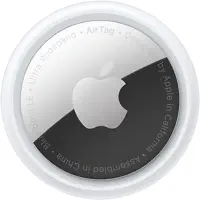
The AirTag 2 is the tracker to beat. Apple's Find My network spans over 2 billion active devices worldwide, which means your lost item can be detected almost anywhere there's foot traffic. The ultra-wideband chip enables Precision Finding on iPhone 11 and later: your phone shows an arrow pointing directly at the tracker with distance measured in feet.
The second-generation AirTag improved speaker volume and added a visionOS integration, but the core tracking technology remains largely the same as the original. At $29 with no subscription, it's hard to argue against. Read the full AirTag review for testing details.
The catch: AirTag only works with iPhones. Android users can detect an unknown AirTag near them (Apple added cross-platform tracker detection for anti-stalking), but you can't use an AirTag as your own tracker with an Android phone.
2. Samsung SmartTag 2
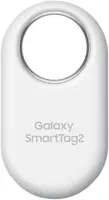
Samsung's answer to the AirTag. The SmartTag 2 has ultra-wideband for AR-guided directional finding on newer Galaxy phones and a 500-day battery life that outlasts the AirTag by a wide margin. The compass view shows direction and distance, similar to Apple's Precision Finding.
The SmartThings Find network is smaller than Apple's, but Samsung has been expanding it aggressively. The SmartTag 2 also has a built-in keyring hole, so you don't need to buy a separate holder. For a deeper comparison, see our AirTag vs SmartTag breakdown.
Limitation: SmartTag 2 only works with Samsung Galaxy devices for full functionality. Other Android phones can't use it.
3. Chipolo Pop
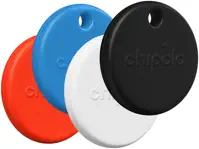
The Chipolo Pop replaced the discontinued Chipolo ONE Spot. Its main advantage: you choose between Apple Find My or Google Find Hub at setup. That makes it the only tracker that works well across both ecosystems without buying ecosystem-specific hardware.
At 120 dB, the Chipolo Pop is the loudest tracker on this list. That matters when your keys are buried under coats or stuffed in a bag. The trade-off: IPX5 water resistance (splash-proof) is weaker than the IP67 rating on AirTag and SmartTag 2. See the full Chipolo review for details.
One caveat: you pick one network at factory setup. Switching from Find My to Find Hub (or vice versa) requires a factory reset.
4. Tile Pro 2024
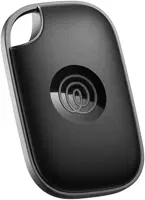
Tile was the original lost item tracker company, and the Tile Pro still has the longest direct Bluetooth range at about 150 meters (500 feet). That's roughly twice the range of an AirTag. It works with both iOS and Android through the Tile app.
Tile's crowd network is smaller than Apple's or Samsung's. The company knows this and has been partnering with Amazon Sidewalk and Life360 to expand coverage. Free basic tracking is included, but Tile Premium ($3/month) adds 30-day location history and smart alerts. Check our Tile tracker review and AirTag vs Tile comparison for the full picture.
5. Pebblebee Clip 5
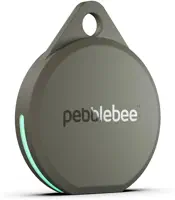
The Pebblebee Clip 5 solves the dead-battery problem. Instead of replacing a coin cell, you recharge it via USB-C about once a year. Like the Chipolo Pop, it supports either Apple Find My or Google Find Hub (pick one at setup, factory reset to switch).
The built-in clip attaches directly to bags, zippers, and keychains without needing a separate holder. At 150 meters of Bluetooth range, it matches the Tile Pro. Read our Pebblebee review for long-term testing notes.
6. Tile Mate 2024
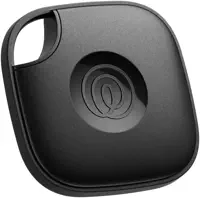
If you want a tracker you can attach and forget for three years, the Tile Mate 2024 is the simplest option. The sealed battery is not replaceable, but it lasts about 3 years before you need to buy a new unit. At $25, that works out to roughly $8 per year. No charging, no battery swaps.
Range is shorter at 76 meters (250 feet) compared to the Tile Pro, but for keys that are usually somewhere in your house, that's plenty.
Quick Comparison
| Tracker | Price | Battery | Range | Water | Works with |
|---|---|---|---|---|---|
| AirTag 2 | $29 | CR2032, ~1 yr | 120m | IP67 | iPhone only |
| SmartTag 2 | $25 | CR2032, ~500 days | 120m | IP67 | Galaxy only |
| Chipolo Pop | $28 | CR2032, ~1 yr | 60m | IPX5 | Find My or Find Hub |
| Tile Pro | $35 | CR2032, ~1 yr | 150m | IP67 | iOS and Android |
| Pebblebee Clip 5 | $30 | USB-C, ~12 mo | 150m | IPX6 | Find My or Find Hub |
| Tile Mate | $25 | Sealed, ~3 yr | 76m | IP67 | iOS and Android |
How To Choose the Right Tracker
Your phone decides most of the choice for you.
- AirTag 2 is the default pick. Precision Finding, biggest network, no subscription
- Chipolo Pop if you want 120 dB alerts or plan to switch to Android later
- Samsung SmartTag 2 if you have a Galaxy phone
- Tile Pro or Pebblebee Clip 5 if you have a non-Samsung Android
- Chipolo Pop for Google Find Hub network access
Beyond phone compatibility, consider these factors:
- What you're tracking: Keys and wallets need a compact tracker. Luggage benefits from the longest-range option available.
- Sound volume: If you need to hear the tracker through bags or from another room, the Chipolo Pop at 120 dB is significantly louder than the AirTag.
- Battery preference: Replaceable CR2032 (AirTag, SmartTag 2, Tile) vs rechargeable USB-C (Pebblebee) vs sealed 3-year (Tile Mate).
- Water resistance: IP67 (AirTag, SmartTag 2, Tile) survives submersion. IPX5/IPX6 (Chipolo, Pebblebee) handles splashes only.
Lost Item Trackers vs GPS Trackers
If you need to track a car, a pet, or a person in real time, a Bluetooth lost item tracker won't do the job. These devices don't know their own location. They depend entirely on nearby smartphones to relay their position.
For real-time tracking with live coordinates, you need a GPS tracker. GPS trackers have their own satellite receivers and cellular modems. They cost more (typically $20-170 for the device plus $5-50/month in subscription fees), but they provide continuous, accurate location data anywhere with cell coverage. See our guide to Bluetooth vs GPS trackers for a detailed comparison.
5 Tips for Getting the Most From Your Tracker
- Put trackers on things you lose, not things you don't. Sounds obvious, but most people buy a 4-pack and track things they never actually misplace. Start with your keys and wallet.
- Test the sound volume in your home. Ring the tracker from another room before you actually need it. If you can't hear it through a closed door, you'll know to check the sound settings.
- Replace batteries proactively. Don't wait for the low-battery alert. Set a calendar reminder for 10 months after inserting a CR2032. A dead tracker is just a sticker.
- Enable separation alerts. Most trackers can notify you when you leave an item behind. This prevents loss instead of just helping you recover afterward.
- Register your tracker in the app. If someone finds your lost item, a registered tracker lets Good Samaritans contact you through the app without seeing your personal information.
Bottom Line
Lost item trackers have matured into a three-ecosystem race: Apple Find My, Samsung SmartThings Find, and Google Find Hub. The tracker you buy should match the phone you carry. For most iPhone users, the AirTag 2 at $29 with no subscription is the easy answer. Galaxy users should grab the SmartTag 2. Everyone else should look at Tile or Chipolo Pop. The technology gap between brands has narrowed. What separates them now is network size and ecosystem integration.
FAQ
What is the best lost item tracker overall?
The Apple AirTag 2 for iPhone users and the Samsung SmartTag 2 for Galaxy users. Both offer ultra-wideband precision finding, IP67 water resistance, and access to the two largest crowd-sourced tracking networks. For cross-platform use, the Chipolo Pop works with either Apple Find My or Google Find Hub.
Do lost item trackers use GPS?
No. Despite the common misconception, no consumer lost item tracker contains a GPS chip. They use Bluetooth Low Energy to communicate with nearby smartphones, which then report the tracker's location via crowd-sourced networks. For actual GPS tracking, you need a dedicated GPS tracker with a cellular subscription.
How far can a lost item tracker reach?
Direct Bluetooth range varies from 60 meters (Chipolo Pop) to 150 meters (Tile Pro, Pebblebee Clip 5). Beyond that range, the tracker relies on other people's phones to detect it. In a busy city, a lost AirTag might update its location every few minutes through passing iPhones. In a rural area with no foot traffic, it could go silent for hours or days.
Can someone track me with a lost item tracker?
Apple, Samsung, and Google have all implemented anti-stalking protections. Unknown trackers traveling with you trigger automatic alerts on both iPhone and Android. The tracker will also play a sound after being separated from its owner for an extended period. These protections apply across platforms.
Do I need a monthly subscription for a lost item tracker?
AirTag, SmartTag 2, Chipolo Pop, and Pebblebee all work fully without any subscription. Tile offers free basic tracking, but Tile Premium ($3/month or $30/year) adds 30-day location history, smart alerts, and free battery replacements.
How long do lost item tracker batteries last?
Most use a CR2032 coin cell battery lasting about 1 year. The Samsung SmartTag 2 claims up to 500 days. The Tile Mate 2024 has a sealed 3-year battery that cannot be replaced. The Pebblebee Clip 5 uses a rechargeable battery via USB-C lasting about 12 months per charge.
Can I put a lost item tracker in checked luggage?
Yes. The FAA has confirmed that Bluetooth trackers like AirTags are permitted in checked luggage. The CR2032 battery falls below the lithium content threshold for air travel restrictions. Many travelers use them specifically for luggage tracking. See our AirTag in checked luggage guide for details.