The Pawscout Smart Pet Tag costs $19.95 with no monthly fee, but its proprietary community network is far smaller than Apple's Find My or Tile's Life360. It works in dense urban areas where Pawscout users are common and falls short in suburbs. Most pet owners should spend $9 more on AirTag 2 for access to over 1 billion Find My devices.
The Pawscout Smart Pet Tag has been on sale since 2015, positioned as a community-powered alternative to GPS trackers for pets. In 2026, the same $20 Bluetooth tag competes against AirTag 2 and Tile Pro, both of which ride on networks of hundreds of millions of phones. This review looks at whether the community model still holds up and who actually benefits from choosing Pawscout over the mainstream options.
- $19.95 MSRP with zero monthly fees — same price as Tile Mate, $9 less than AirTag 2
- Proprietary Pawscout community app — not part of Apple Find My, Google Find Hub, or Tile’s Life360 network
- 300 ft Bluetooth range with IPX7 water resistance — Class 1 Bluetooth, no UWB precision finding
- CR2032 coin-cell battery — vendor rates 6-12 months, not rechargeable
- Coverage depends on local app density — good in parts of NYC or LA, near-zero in most suburbs
What the Pawscout Tag Actually Is
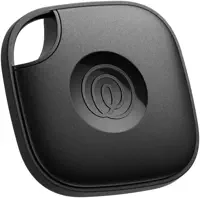
At its core, the Pawscout tag is a small plastic Bluetooth beacon that clips to a dog or cat collar. It pairs with the free Pawscout app on iOS or Android and broadcasts a signal that any other Pawscout user within roughly 300 feet can anonymously pick up. When your pet goes missing, the app notifies you if a nearby user pings the tag, so you can walk toward the last known location and call for them.
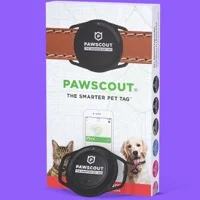
Hardware-wise, the tag is simple. No GPS, no cellular radio, no UWB precision finding. It’s a Bluetooth Low Energy beacon with a user-replaceable coin cell, nothing more.
What makes it useful beyond a dumb tag is the Pawscout app.
The app stores a digital pet profile with photos, vaccination records, medical notes, and a walk log, and it shows a community-activity map for your region. Setup is a standard app-pairing flow on either iOS or Android.
Architecturally, this is the key distinction from AirTag and Tile: Pawscout runs a closed network rather than piggybacking on an operating-system-level network. For a deeper look at the technology split, see our Bluetooth vs GPS trackers explainer.
How Does the Pawscout Community Network Work?
Here’s the mechanic. Your tag broadcasts a short Bluetooth identifier every few seconds, and any phone running the Pawscout app within range anonymously logs that identifier along with its location. If you mark your pet as lost in the app, nearby users receive an alert and the app shows you the most recent ping location.
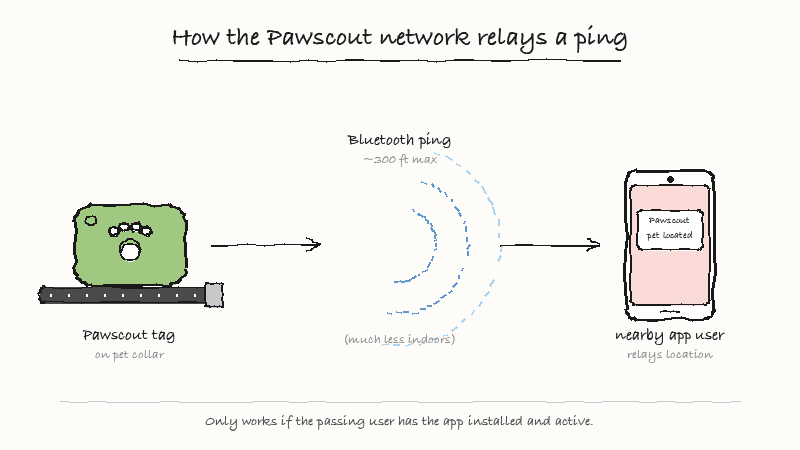
The 300-foot range is a standard Class 1 Bluetooth spec. According to the Bluetooth SIG technical brief on range, real-world distances vary dramatically with obstructions; indoor walls, fences, foliage, and parked cars can cut the useful distance sharply. That matters because a lost pet usually ends up behind an obstacle, and the signal degrades fast.
Here’s where the model starts to creak. The Pawscout network only includes people who installed the Pawscout app.
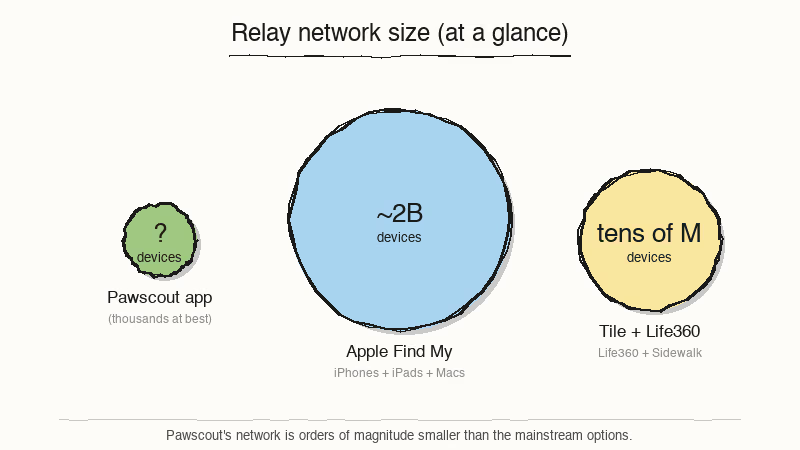
Apple’s Find My taps every iPhone on the planet automatically, and Tile uses Amazon Sidewalk plus Life360. Pawscout needs a specific user, with the specific app active in the background, to be within Bluetooth range of your lost tag. That’s a high coverage floor for a small user base to clear.
Does the Coverage Map Actually Help You Find a Lost Pet?
The honest answer is: sometimes, depending almost entirely on where you live. The Pawscout app shows an active-user density map, and it varies wildly between regions.
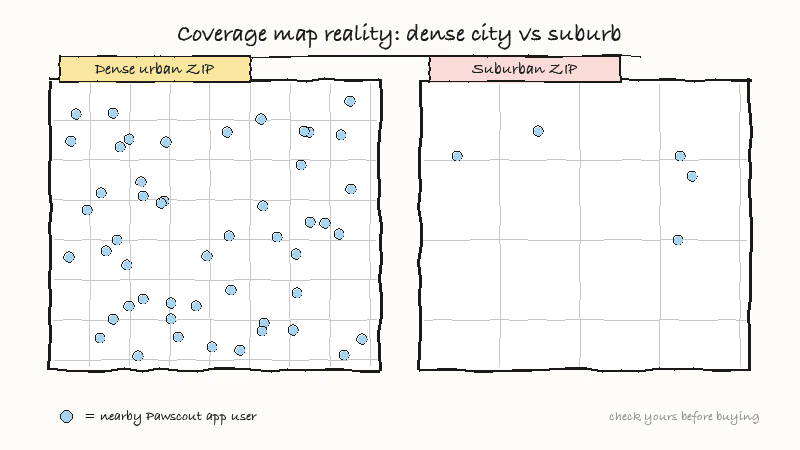
Vetstreet’s original hands-on assessment reported that the tracker worked well in the tested area but noted “virtually no users in some areas” of the country, and recommended checking the coverage map before buying.
That assessment from 2017 still holds in 2026, and the gap against the mainstream networks has grown rather than narrowed. Geekspin’s hands-on range test similarly found that the Bluetooth range held up outdoors but dropped sharply with walls or foliage, which matters for an escaped pet hiding under a porch. Their review flagged that “Bluetooth is not the best way to find a lost dog” because it assumes the pet passes near a participating app user.
For context, the American Humane Association reports that over 10 million pets go missing each year in the United States.
Before you buy a Pawscout tag, open the Pawscout app store listing and check user activity in your ZIP code. If the community map shows a handful of dots or none at all, the tag will work as a no-network Bluetooth beacon at best. In dense neighborhoods where the app has traction, it can truly help; that’s the one use case where this product holds up against the alternatives.
Pawscout vs AirTag vs Tile: Networks and Price Compared
Here’s the comparison that matters most for a 2026 buyer. The three tags sit at similar price points, but their networks aren’t in the same league.
| Feature | Pawscout Smart Tag | Apple AirTag 2 | Tile Mate (2024) |
|---|---|---|---|
| Price | $19.95 | $29 | ~$25 |
| Monthly fee | None | None | None (Premium optional) |
| Network | Pawscout app users | Apple Find My (1B+ devices) | Life360 + Amazon Sidewalk |
| Precision Finding (UWB) | No | Yes (iPhone 11+) | No |
| Bluetooth range | ~300 ft | ~200 ft | ~350 ft |
| iOS | Yes | Yes | Yes |
| Android | Yes | Limited (no Find My) | Yes |
| Pet-specific app features | Yes (profiles, walks, medical) | No | No |
Apple confirms that over 1 billion iPhones, iPads, and Macs anonymously relay AirTag signals, according to the Find My support documentation. That’s the number to beat, and Pawscout isn’t in the ballpark.
The practical gap is wide. AirTag 2’s UWB Precision Finding delivers directional arrows from noticeably farther out than the original AirTag, something no non-UWB tag can match. Tile Pro, by contrast, flags only a general location through the Life360 network and gives no directional guidance. Pawscout, with its proprietary app-only network, lights up only if a fellow app user happens to walk past your lost pet.
 Best Value
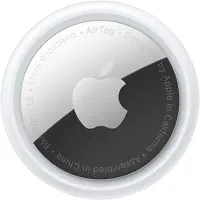
For most readers, the answer is AirTag 2 (iPhone household) or Tile Mate (Android household). The $9 price gap between Pawscout and AirTag 2 isn’t large enough to pick a proprietary network over Find My in any household with an iPhone user.
Who Should Buy the Pawscout
The Pawscout fits a narrow set of readers. If you land in one of these profiles, the $20 tag is a reasonable buy. If not, stop reading and pick AirTag 2 or Tile Mate.
Buy the Pawscout if…
- You live in a dense urban area (NYC, LA, SF, Boston, Chicago, Seattle) and the Pawscout app shows active users on your ZIP code coverage map before purchase
- You refuse to participate in Apple Find My or Amazon Sidewalk for privacy reasons and want a pet-specific app outside those ecosystems
- You want the pet-centric app features (vaccination records, walk logs, digital pet profile) enough to tolerate a smaller network
- You already know the Bluetooth range limit and treat the tag as a short-range ID, not a real tracker
Skip the Pawscout if…
- You live in a suburban or rural area where the coverage map is thin; Find My or Life360 will outperform Pawscout there by orders of magnitude
- You have an iPhone in the household (buy AirTag 2, the math isn’t close)
- You want real-time GPS tracking for an escape-prone pet (see our GPS trackers for pets guide)
- You need directional finding indoors (AirTag 2’s UWB Precision Finding is the only sub-$50 tag that offers this)
Pawscout Pros and Cons at a Glance
For a quick scan, here’s how the tag lands on both sides of the ledger.
Pawscout Smart Pet Tag
- $19.95 with zero subscriptions or hidden fees
- Pet-specific app with digital ID, medical records, walk logs
- Outside the Apple and Amazon ecosystems for privacy-minded buyers
- Replaceable CR2032 battery keeps long-term cost near zero
- IPX7 water resistance handles rain, splashes, and short puddles
- Proprietary community network is tiny compared to Find My or Life360
- Coverage is highly dependent on local app density; unreliable in suburbs
- No UWB Precision Finding, no real-time GPS, no cellular relay
- Bluetooth range drops sharply behind walls, fences, or foliage
- Only $9 cheaper than AirTag 2, which buys access to over 1 billion devices
Readers who don’t fit the “dense urban + privacy-motivated + pet-app features” profile will be better served by the mainstream alternatives. Our best Bluetooth tracker guide and AirTag alternatives list cover the broader field for owners willing to step outside Pawscout’s narrow privacy niche.
Bottom Line
The Pawscout Smart Pet Tag is a competent $20 Bluetooth beacon with a useful pet-specific app. It’s held back by a proprietary network that can’t match Apple Find My or Tile’s Life360. Buy it only if you live in a dense city with real coverage, or if you need to stay outside the Apple and Amazon ecosystems. Most pet owners should spend $9 more on AirTag 2. For escape-prone pets, step up to a GPS trackers for pets pick instead.
FAQ
Is Pawscout still selling tags in 2026?
Yes. As of April 2026, the Pawscout Smart Pet Tag version 2.5 is in stock at Walmart, Chewy, the official pawscout.com store, and on Amazon under ASIN B084Q36G7C. The company has been operating since 2015 and continues to maintain the app on iOS and Android. The product itself is mature rather than actively evolving.
How is Pawscout different from AirTag?
AirTag uses Apple's Find My network, which anonymously relays location through an estimated over 1 billion iPhones, iPads, and Macs. Pawscout runs its own proprietary network that only includes phones with the Pawscout app installed. AirTag also supports UWB Precision Finding on iPhone 11 and later, giving you directional arrows at close indoor range. Pawscout has no UWB and no equivalent feature.
Does Pawscout require a subscription?
No. The $19.95 tag is a one-time purchase and the Pawscout app is free. There are no monthly fees, no premium tier, and no hidden charges. This is one of the tag's cleanest selling points and matches what AirTag and Tile Mate offer on the pricing side.
What is the Pawscout community network, and how large is it?
It's a closed network of Pawscout app users who passively relay tag pings. Pawscout doesn't publish exact user counts, so the best way to gauge density is to install the app and check the community map for your area before buying. In dense urban ZIP codes the network can show visible activity; in suburban or rural areas it often shows near-zero. Compared with Apple Find My (over 1 billion devices) or Life360 (tens of millions of active users), Pawscout's user base is orders of magnitude smaller.
How long does the Pawscout battery actually last?
Pawscout rates the CR2032 coin cell at 6-12 months. Third-party reviewers have reported outcomes ranging from a few weeks on early units to close to a year on recent v2.5 hardware. The battery is user-replaceable, so long-term cost stays near zero. For context, AirTag 2 targets roughly 12 months on the same cell size, and Tile Mate 2024 targets about 1 year.
Can Pawscout track my pet's location in real time?
No. Pawscout is Bluetooth only, so it shows the last location where any Pawscout user's phone passed within Bluetooth range of the tag. If no user passes nearby, the location doesn't update. For real-time tracking with live GPS coordinates, you need a cellular GPS tracker, not a Bluetooth tag.
What happens when my lost pet is out of Bluetooth range and no Pawscout users are nearby?
The tag won't report a new location until another Pawscout app user comes within Bluetooth range, which in sparse areas may never happen. This is the core reliability gap between Pawscout and the bigger networks. A lost pet more than a few blocks from a Pawscout-dense area is effectively invisible to the system until chance brings a participating user close. AirTag 2 or Tile Mate will typically ping against a passing phone within minutes in the same scenario.