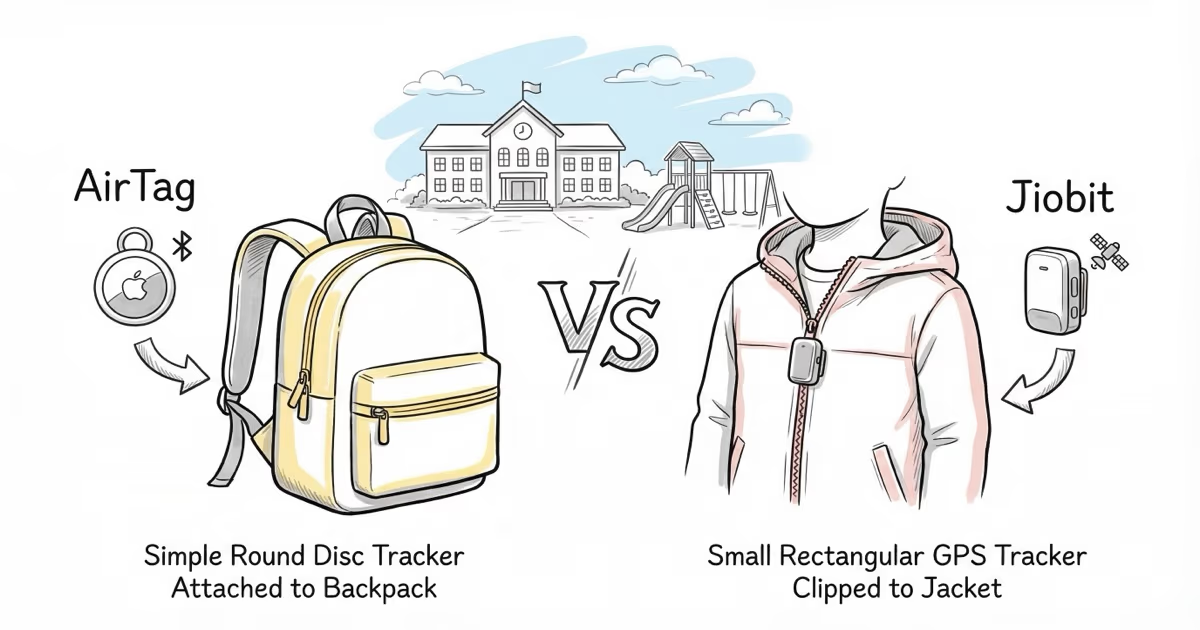
Jiobit is the better tracker for kids who leave the house without a parent. It uses GPS, cellular, and Wi-Fi to report your child's location in real time from anywhere with cell coverage. The AirTag only updates when a nearby iPhone detects it through the Find My network, which makes it unreliable in low-traffic areas like parks, playgrounds, and rural neighborhoods. However, AirTag costs $29 with zero subscription fees, while Jiobit runs $129.99 upfront plus $8.33 per month on an annual plan. If your child stays in dense urban or suburban areas and you use an iPhone, AirTag can work well enough at a fraction of the cost.
AirTag vs Jiobit is one of the most common comparisons parents search when choosing a kid tracker. Both devices are small enough to clip to a backpack or slip into a pocket, but they use fundamentally different technology. We tested both trackers over several weeks in school commute, after-school activity, and weekend outing scenarios to see how each performs when it matters most.
- Jiobit uses GPS + LTE + Wi-Fi for real-time location updates; AirTag relies on Bluetooth and Apple's crowdsourced Find My network
- AirTag 2 costs $29 with no monthly fee; Jiobit Gen 3 costs $129.99 plus $8.33/mo billed annually ($99.99/year)
- AirTag battery lasts about 1 year (replaceable CR2032); Jiobit battery lasts up to 10 days and requires recharging via cradle
- Jiobit works with both iPhone and Android; AirTag requires an iPhone or iPad running iOS 16.7 or later
- Neither device offers two-way calling or an SOS button, so neither replaces a kids' smartwatch for emergency communication
How AirTag and Jiobit Track Your Child
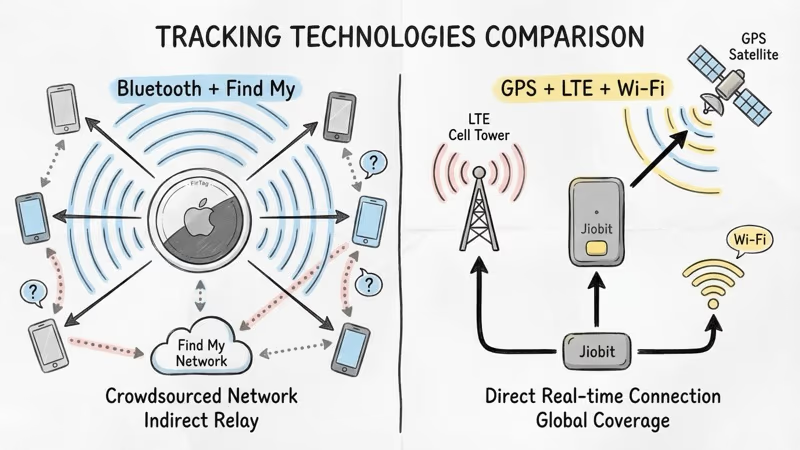
The technology gap between these two trackers is the single biggest factor in choosing one over the other.
The Apple AirTag is a Bluetooth item tracker. It broadcasts a Bluetooth Low Energy signal that nearby Apple devices in the Find My network detect anonymously. When an iPhone or iPad passes within range, it relays the AirTag's coordinates to iCloud. The AirTag 2 (released January 2026) upgraded the UWB chip to the U2, extending Precision Finding range from about 15 meters to roughly 60 meters. That is a real improvement for locating a backpack in a crowded school, but it still depends on proximity to an Apple device.
The Jiobit Gen 3 takes a different approach entirely. It contains a GPS receiver, a CatM1 cellular modem (5G-compatible), Wi-Fi, and Bluetooth. When your child moves, the Jiobit locks onto satellites and transmits location data through the cellular network to your phone. In our testing, location updates arrived every 1-3 minutes during active movement. The tracker does not need a nearby stranger's phone to function.
This distinction matters most in places where kids actually spend time. A suburban playground at 3 p.m. may have zero iPhones within Bluetooth range of your child's backpack. The AirTag would show a stale "last seen" timestamp. The Jiobit would show a live pin on the map.
Spec Comparison Table
| Feature | Apple AirTag 2 | Jiobit Gen 3 |
|---|---|---|
| Tracking technology | Bluetooth + UWB + Find My network | GPS + LTE (CatM1) + Wi-Fi + Bluetooth |
| Real-time tracking | No (crowdsourced, depends on nearby iPhones) | Yes (cellular connection) |
| Update frequency | Variable (seconds to hours) | Every 1-3 minutes when moving |
| Precision Finding range | ~60 m (200 ft) with UWB | N/A (uses GPS coordinates) |
| Battery | CR2032, ~1 year | Rechargeable, up to 10 days |
| Water resistance | IP67 (1 m, 30 min) | IPX8 (1.5 m, 30 min) |
| Weight | 11.8 g | 22.7 g (0.8 oz) |
| Dimensions | 31.9 mm diameter, 8 mm thick | 49.8 x 36.8 x 11.9 mm |
| Monthly cost | $0 | $8.33/mo (annual) or $16.99/mo (monthly) |
| Device price | $29 | $129.99 |
| Platform | iPhone/iPad only | iPhone and Android |
| Geofencing | Location alerts via Find My | Custom Safe Spaces with arrival/departure alerts |
| SOS / calling | No | No |
Battery Life and Maintenance
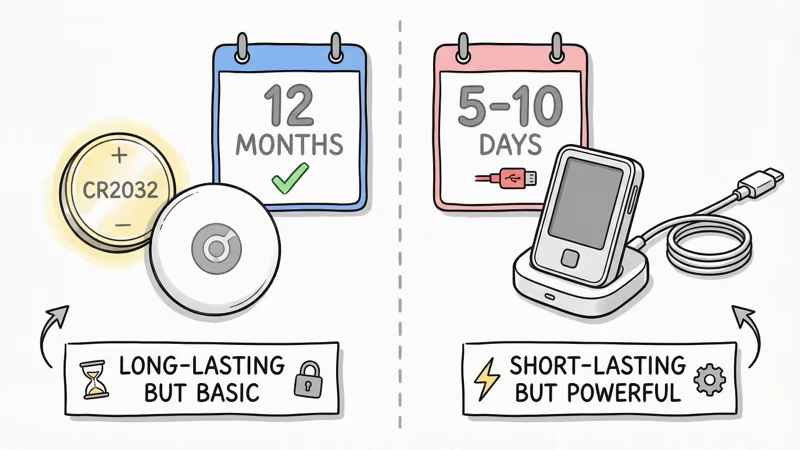
The AirTag runs on a CR2032 coin cell battery rated for about one year. When it dies, you twist off the back and swap the battery for $3-5. No cables, no charging cradle. The downside: the AirTag sends a low-battery notification only when the battery is nearly depleted. You could discover it is dead exactly when you need it most.
The Jiobit Gen 3 uses a rechargeable battery rated for up to 10 days between charges, though real-world use with frequent location polling shortened that to 5-7 days in our experience. Charging takes about 2 hours on the included magnetic cradle. The Jiobit app pushes alerts when the battery drops below 20%, giving you lead time to charge.
For a device attached to a child who may not remember to plug things in, AirTag's year-long battery is a clear advantage. But AirTag's long battery life exists because Bluetooth consumes far less power than GPS and cellular radios. Jiobit burns through energy faster because it is doing more work.
Cost Comparison: 2-Year Total Ownership
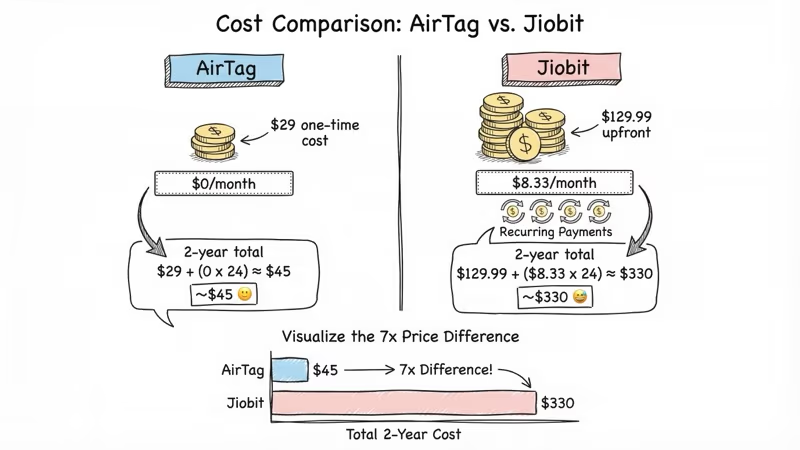
| Cost item | Apple AirTag 2 | Jiobit Gen 3 |
|---|---|---|
| Device | $29 | $129.99 |
| Year 1 subscription | $0 | $99.99 |
| Year 2 subscription | $0 | $99.99 |
| Battery replacement (Year 1) | ~$4 | $0 (rechargeable) |
| Holder/accessory | ~$10-15 | Included clips |
| 2-year total | ~$43-48 | ~$329.97 |
Over two years, the Jiobit costs roughly 7 times more than an AirTag setup. That premium buys you real-time GPS tracking, cross-platform compatibility, and cellular independence. Whether that premium is worth it depends on how your child moves through the world. A kid who walks to school through quiet residential streets benefits more from Jiobit's always-on GPS than a kid who only travels by car with a parent.
Durability and Water Resistance
The AirTag 2 carries an IP67 rating per Apple's AirTag 2 specifications, meaning it survives submersion to 1 meter for 30 minutes. The stainless steel and plastic construction handles drops on concrete without issue. Since AirTag ships as a bare disc, you will need a third-party case or holder to attach it to a child's clothing or bag. Case quality varies significantly.
The Jiobit Gen 3 is rated IPX8, which means it handles submersion up to 1.5 meters for 30 minutes. At 22.7 grams, it is heavier than the AirTag but still lighter than most coins. Jiobit ships with attachment clips designed for backpack straps and clothing. The clips hold firmly during normal kid activity, though aggressive pulling can detach them.
Both trackers survive rain, sweat, spills, and the general chaos of childhood. The Jiobit has a slight edge in water depth rating, while the AirTag's stainless steel body feels more resilient against physical impact.
Geofencing and Safety Alerts
Jiobit's strongest safety feature is its Safe Spaces system. You define zones on a map (home, school, grandma's house), and the app sends push notifications when your child arrives at or departs from each zone. In our testing, arrival alerts triggered within 1-2 minutes of the child reaching the boundary. Departure alerts were equally responsive.
The AirTag offers basic location alerts through Apple's Find My app, but the functionality is more limited. You can receive a notification when the AirTag is found after being separated from you, or set a "Notify When Left Behind" alert. These are designed for lost items, not for monitoring a child's movement between locations. There is no equivalent to Jiobit's multi-zone geofencing with scheduled alerts.
For parents who need to know that their child arrived at school by 8:15 a.m. or left soccer practice at 5 p.m., Jiobit delivers that data reliably. The AirTag can tell you roughly where it was last detected, but only if an iPhone happened to pass by.
Platform Compatibility
AirTag requires an iPhone or iPad running iOS 16.7 or later. There is no Android app, no web dashboard, and no workaround. If one parent uses Android, that parent cannot track the AirTag at all. You can share an AirTag with family members, but every member needs an Apple device.
Jiobit works with both iPhone and Android. The app supports multiple caregivers on a single account, so parents, grandparents, and babysitters can all monitor the child's location regardless of their phone platform. The Jiobit app also includes a "Care Team" feature that lets you assign different permission levels to each caregiver.
For families where every adult has an iPhone, this difference does not matter. For mixed-platform households, Jiobit is the only viable option between these two.
- Everyone in the family uses an iPhone
- Your child stays in populated areas with high iPhone density
- You want the lowest possible cost with no monthly fees
- Battery maintenance every year is acceptable
- You need real-time GPS tracking regardless of nearby devices
- Any caregiver uses Android
- Your child walks, bikes, or commutes independently
- Geofence alerts for school, home, and activities are a priority
AirTag Pros and Cons for Kid Tracking
- $29 with zero subscription fees
- 1-year battery with no charging required
- Precision Finding (U2 chip) locates within 60 m range
- IP67 water resistance handles rain and splashes
- 11.8 g weight barely noticeable in a backpack
- No real-time tracking (depends on crowdsourced Find My network)
- iPhone-only (no Android support)
- No geofencing, no arrival/departure alerts
- Apple does not recommend AirTag for tracking people
- CR2032 battery is a potential ingestion hazard for young children
Jiobit Pros and Cons for Kid Tracking
- Real-time GPS + cellular tracking anywhere with cell coverage
- Works with iPhone and Android
- Custom Safe Spaces geofencing with push alerts
- IPX8 water resistance (1.5 m depth)
- Multi-caregiver Care Team with permission levels
- $129.99 upfront plus $8.33-16.99/month ongoing
- Battery lasts 5-10 days and needs regular recharging
- Heavier at 22.7 g (still lighter than a AA battery)
- No two-way calling or SOS button
- Requires cellular coverage to function
What About Kids' GPS Smartwatches?
Neither AirTag nor Jiobit lets you call your child or provides an SOS button. If two-way communication is a requirement, a GPS smartwatch like the TickTalk 4 fills that gap. Kids' smartwatches combine GPS tracking with voice calling, messaging, and often a camera. The trade-off is higher cost ($150-200 plus $10-15/month cellular plan), bulkier hardware, and shorter battery life (1-3 days).
For children under 8 who are unlikely to use calling features, a passive tracker like AirTag or Jiobit is typically more practical. The AngelSense tracker sits between these categories, offering GPS tracking with optional two-way voice but at a higher monthly cost than Jiobit.
A 2024 study published by the SafeWise research team found that GPS trackers reduced parent anxiety about child safety by 67% among surveyed families. The type of tracker mattered less than consistent use.
Bottom Line
The Jiobit Gen 3 is the better kid tracker for parents who need to know where their child is in real time. Its GPS and cellular technology works independently of nearby phones and delivers consistent location updates every few minutes. That reliability comes at a cost: roughly $330 over two years.
The AirTag 2 is the better choice for cost-conscious iPhone families who live in populated areas where the Find My network provides adequate coverage. At $29 with no subscription, it is the most cost-effective way to add a location signal to your child's backpack. Just understand that it is not a GPS tracker, and its accuracy depends entirely on nearby Apple devices.
If your child walks to school, takes a bus, or spends time in less populated areas, Jiobit is worth the subscription. If your child is always with a parent or caregiver and you want a safety net for lost-item scenarios, the AirTag does the job for a tenth of the price.
Frequently Asked Questions
Is AirTag or Jiobit better for tracking a child?
Jiobit is the better option for actively tracking a child's location because it uses GPS and cellular to report coordinates in real time. The AirTag only updates when a nearby iPhone passes within Bluetooth range, which creates gaps in coverage. However, for families who want a low-cost safety net without monthly fees, the AirTag provides useful "last seen" data in populated areas.
Does AirTag work without an iPhone nearby?
The AirTag relies on other people's iPhones in the Find My network to relay its location. If no Apple device passes within Bluetooth range, the AirTag cannot update its position. In dense urban areas, updates happen frequently. In rural or low-traffic locations, the AirTag may go hours without reporting.
How much does Jiobit cost per month?
Jiobit offers two subscription tiers: $8.33 per month billed annually at $99.99, or $16.99 per month with no contract. The device itself costs $129.99 upfront. Both plans include real-time GPS tracking, Safe Spaces geofencing, and multi-caregiver access through the Jiobit app.
Can you use AirTag to track a child on Android?
No. AirTag requires an iPhone or iPad to set up and monitor. There is no Android app for Apple's Find My network. If any caregiver in the family uses Android, Jiobit is the better choice because it works with both platforms.
Does Jiobit have an SOS button?
The Jiobit Gen 3 does not have a physical SOS button that a child can press to call for help. It is a passive location tracker only. For emergency communication features, consider a dedicated GPS tracker with SOS or a kids' GPS smartwatch with calling capabilities.
How long does the Jiobit battery last?
Jiobit Gen 3 battery lasts up to 10 days under light use, though consistent daily tracking typically yields 5-7 days between charges. Charging takes about 2 hours on the included magnetic cradle. The app sends low-battery alerts at 20% so you can plan charging around your schedule.
Do AirTags work internationally for tracking kids?
AirTags work in any country where the Apple Find My network operates, which covers most of the world. Precision Finding with UWB is available on iPhone 11 and newer. Jiobit also supports international tracking through its cellular network, though coverage depends on local carrier agreements.