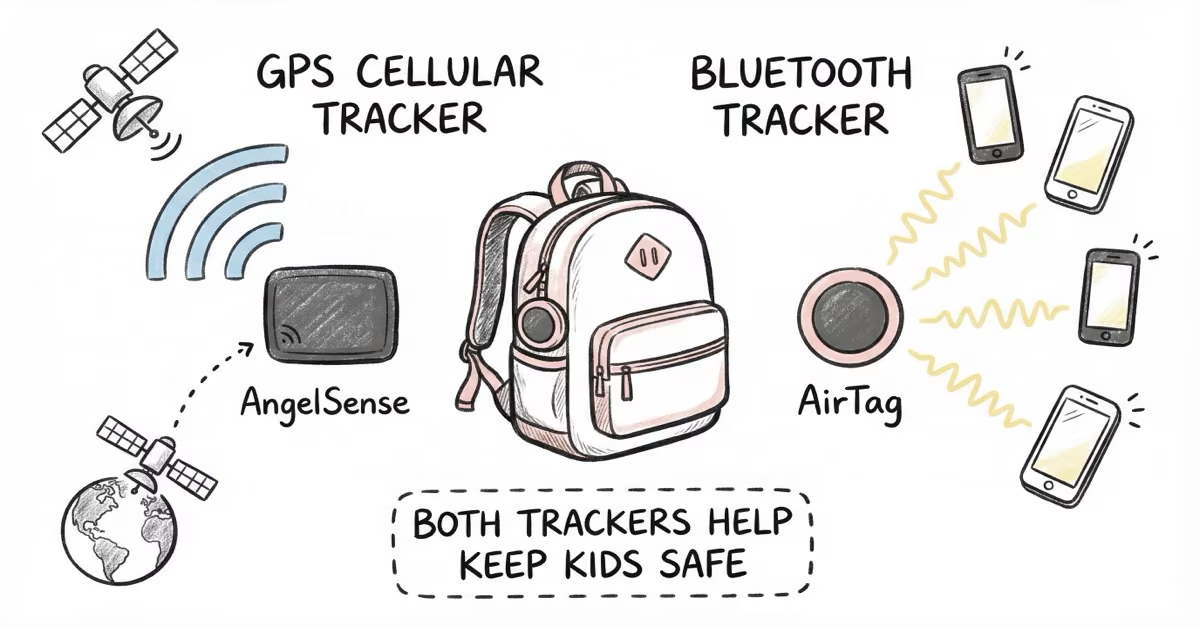
AngelSense is the better choice for children with autism or special needs who tend to wander. It provides real-time GPS tracking every 10 seconds, 2-way voice calls, listen-in audio, and an SOS button. AirTag costs $29 with no monthly fee but only offers Bluetooth-based location updates through nearby iPhones. It was designed for tracking items, not children.
These two trackers solve fundamentally different problems. AngelSense is a cellular GPS device built for child safety. AirTag is a Bluetooth finder designed for keys and wallets. Comparing them is like comparing a baby monitor to a luggage tag. But parents search for this comparison constantly, so let’s break down exactly where each one fits.
I’ve tested AirTags extensively since 2021 and researched AngelSense’s capabilities through their documentation and parent community feedback. Here’s what actually matters when choosing between them.
- AngelSense provides real-time GPS tracking every 10 seconds with cellular connectivity, while AirTag relies on crowd-sourced Bluetooth pings from nearby iPhones.
- AngelSense costs $44.99/month (or $34.99/month annual) plus the device, while AirTag costs $29 once with no subscription.
- AngelSense includes 2-way voice, listen-in, SOS button, safe zones, and transit alerts, none of which AirTag offers.
- AirTag works only with iPhones, while AngelSense supports both iOS and Android.
- For special needs children who may wander, AngelSense's safety features justify the subscription cost.
AngelSense vs AirTag: Quick Specs Comparison
| Feature | AngelSense | AirTag |
|---|---|---|
| Tracking Technology | ✓ GPS + Cellular + Wi-Fi | ⚠ Bluetooth (crowd-sourced) |
| Update Frequency | ✓ Every 10 seconds | ✗ Depends on nearby iPhones |
| 2-Way Voice | ✓ Yes | ✗ No |
| Listen-In | ✓ Yes | ✗ No |
| SOS Button | ✓ Yes | ✗ No |
| Safe Zones / Geofencing | ✓ Customizable | ✗ No |
| Transit Alerts | ✓ Bus/route tracking with ETAs | ✗ No |
| Location History | ✓ 90 days | ✗ None |
| Battery Life | ⚠ ~24 hours (rechargeable) | ✓ ~1 year (CR2032) |
| Water Resistance | Splash-proof | ✓ IP67 |
| Monthly Cost | ⚠ $34.99-$44.99/month | ✓ $0 |
| Device Cost | ~$89 (with plan) | $29 |
| Phone Compatibility | ✓ iOS + Android | ⚠ iPhone only |
| Anti-Removal Design | ✓ Yes | ✗ No |
How AngelSense and AirTag Actually Work
The technology gap between these two devices is massive.
AngelSense connects to cellular networks (AT&T in the US) and uses GPS satellites plus Wi-Fi positioning. It doesn’t depend on other people’s phones. Whether your child is in a rural field, inside a school building, or on a moving bus, AngelSense maintains a direct connection and updates their location every 10 seconds. The device functions like a dedicated phone that only you control.
AirTag has no GPS chip and no cellular radio. It sends out a Bluetooth signal, and if an iPhone happens to be within range (about 30 feet), that iPhone anonymously relays the AirTag’s location to Apple’s servers. In dense urban areas with lots of iPhones around, this works reasonably well. In suburban parks, rural areas, or less populated spaces, updates can lag by minutes or hours. I’ve seen my own AirTags go completely silent for 20+ minutes in my testing.

AirTag was designed by Apple to track items like keys and luggage. Apple has explicitly stated it is not intended for tracking people, including children. According to Apple's AirTag safety documentation, the anti-stalking features (alerts to nearby iPhone users) can actually work against parents trying to monitor kids.
AngelSense Safety Features That AirTag Can't Match
This is where the comparison gets lopsided. AngelSense was purpose-built for vulnerable children. AirTag was built for wallets.
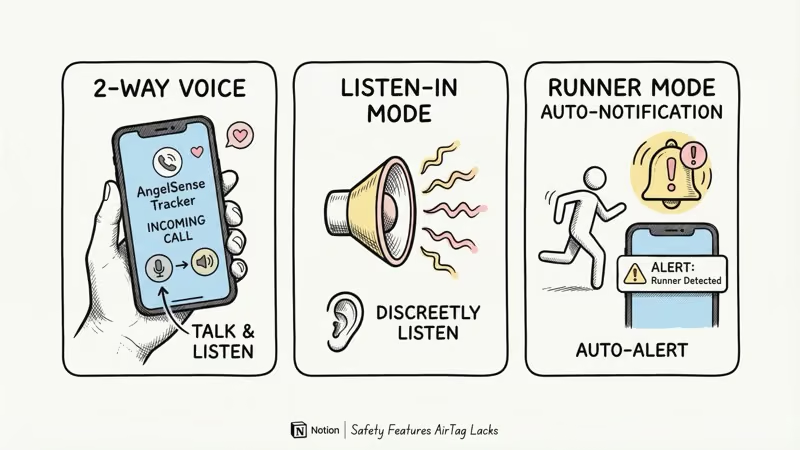
2-way voice calling. Your child can press a button to call you. You can call them through the device. For non-verbal children or those with limited communication abilities, parents can also activate a one-way listen-in to hear what’s happening around the child.
SOS button. One press triggers an immediate call to designated guardians. No phone needed, no app to navigate. This matters when seconds count.
Safe zones and alerts. Set geofences around school, home, therapy centers, or any location. AngelSense sends push notifications the moment your child arrives, leaves, or never shows up. Parents of children with autism who are prone to wandering or elopement rely heavily on these alerts.
Transit tracking. If your child rides a school bus, AngelSense tracks the route in real time, shows ETAs, and alerts you if the bus deviates from its normal path or if your child doesn’t arrive on time.
Runner/speed alerts. Get notified if your child is moving faster than walking speed. This catches elopement attempts early.
Anti-removal design. AngelSense clips onto clothing or attaches via a sensory-friendly sleeve that a child can’t easily remove. AirTags are small, smooth, and can be pulled off a backpack in seconds.
AirTag offers none of this. Zero. It shows you a dot on a map, sometimes with a delay.
Where AirTag Wins Over AngelSense
AirTag isn’t all bad for kid tracking. It has genuine advantages in specific scenarios.
No subscription fee. $29 once. That’s it. Over two years, an AirTag costs about $33 total (device plus one battery replacement). AngelSense over the same period runs $928 or more. For families tracking multiple neurotypical kids, that math matters.
Battery life. AirTag’s CR2032 battery lasts about a year. AngelSense needs nightly charging. If you forget to charge it, you have no tracking the next day. After using AirTags daily, I can confirm the set-it-and-forget-it battery is one of its strongest selling points.
Water resistance. AirTag carries an IP67 rating, meaning it survives submersion in 1 meter of water for 30 minutes. AngelSense is splash-proof only. For kids who end up in puddles, rain, or forget things near water, AirTag handles it better.
Size and weight. AirTag weighs 11 grams. AngelSense is closer to a small phone. For older neurotypical kids who’d notice a bulky device, AirTag slides into a backpack pocket without anyone knowing.
Precision Finding. With an iPhone 11 or later, AirTag’s UWB chip gives you directional arrows and distance readings accurate to about 20-30 cm when you’re within 60 feet. Helpful for finding the exact backpack on a rack.
The Cost Breakdown: 2-Year Total Ownership
| Cost Component | AngelSense | AirTag |
|---|---|---|
| Device | ~$89 | $29 |
| Monthly subscription | $34.99/mo (annual) or $44.99/mo (monthly) | $0 |
| Year 1 total | $509 - $629 | $29 |
| Year 2 total (cumulative) | $929 - $1,169 | ~$33 (battery replacement) |
AngelSense offers discounts for families with children who have documented special needs. Check AngelSense's pricing page for current plans and any available disability accommodations.
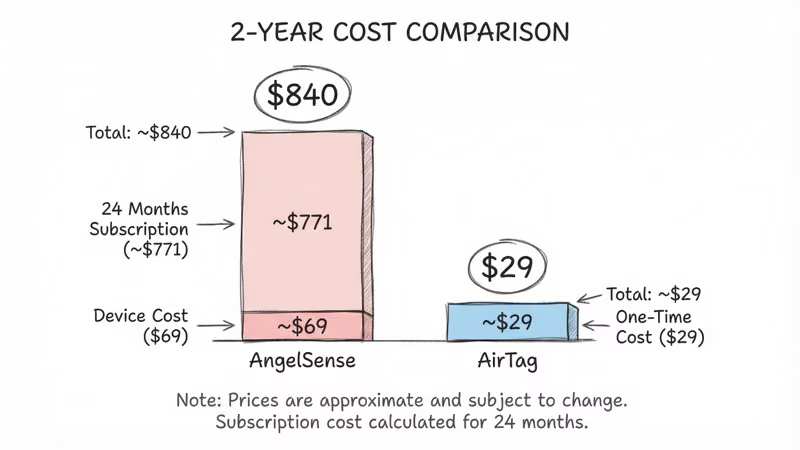
The cost gap is significant. But comparing the price of a GPS cellular device with voice calling to a Bluetooth finder disc is comparing two entirely different product categories. You’re paying for real-time safety infrastructure, not just a location ping.
Which Tracker Fits Your Family?
- Your child has autism, Down syndrome, or other conditions that increase wandering risk
- You need real-time tracking that works everywhere, not just near iPhones
- 2-way voice, listen-in, and SOS are priorities
- Your child rides a school bus and you want route/arrival alerts
- You use an Android phone (AirTag won't work for you)
- You need an anti-removal design so your child can't take it off
- You're tracking a neurotypical school-age kid in urban/suburban areas
- You just want occasional location awareness, not constant monitoring
- Budget is a primary concern and $35+/month isn't feasible
- You're already in the Apple ecosystem with iPhones
- You want zero maintenance (no daily charging)
- You're tracking backpacks, lunchboxes, or other items your kid carries
AngelSense Pros and Cons
- Real-time GPS tracking every 10 seconds, indoors and outdoors
- 2-way voice calls and listen-in capability
- SOS button for immediate emergency contact
- Customizable safe zones with instant departure alerts
- School bus route tracking with ETAs
- Works on both iOS and Android
- Anti-removal design for children who might take off wearables
- $34.99-$44.99/month subscription required
- Battery lasts only ~24 hours, needs nightly charging
- Bulkier than most trackers (closer to a small phone)
- Splash-proof only, not fully waterproof
- Not available on Amazon (sold through angelsense.com only)
AirTag Pros and Cons for Kid Tracking
- No monthly fee, $29 one-time cost
- CR2032 battery lasts about 1 year
- IP67 water and dust resistant
- Tiny (32mm diameter, 11g) and easy to conceal
- UWB Precision Finding for close-range locating
- Massive Find My network with 2 billion+ Apple devices
- No real-time tracking. Location updates depend on nearby iPhones
- No voice calls, listen-in, or SOS features
- No geofencing or departure alerts
- iPhone only. Android users need alternatives
- Small enough to be a choking hazard for toddlers
- Anti-stalking alerts may notify your child's iPhone (if they have one)
- Easily removed from bags or clothing
AirTag Safety Concerns for Children
Parents should be aware of several issues when using AirTags on or near children.
Choking hazard. The CR2032 battery and the AirTag itself are small enough for toddlers to swallow. Apple redesigned the battery compartment in the AirTag 2 to make it harder to open, but the risk remains for very young children.
Anti-stalking alerts work against parents. Apple’s unwanted tracking detection means if your teenager has an iPhone, they’ll receive a notification that an unknown AirTag is traveling with them. This feature exists to prevent stalking, but it also undermines parental monitoring.
No location data in emergencies. AirTag doesn’t store location history. If your child goes missing, you can’t review where they’ve been. You only see the last reported position, which may be minutes or hours old.
Unreliable in low-density areas. If your child is in a park, rural area, or any location without many iPhones nearby, the AirTag goes dark. There’s no comparison between Bluetooth crowd-sourcing and direct GPS tracking when it comes to reliability.
Can You Use Both Together?
Some parents do. And it’s not a bad strategy.
AngelSense handles the heavy lifting: real-time tracking, voice communication, safe zone alerts, and transit monitoring during the school day. AirTag serves as a backup tracker attached to a backpack or jacket. If AngelSense runs out of battery (it happens), the AirTag can still provide a rough location.
I’ve seen parents on forums describe using this dual approach for children with elopement history. The GPS device covers active monitoring hours. The AirTag covers the “I forgot to charge the AngelSense” scenario.
The combined cost is still dominated by AngelSense’s subscription. Adding a $29 AirTag to an existing AngelSense setup is a low-cost insurance policy.
Alternatives Worth Considering
If neither AngelSense nor AirTag fits perfectly, a few other options exist.
Jiobit Gen 3 ($129.99 device, from $8.33/month) sits between these two products. It’s a small GPS tracker with geofencing and real-time tracking, designed for kids and elderly family members. Less feature-rich than AngelSense but much smaller and less expensive. We compared it in detail in our AirTag vs Jiobit breakdown.
Dedicated GPS trackers designed for vehicles or general use may work for older teens. See our GPS trackers with no monthly fee guide for options that split the difference on cost.
Bottom Line
Buy AngelSense if your child has special needs, is prone to wandering, or you need real-time GPS tracking with voice communication. The $35-$45/month subscription is the price of genuine safety infrastructure. For families managing autism or other developmental conditions, the documented wandering risks make this a worthwhile investment.
Use AirTag if you want basic location awareness for a neurotypical school-age kid and can’t justify a monthly subscription. It won’t call for help, it won’t alert you when your child leaves school, and it won’t work without nearby iPhones. But for $29, it’s better than nothing.
Don’t expect AirTag to do what AngelSense does. They’re fundamentally different tools for different situations.
Frequently Asked Questions
Is AngelSense better than AirTag for kids with autism?
Yes, significantly. AngelSense was specifically designed for children with autism and other developmental disabilities. It includes features like anti-removal attachments, listen-in audio, 2-way voice, and speed/departure alerts that address common elopement scenarios. AirTag has none of these capabilities and lacks any microphone or speaker.
Does AngelSense require a monthly subscription?
Yes. AngelSense plans start at $34.99/month with an annual commitment or $44.99/month on a month-to-month basis. The subscription covers cellular connectivity, GPS tracking, and all app features. There's no way to use the device without an active plan.
Can you track a child with just an AirTag?
You can get a general sense of where they are, but it's unreliable for real-time child safety. AirTag updates only when it connects to a nearby iPhone via Bluetooth. In parks, playgrounds, or less populated areas, updates can lag by 15 minutes or longer. Apple explicitly states AirTags are designed for items, not people.
Does AngelSense work with Android phones?
Yes. AngelSense supports both iOS and Android through its dedicated app. This is a significant advantage over AirTag, which requires an iPhone running iOS 14.5 or later and has no Android compatibility at all.
How long does the AngelSense battery last?
About 24 hours with active GPS tracking. It uses a rechargeable battery that needs nightly charging through a magnetic charging dock. The short battery life is the trade-off for continuous 10-second GPS updates over cellular networks. Missing a charge means no tracking the next day.
Is AngelSense available on Amazon?
No. AngelSense is sold exclusively through angelsense.com. The device comes bundled with a subscription plan. You can't buy the hardware separately or from third-party retailers.
Can my child remove an AngelSense tracker?
AngelSense is specifically designed to resist removal. It attaches to clothing with a secure pin mechanism or a sensory-friendly sleeve, and some models use a magnetic lock that requires a parent's tool to detach. This is one of its core design features for children who may try to remove wearable devices.