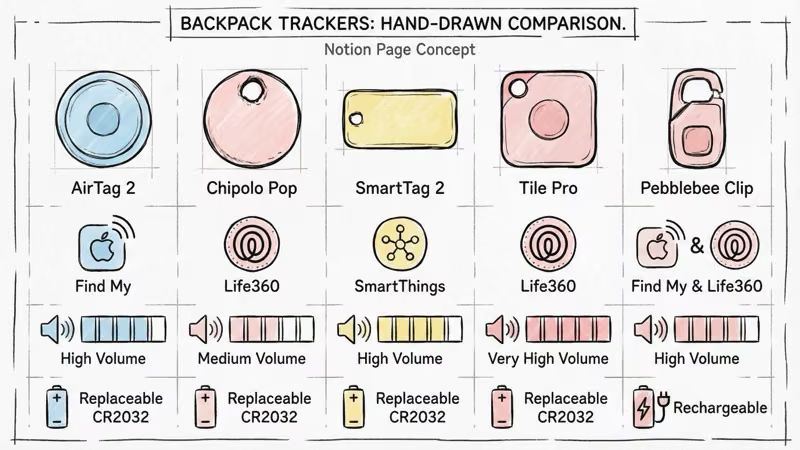
AirTag 2 ($29) is the best backpack tracker for iPhone users with 1B+ device network and UWB. Android users pick Chipolo Pop ($29) cross-platform or Samsung SmartTag 2 ($30).
Your backpack holds your laptop, your keys, your passport, maybe a few hundred dollars worth of gear you’d rather not replace. Losing it — or having it stolen — can ruin a trip, a school day, or a commute. A Bluetooth tracker slipped into an inner pocket changes the equation: you go from “it’s gone” to “it’s at Gate B7” in seconds.
These five trackers actually work for bags, not just keys on a counter. This guide ranks them on what matters for a backpack: network density, attachment security, separation alerts, and water resistance.
- AirTag 2 is the top backpack tracker for iPhone users, with the largest tracking network (1B+ devices) and extended UWB range.
- Chipolo Pop and Pebblebee Clip 5 can be set up on either Apple Find My or Google Find Hub, making them flexible picks for households that may switch ecosystems.
- Samsung SmartTag 2 offers the longest UWB range (120m) but only works with Samsung Galaxy phones.
- For backpacks, size and attachment method matter more than for keys — a clip-on or pocket-sized tracker beats a bulky GPS unit every time.
- All five picks here cost under $35 with no monthly fees, unlike GPS trackers that run $5-15/month on top of the device cost.
Best Backpack Trackers at a Glance
| Tracker | Best For | Network | Battery | Water Resistance | Price |
|---|---|---|---|---|---|
| AirTag 2 | iPhone users | Apple Find My (1B+) | about 12 mo (CR2032) | IP67 | $29 |
| Chipolo Pop | Cross-platform / value | Find My or Google Find Hub | about 12 mo (CR2032) | IP55 | $29 |
| Samsung SmartTag 2 | Samsung Galaxy users | SmartThings Find | about 700 days (CR2032) | IP67 | about $30 |
| Tile Pro 2024 | Loudest ring / Android | Life360 + Sidewalk | about 12 mo (CR2032) | IP68 | about $35 |
| Pebblebee Clip 5 | Rechargeable / clip-on | Find My or Google Find Hub | about 12 mo (USB-C) | IP66 | about $35 |
Apple AirTag 2 — Best Backpack Tracker for iPhone Users
§ Review summary
Apple AirTag 2 — at a glance
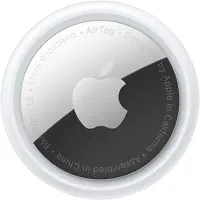
≡ Specs
- Network
- Apple Find My (1B+ devices)
- Precision Finding
- Longer-range UWB
- Battery
- CR2032, about 12 months
- Water rating
- IP67 waterproof
- Weight
- 11g
- Subscription
- None
✓ Pros
- +Largest tracking network on earth (1B+ devices)
- +Longer-range UWB Precision Finding with directional arrow
- +$29 with no subscription, cheapest premium tracker
- +IP67 waterproof, handles rain and accidental spills
- +12-month CR2032 battery, user-replaceable for under $2
✗ Cons
- −iPhone only, completely invisible to Android users
- −No built-in clip or hole, needs a holder for external attachment
- −Crowd-sourced, not real-time GPS, less reliable in rural areas
§ Buy if
- ·You carry an iPhone (and your household is iPhone-dominant)
- ·Apple Find My network density matters more than cross-platform compatibility
- ·UWB Precision Finding helps in crowded venues (airports, lecture halls)
- ·You're OK adding a $10-15 holder for backpack attachment
If you carry an iPhone, the AirTag 2 is the backpack tracker to buy. Not close.
Apple’s Find My network includes over 1 billion active devices worldwide. In practical terms, that means your tagged backpack gets pinged by passing iPhones, iPads, and Macs constantly — in airports, on campuses, in coffee shops. No other tracker has anything close to this density.
In busy places like train stations, an AirTag 2 benefits from the number of passing iPhones that can relay its position, while a Tile Pro depends on the smaller Life360 network. Wirecutter’s best Bluetooth tracker guide recommends AirTag for exactly this crowd-network density.
The January 2026 update brought a U2 Ultra-Wideband chip that extends Precision Finding range up to 50% farther than the original. That’s useful in a lecture hall, a hotel lobby, or a crowded terminal when your phone can show a directional arrow pointing toward your bag. The speaker is also 50% louder than Gen 1, which matters when your backpack is buried in an overhead bin or wedged between seats.
The AirTag fits in any backpack pocket — it’s 31.9mm across and 8mm thick, smaller than a coat button. Drop it in a zippered inner pocket and forget about it until you need it. Battery life runs about 12 months on a standard CR2032, which costs under $2 to replace.
IP67 means it handles rain, spills, and whatever else happens to a daily-use backpack. For the complete specs and long-term performance data, see our AirTag 2 review.
One hard limitation: no Android support. AirTag requires an iPhone to set up and track. If your household mixes platforms, keep reading.
- Largest tracking network on earth (1B+ devices)
- Longer-range UWB Precision Finding with directional arrow
- $29 with no subscription — cheapest premium tracker
- IP67 waterproof, handles rain and accidental spills
- 12-month CR2032 battery, user-replaceable for under $2
- iPhone only — completely invisible to Android users
- No built-in clip or hole; needs a holder for external attachment
- Crowd-sourced, not real-time GPS — less reliable in rural areas
Chipolo Pop — Best Cross-Platform Backpack Tracker
§ Review summary
Chipolo Pop — at a glance
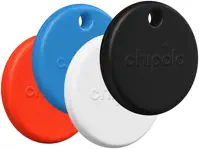
≡ Specs
- Network
- Find My or Google Find Hub (choose one)
- Speaker
- 120dB (loudest)
- Battery
- CR2032, about 1 year
- Water rating
- IP55 splash-proof
- Weight
- 10g
- Subscription
- None (separation alerts free)
✓ Pros
- +Dual-network: works on both Apple Find My and Google Find Hub
- +120dB speaker, loudest tracker in the roundup
- +Free out-of-range separation alerts, no subscription needed
- +Built-in keyring hole for easy bag attachment
✗ Cons
- −No UWB Precision Finding, Bluetooth range only
- −IP55 water resistance, not submersion-rated
- −Smaller crowd-sourced network than AirTag alone
§ Buy if
- ·Your household may switch between iPhone and Android later
- ·Loudest speaker (120dB) matters for finding bag inside a packed home or office
- ·Built-in keyring hole eliminates the holder cost vs AirTag
- ·Free separation alerts save $3-5/mo vs Tile Premium
The Chipolo Pop does something no Apple or Samsung tracker can: it can be set up on either Apple Find My or Google Find Hub. You choose one network during setup, and switching later requires a factory reset and re-pair. For families that may move between iPhone and Pixel over time, that flexibility matters; for same-day mixed-phone sharing, assign the tracker to the ecosystem that will be nearest the backpack most often.
At $29, the Pop matches AirTag’s price while adding a built-in keyring hole and a 120dB speaker rating. That louder speaker spec makes it the better choice if you often need to ring a tracker through a packed bag. Chipolo also includes free out-of-range alerts — your phone notifies you when you walk away from your bag, no subscription required. That’s a feature Tile charges extra for.
Where it falls short: no UWB Precision Finding (Bluetooth only, so no directional arrow), and IP55 water resistance is a step below AirTag’s IP67. Rain won’t kill it, but don’t drop it in a puddle. Battery runs about 12 months on a CR2032.
- Dual-network: works on both Apple Find My and Google Find Hub
- 120dB speaker, loudest tracker in the roundup
- Free out-of-range separation alerts, no subscription needed
- Built-in keyring hole for easy bag attachment
- No UWB Precision Finding, Bluetooth range only
- IP55 water resistance, not submersion-rated
- Smaller crowd-sourced network than AirTag alone
Samsung SmartTag 2 — Best Backpack Tracker for Galaxy Users
§ Review summary
Samsung SmartTag 2 — at a glance
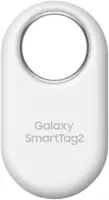
≡ Specs
- Network
- Samsung SmartThings Find
- Precision Finding
- UWB up to 120m Compass View
- Battery
- CR2032, about 700 days
- Water rating
- IP67 waterproof
- Weight
- 33g
- Subscription
- None
✓ Pros
- +Longest UWB range of any tracker (up to 120m)
- +IP67 water resistance, built-in ring hole
- +Integrates with Samsung SmartThings ecosystem
- +Compass View precision finding
✗ Cons
- −Samsung Galaxy only, no iPhone or generic Android support
- −UWB precision finding needs a UWB-equipped Galaxy phone
- −SmartThings network is smaller than Apple Find My
§ Buy if
- ·You carry a Samsung Galaxy phone (no other Android works with SmartTag 2)
- ·Longest UWB range (120m) matters for finding bag across large venues
- ·Built-in ring hole eliminates the AirTag-style holder requirement
- ·Twice-a-year CR2032 battery swap is acceptable
Samsung Galaxy owners have a clear answer: the SmartTag 2. It’s the only tracker with UWB Precision Finding that matches or exceeds AirTag, with a claimed range of up to 120 meters in Compass View mode. That’s double AirTag 2’s spec, though real-world results depend on obstacles and interference.
The design is worth noting for backpack use specifically. SmartTag 2 has a built-in ring hole and a slightly larger, flatter form factor than AirTag, which actually makes it easier to locate inside a bag by feel. Samsung’s SmartThings Find network is the second-largest after Apple’s, and growing as Galaxy adoption continues.
Battery life is actually a strength: up to about 700 days on a CR2032 in power-saving mode, well beyond the 12 months you get from AirTag and most Tile models. The real catch is the ecosystem lock-in — like AirTag locks you into iPhone, SmartTag 2 locks you into Samsung Galaxy, and it won’t work with other Android phones or iPhones. For a detailed feature-by-feature breakdown, see our AirTag vs SmartTag 2 comparison.
- Longest UWB range of any tracker (up to 120m)
- IP67 water resistance, built-in ring hole
- Integrates with Samsung SmartThings ecosystem
- Samsung Galaxy only — no iPhone or generic Android support
- UWB precision finding needs a UWB-equipped Galaxy phone
- SmartThings network is smaller than Apple Find My
Tile Pro 2024 — Loudest Backpack Tracker for Android
§ Review summary
Tile Pro (2024) — at a glance
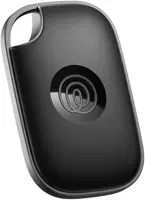
≡ Specs
- Network
- Life360 + Amazon Sidewalk
- Bluetooth range
- 500ft direct
- Battery
- CR2032, about 1 year
- Water rating
- IP68 waterproof
- Platform
- iOS + Android
- Subscription
- Optional for premium features
✓ Pros
- +500ft Bluetooth range, longest of any tracker in this roundup
- +Reverse-find: press Tile button to ring your phone even on silent
- +IP68 water resistance, rugged build for gym bags and school packs
- +Works on both iOS and Android
✗ Cons
- −Life360 network is much smaller than Apple Find My
- −Slower location updates in lower-density areas
- −Premium features (smart alerts, 30-day history) require paid subscription
§ Buy if
- ·You're on Android without a Samsung phone (no SmartTag support)
- ·Reverse-find your phone (press Tile button to ring your phone) is a regular use case for you
- ·Direct Bluetooth range (500ft) matters because you often misplace bag close-by
- ·iOS + Android cross-compatibility matches your household setup
The Tile Pro has been a reliable backpack tracker for years, and the 2024 model keeps what works: 500ft Bluetooth range (the longest of any tracker here), a 90dB speaker, and broad platform support through the Tile app on both iOS and Android.
What makes it good for backpacks specifically? Two things. First, the reverse-find feature: press the Tile button to ring your phone, even when it’s on silent.
If you’re someone who loses both their phone and their bag, this is a real lifesaver. Second, the IP68 water resistance and rugged build quality make it better suited to gym bags and school backpacks than splash-only tags.
The weakness is network size. Tile runs on Life360’s network combined with Amazon Sidewalk, covering roughly 77 million nodes. That’s workable in cities but noticeably thinner than Apple’s billion-device mesh.
On that thinner network, Tile Pro updates depend more heavily on whether other Life360 users or Sidewalk devices pass nearby. Apple’s denser mesh gives AirTag more relay opportunities in many public places. For a broader look at Tile’s lineup and how it stacks up, see our AirTag vs Tile comparison.
- 500ft Bluetooth range, longest of any tracker in this roundup
- Reverse-find: press Tile button to ring your phone even on silent
- IP68 water resistance, rugged build for gym bags and school packs
- Works on both iOS and Android
- Life360 network is much smaller than Apple Find My
- Slower location updates in lower-density areas
- Premium features (smart alerts, 30-day history) require paid subscription
Pebblebee Clip 5 — Best Rechargeable Backpack Tracker
The Pebblebee Clip 5 is built for bags. The built-in carabiner clip attaches directly to a backpack zipper pull, D-ring, or internal loop without any case or holder. That clip design solves the biggest practical problem with using an AirTag in a backpack: you don’t need to buy a separate $15 holder to keep it from floating around loose.
Like the Chipolo Pop, the Clip 5 can be registered to Apple Find My or Google Find Hub, one network per setup. The 130dB siren rating is the loudest in this roundup. There’s also a separation alert that notifies you when you walk away from your bag. For school kids who leave backpacks on the bus, that alert alone justifies the cost.
The USB-C rechargeable battery eliminates the CR2032 swap entirely, lasting up to 12 months per charge. One trade-off: IP66 water resistance is a step below IP67. Heavy rain and water jets are fine; submersion isn’t. For a wider view of cross-platform tracker options, check our AirTag alternatives roundup.
Pebblebee Clip 5 at a glance: the built-in carabiner clip snaps directly onto bag zippers and D-rings, dual-network support lets you pick Apple Find My or Google Find Hub at setup, the 130dB siren is the loudest in this roundup, and USB-C recharging means no replacement batteries. Trade-offs: IP66 water resistance doesn’t cover submersion, $35 is slightly more expensive than AirTag or Chipolo Pop, and there’s no UWB Precision Finding.
What Makes a Good Backpack Tracker?
Backpacks aren’t keys. You don’t lose them between couch cushions — you leave them on a bus, at a cafe, or in a lecture hall. That changes what matters in a tracker.
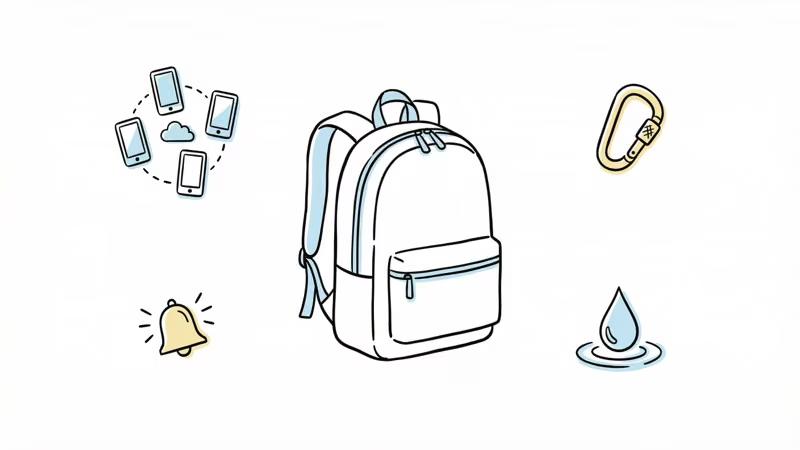
Network density over raw range. Bluetooth range specs (200ft, 400ft, 500ft) measure how far your phone can connect directly. But when your backpack is across campus or on a different train, direct range is irrelevant.
What matters is how many other phones can detect your tracker and relay its position. Apple’s Find My page confirms that the network spans over 1 billion active devices, which gives AirTag more relay opportunities than smaller networks in many public places.
Attachment method. A tracker rattling loose inside a bag is a tracker you’ll eventually lose separately. AirTag needs a holder (the Belkin secure holder with carabiner is the go-to).
Pebblebee Clip 5 has a built-in clip. Tile Pro has a keyring hole. Match the attachment to your bag’s design.
Separation alerts matter more for bags. You might notice a missing keyring in your pocket within seconds. A backpack left under a table? That can take 20 minutes.
Trackers with proactive leave-behind alerts — Chipolo Pop and Pebblebee Clip 5 offer this free — catch the mistake before it becomes a problem.
Water resistance. Backpacks get rained on, dropped in puddles, tossed onto wet ground. IP67-rated trackers (AirTag 2, SmartTag 2) handle submersion up to 1 meter, and the Tile Pro goes a step further with IP68. IP55 and IP66 trackers (Chipolo Pop, Pebblebee Clip 5) handle splashes and rain but shouldn’t be submerged.
That translates to practical durability: an IP67-rated unit is covered for rain, a dropped puddle, or a wet-ground toss on a daily commute, while IP55 and IP66 models survive splashes but should not be deliberately submerged. For a backpack that rides outdoors year-round, IP67 is the rating to prioritize.
Bluetooth trackers vs GPS trackers for backpacks: All five picks in this guide are Bluetooth trackers. They cost $29-35 with no monthly fees. GPS trackers (like Invoxia or LandAirSea 54) provide real-time location but cost $50-100+ with $5-15/month subscriptions. For most backpack tracking scenarios — campus, commute, travel — Bluetooth trackers are more than enough. GPS trackers make sense only if you need live location in remote areas with no smartphone traffic nearby. If you fly internationally and want GPS coverage in low-iPhone regions, our best GPS tracker for international luggage guide compares cellular options that work in 150-190+ countries.
Where Should You Put a Tracker in Your Backpack?
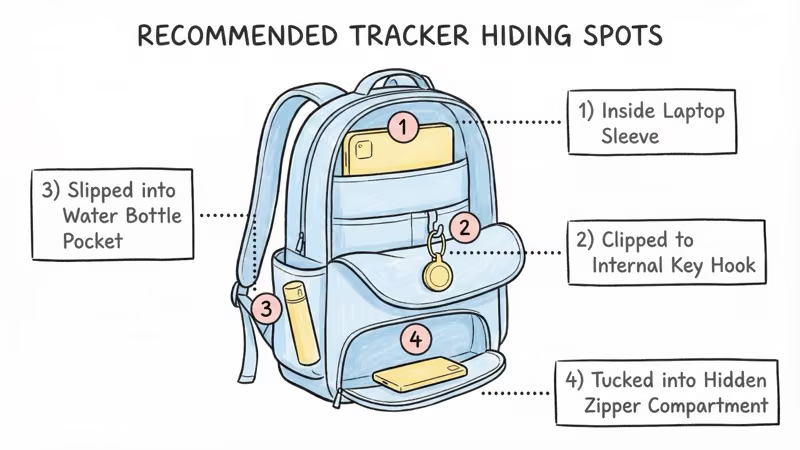
Placement matters. A visible tracker on an external zipper pull is easy for a thief to spot and remove. Here are the spots that work:
Inner zippered pocket: Most backpacks have a small organizer pocket inside the main compartment. Drop the tracker here. It won’t shift around, and a thief grabbing the bag in a hurry won’t think to check it.
Laptop sleeve lining: The padded laptop compartment often has a gap between the padding and outer shell. Slide a tracker in there. It’s invisible without deliberately searching.
Clip to an internal D-ring or zipper pull: The Pebblebee Clip 5’s carabiner or a keychain-style AirTag holder clips directly to internal hardware. Stays put even when you empty the bag.
Dual-tracker setups improve recovery odds by giving you both close-range sound and long-range crowd-finding. A common approach: one AirTag in the laptop sleeve lining (invisible, permanent) and a second Chipolo Pop clipped to the internal zipper pull (easy to transfer between bags).
Two trackers might seem excessive, but at $29 each with no monthly fee, it’s cheaper than one month of GPS tracker service. For more placement ideas, Apple’s Find My safety documentation states that an unknown tracker moving with someone triggers an alert on their phone and eventually plays a sound on its own, so a tag you place in a shared or borrowed bag may notify whoever carries it.
Which Backpack Tracker Should You Buy
Each product’s “Buy if…” bullets above capture the main decisions: AirTag 2 for iPhone households, Chipolo Pop or Pebblebee Clip 5 for mixed iOS/Android households, SmartTag 2 for Galaxy users, Tile Pro for general Android.
For Samsung Galaxy users, the SmartTag 2 is the easy answer. Its UWB range and Samsung integration make it the best option within that ecosystem. For general Android users who don’t have a Samsung phone, the Tile Pro or Chipolo Pop give you the widest compatibility. If you’re weighing those two alongside AirTag 2, our AirTag 2 vs Chipolo Pop vs Tile Pro comparison breaks down network size, UWB, battery life, and water resistance side by side.
Students tracking a school backpack on a budget should look at the best item tracker roundup for the full field, including wallet and key options. Travelers checking bags at airports will benefit from our best luggage tracker guide, which covers airline-specific rules and TSA compliance.
And if you’re curious whether you can toss a tracker in checked luggage at all, we’ve answered that in can you use an AirTag in checked luggage.
Bottom Line
For most people, the answer is simple. iPhone user? Buy the AirTag 2 ($29). Nothing else matches Apple’s Find My network for finding a lost backpack.
Mixed iPhone/Android household? Get the Chipolo Pop ($29) or Pebblebee Clip 5 ($35) if you want one tracker model that can be assigned to either network. Samsung Galaxy? SmartTag 2 (~$30).
At $29-35 with zero monthly fees, there’s no reason to leave a backpack untracked. The cost of the tracker is less than a single replacement textbook, and it takes under a minute to set up.
FAQ
What is the best tracker to put in a backpack?
The AirTag 2 is the best backpack tracker for iPhone users, thanks to the Find My network’s 1 billion+ active devices and longer-range UWB Precision Finding. For Android users, the Chipolo Pop ($29) offers dual Apple/Google network coverage at the same price point. If you want a built-in clip for easy attachment, the Pebblebee Clip 5 is the way to go.
Can a Bluetooth tracker find a stolen backpack?
It depends on location density. In cities and populated areas, Bluetooth trackers like AirTag update when passing smartphones relay the signal. In rural areas with few smartphones nearby, updates can take hours or never arrive. Bluetooth trackers improve your odds significantly but don’t guarantee recovery the way a real-time GPS tracker would.
Do I need a GPS tracker for my backpack or is Bluetooth enough?
For daily commuting, school, and travel through populated areas, Bluetooth is enough. GPS trackers cost $50-100+ upfront with $5-15/month subscriptions, and they’re designed for vehicles and remote asset tracking. A $29 AirTag or Chipolo Pop handles the vast majority of backpack tracking scenarios without any monthly cost. Consider GPS only if you regularly travel to remote areas with minimal smartphone traffic.
Where should I hide a tracker in my backpack?
The best spot is inside a zippered internal organizer pocket or slid between the laptop sleeve padding and the backpack shell. These locations keep the tracker invisible to anyone who grabs the bag quickly. Avoid external zipper pulls or easily accessible front pockets where a thief might check first. The Pebblebee Clip 5’s built-in carabiner clips directly to internal D-rings for a secure, hidden attachment.
Will a backpack tracker set off airport security?
No. Bluetooth trackers like AirTag, Tile, and Chipolo are permitted by the FAA in both carry-on and checked luggage. They use standard coin cell batteries that fall well below the lithium content limits for air travel. TSA screeners see them regularly and won’t flag them. Just leave the tracker in your bag during screening.
Do backpack trackers work without Wi-Fi or cell service?
Yes. Bluetooth trackers don’t use Wi-Fi or cell service directly. They broadcast a Bluetooth signal that nearby smartphones pick up and relay to the cloud via whatever internet connection those phones have. Your tracker itself needs nothing — no SIM card, no Wi-Fi password, no data plan. The only requirement is that other people’s phones pass within Bluetooth range (a few dozen feet indoors).
How long do backpack tracker batteries last?
Most Bluetooth trackers run 6-12 months on a single CR2032 coin cell battery that costs under $2 to replace. AirTag 2, Chipolo Pop, and Tile Pro are rated around 12 months, and Samsung SmartTag 2 lasts the longest at up to about 700 days in power-saving mode. The Pebblebee Clip 5 is the exception: it’s USB-C rechargeable with up to 12 months per charge, so you never buy replacement batteries at all.