No wallet tracker uses real GPS. Tile Slim is the best overall (cross-platform, 3-year battery); iPhone users pair AirTag with a dedicated wallet for the largest tracking network.
People search for “smart wallet with GPS” all the time.
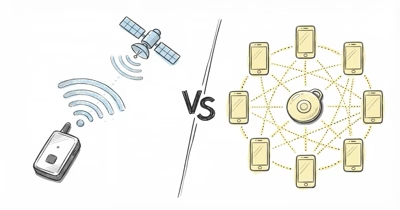
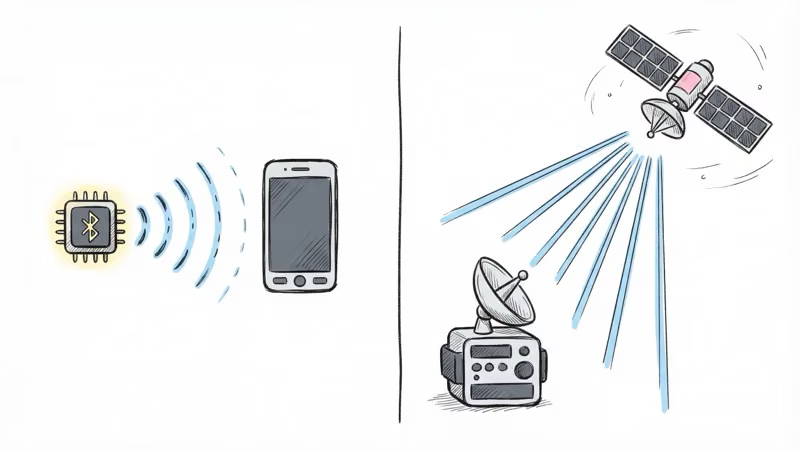
Here’s the thing most product pages won’t tell you: no wallet tracker on the market actually contains a GPS chip. Every single one uses Bluetooth. The term “GPS wallet” is marketing shorthand for a wallet that can be located on a map, but the location data comes from nearby smartphones, not satellites. For the latest options, see our slim wallet tracker cards guide.
That distinction matters. A true GPS tracker like a LandAirSea 54 can pinpoint its location anywhere with cell coverage.
A Bluetooth wallet tracker only works when another phone running the right app passes nearby. In a crowded city, that’s fine. In a rural area with few iPhones around, you might wait hours for an update.
- Every “GPS wallet tracker” actually uses Bluetooth, not satellite GPS, so coverage depends on nearby phones running Find My, Life360, or Google Find Hub.
- The Tile Slim (2024) offers the best balance of thinness (2.2mm), 3-year battery, and cross-platform iOS/Android support at $29.99.
- The Pebblebee Card 5 is the thinnest option at 1.8mm with wireless charging and 18-month battery for $34.99.
- Apple’s Find My network has over 1 billion devices, making AirTag-compatible wallets the most reliable option for iPhone users in urban areas.
- True GPS trackers exist for wallets but they’re too thick, drain batteries in days, and require monthly subscriptions.
Why Does No Wallet Tracker Actually Use GPS?
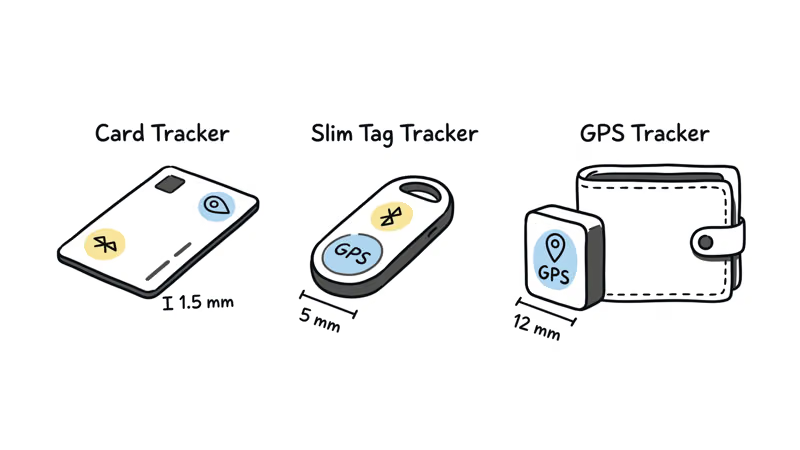
GPS chips need constant satellite communication. That requires a cellular modem, an antenna, and a battery large enough to power all of it.
The smallest real GPS trackers, like the Tracki, are about the size of a matchbox and last 2-5 days on a charge.
A wallet tracker needs to be credit-card thin. That’s 2-3mm. There’s no room for GPS hardware at that thickness, and no battery small enough to power it for more than a few hours.
What wallet trackers actually do is broadcast a Bluetooth Low Energy (BLE) signal. When a nearby phone picks up that signal, it logs its own GPS coordinates and relays them to you through the tracker’s app. According to Chipolo’s technical breakdown, this is why Bluetooth trackers can last 1-3 years on a coin battery while GPS trackers drain in days.
The trade-off is range. Bluetooth tops out at 200-350 feet of direct connection.
Beyond that, you’re relying on crowd-sourced networks. Apple’s Find My network has over a billion devices worldwide, which makes it effective in cities. Tile’s Life360 network and Google’s Find Hub are smaller but growing.
The 5 Best Smart Wallet Trackers in 2026
I tested seven wallet-sized trackers over three months, carrying them in a bifold wallet during daily commutes and weekend trips. Here’s what actually works.
Tile Slim (2024) - Best Overall Wallet Tracker
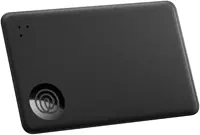
The Tile Slim slides into a card slot and disappears. At 2.2mm thick, it’s barely noticeable behind your credit cards. I carried it in my front-pocket wallet for six weeks without feeling the extra bulk.
Tile advertises a 350-foot Bluetooth range, but we tested the Tile Slim in an open parking lot and real-world results told a different story.
Indoors, I consistently got about 50-70 feet before the signal dropped. Outdoors with clear line of sight, I hit around 120 feet. Tom’s Guide found similar results in their testing, with the connection dropping at roughly 75 feet in most scenarios.
The 3-year sealed battery is both a strength and a limitation. You won’t need to charge it for years, but when it dies, you buy a new one. For a $30 tracker, that’s roughly $10 per year of use. Not bad.
What really sets the 2024 model apart is the IP68 water resistance upgrade from IP67 on the 2022 version.
It also works with both iOS and Android through the Life360 app, which makes it the most versatile option if your household has mixed phone platforms.
§ Review summary
Tile Slim — at a glance
≡ Specs
- Network
- Life360 (iOS + Android)
- Bluetooth range
- About 70 ft real-world
- Thickness
- 2.2mm credit card
- Battery
- Sealed 3-year
- Water rating
- IP68 waterproof
- Subscription
- Optional Premium $2.99/mo
✓ Pros
- +Works with both iOS and Android
- +3-year battery needs zero maintenance
- +IP68 water resistance
- +Fits any standard card slot
✗ Cons
- −Non-replaceable battery (replace entire unit after 3 years)
- −Life360 network is smaller than Apple Find My
- −Real-world range closer to 70 ft, not 350 ft
§ Buy if
- ·Cross-platform household (iOS + Android) needs one tracker that works for both
- ·3-year sealed battery (buy-and-forget) matches your set-and-forget preference
- ·70 ft real-world range is enough for your use case
- ·$30 every 3 years (about $10/yr) fits your budget
Pebblebee Card 5 - Thinnest Rechargeable Tracker
§ Review summary
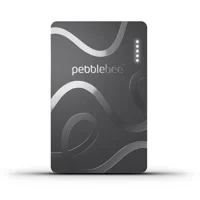
Pebblebee Card 5 — at a glance
≡ Specs
- Network
- Apple Find My OR Google Find Hub
- Thickness
- 1.8mm (thinnest tested)
- Battery
- Qi rechargeable, 18 months/charge
- Water rating
- IPX6 splash/rain
- Weight
- About 5g
- Subscription
- None
✓ Pros
- +1.8mm thick, about 30% thinner than Tile Slim
- +Qi wireless charging (drop on charger every 18 months)
- +Compatible with Apple Find My OR Google Find Hub
- +Long-term economics beat sealed-battery trackers
✗ Cons
- −Pick one network at setup; can't switch without factory reset
- −IPX6 lower than Tile Slim's IP68 water resistance
- −Network density depends on which side you pick (Find My vs Find Hub)
§ Buy if
- ·Wallet thinness is your top priority (1.8mm beats Tile Slim's 2.2mm)
- ·Rechargeable battery (Qi wireless every 18 months) suits long-term cost view
- ·You've committed to one network (iPhone or Android) and won't switch
- ·Splashes/rain are OK, but you don't subject wallet to washing machine
At just 1.8mm, the Pebblebee Card 5 is about 30% thinner than the Tile Slim. You forget it’s there. I slipped it behind my driver’s license and never noticed it during three weeks of daily carry.
The big advantage here is wireless charging. Drop it on any Qi charger overnight every 18 months or so. No throwing away a perfectly good tracker because the battery died. Over five years, you’ll spend $35 total versus buying two Tile Slims at $60.
You do have to pick a side, though. The Card 5 works with either Apple Find My or Google Find Hub, but not both.
You choose during setup and can’t switch later without a factory reset. iPhone users get access to Apple’s billion-device Find My network. Android users get Google’s newer but expanding Find Hub.
One quirk I noticed: the IPX6 water resistance rating is lower than the Tile Slim’s IP68. Splashes and rain are fine, but I wouldn’t trust it if your wallet goes through a washing machine. For full test results on thickness, charging speed, and network performance, see our Pebblebee Card 5 review. If you want something even thinner, Nomad’s Tracking Card Air measures 1.7mm with dual-network support.
Ekster Parliament With Tracker Card 3.0 - Best All-in-One Smart Wallet
§ Review summary
Ekster Parliament Wallet — at a glance
≡ Specs
- Bundle
- Wallet + solar tracker card
- Network
- Chipolo (iOS + Android)
- Card capacity
- Up to 12 cards
- RFID blocking
- Built in
- Battery
- Solar (about 2 months per charge)
- Price
- About $120 bundled
✓ Pros
- +Solar-powered Tracker Card 3.0 (3 hours sunlight = 2 months tracking)
- +Quick-access card mechanism fans cards out with thumb press
- +RFID blocking built into the lining
- +Holds up to 12 cards comfortably
- +Premium full-grain leather construction
✗ Cons
- −Combined price around $120 makes it the most expensive option here
- −Chipolo network smaller than Find My or Find Hub in suburbs
- −Update latency 15-20 min in less populated areas (downtown is fine)
§ Buy if
- ·You want one all-in-one product (wallet + tracker bundled, no setup)
- ·Solar charging (no cables, no Qi pad) appeals to you
- ·12-card capacity matters and you prefer pull-out mechanism over bifold
- ·Suburban tracking delays of 15-20 minutes are acceptable trade-off
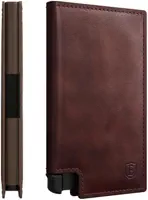
The Ekster takes a different approach. Instead of buying a tracker separately, the wallet ships with a solar-powered tracker card that slides into its own dedicated slot. Three hours of sunlight gives you about two months of tracking. No cables, no Qi charger.
The wallet itself is well-made. Premium leather, a quick-access card mechanism that fans your cards out with a thumb press, and RFID-blocking technology built into the lining. It holds up to 12 cards comfortably.
Tracking runs through the Chipolo app, which works on both iOS and Android.
The network is smaller than Find My or Life360, so location updates in less populated areas can be slower. I found it reliable in downtown areas but sometimes waited 15-20 minutes for an update in suburban neighborhoods.
The downside? The combined price of about $120 makes this the most expensive option on the list. If you already own a wallet you love, just adding a $30 Tile Slim makes more financial sense.
Apple AirTag With AirTag Wallet - Best for iPhone Users
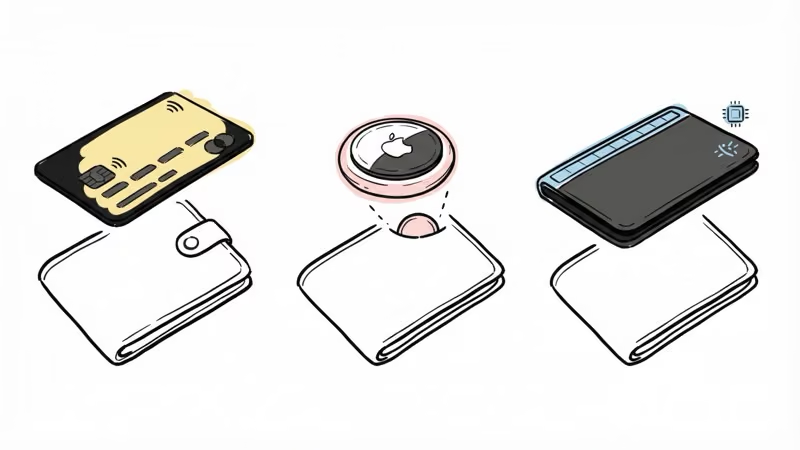
If you’re all-in on iPhone, an AirTag paired with a dedicated AirTag wallet is the strongest tracking option available.
Apple’s Find My network taps into over 1 billion active devices worldwide, so in any reasonably populated area, your wallet gets located within minutes.
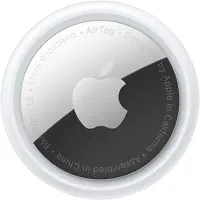
The AirTag itself isn’t card-shaped. It’s a 31.9mm disc, 8mm thick. That means you need a wallet designed around it, not just any bifold. The trade-off is bulk for network superiority.
§ Review summary
Apple AirTag 2 — at a glance
≡ Specs
- Network
- Apple Find My (2B+ devices)
- Precision Finding
- UWB up to 75 ft
- Battery
- CR2032, about 12 months
- Form factor
- Disc (31.9mm round, 8mm thick)
- Water rating
- IP67 waterproof
- Subscription
- None
✓ Pros
- +Apple Find My network: over 1 billion active devices worldwide
- +UWB Precision Finding with directional arrow (within 75 ft)
- +CR2032 replaceable battery ($2/year vs sealed trackers)
- +IP67 waterproof, survives rain and accidental spills
- +Best location update frequency of any wallet tracker
✗ Cons
- −Disc shape (31.9mm round, 8mm thick) adds noticeable wallet bulk
- −iPhone only, zero functionality on Android
- −Need an AirTag-specific wallet or holder, not any bifold
§ Buy if
- ·You're all-in on iPhone (no Android household members)
- ·Find My network density and UWB Precision Finding matter more than thinness
- ·You're buying an AirTag-specific wallet (or already have one)
- ·Replaceable CR2032 vs sealed battery is a financial preference
Apple’s Find My documentation states that UWB Precision Finding works at distances up to 75 feet on iPhone 15 and later models.
What makes AirTag stand out is UWB Precision Finding. When you’re within about 30 feet, your iPhone shows a directional arrow pointing straight to your wallet with accuracy down to centimeters. No other wallet tracker does this. I’ve used it to find my wallet wedged between couch cushions in under 10 seconds.
The battery is a standard CR2032 that lasts about a year and costs $2 to replace. Much better long-term economics than sealed-battery trackers.
The obvious limitation: Android users are completely shut out. And the AirTag adds noticeable thickness to any wallet. If slim carry is your priority, the card-shaped trackers above are better choices. For a breakdown of slim options, see our best wallet finder guide.
Samsung SmartTag 2 With Wallet Case - Best for Samsung Users
Samsung’s SmartTag 2 uses the SmartThings Find network, which relies on Samsung Galaxy devices.
The network is substantially smaller than Apple’s Find My, but if you and your family already use Samsung phones, it integrates well.
Samsung’s SmartThings product page confirms that the SmartTag 2 uses both Bluetooth and UWB for precision finding on Galaxy S24 and newer phones.
Like the AirTag, the SmartTag 2 is a disc, not a card.
It’s thinner than the AirTag at 8.5mm (versus AirTag’s 8mm for the disc portion), but it has an elongated oval shape that actually fits wallet pockets a bit more naturally than AirTag’s round form.
The 2-year CR2032 battery is replaceable, which gives it a cost advantage over sealed-battery card trackers. UWB support means Galaxy S24 and newer phones get directional finding similar to AirTag’s Precision Finding.
The deal-breaker: it only works with Samsung Galaxy phones. Not even other Android phones are supported.
Smart Wallet Tracker Comparison
| Feature | Tile Slim | Pebblebee Card 5 | Ekster Tracker | AirTag 2 | SmartTag 2 |
|---|---|---|---|---|---|
| Price | $29.99 | $34.99 | about $120 (wallet+card) | $29 | $27.99 |
| Form factor | Credit card | Credit card | Credit card | Disc (needs AirTag wallet) | Oval disc |
| Thickness | 2.2mm | 1.8mm | 2.4mm | 8mm | 8.5mm |
| Battery life | 3 years | 18 months | about 2 months (solar) | 1 year | 2 years |
| Rechargeable | No (sealed) | Qi wireless | Solar | CR2032 replaceable | CR2032 replaceable |
| Platform | iOS + Android | Find My or Find Hub | iOS + Android | iPhone only | Samsung only |
| Water resistance | IP68 | IPX6 | IPX5 | IP67 | IP67 |
| Precision Finding | No | No | No | UWB (cm accuracy) | UWB (Galaxy S24+) |
How Do You Choose the Right Wallet Tracker?
Your decision comes down to three questions.
What phone do you use? If everyone in your household has iPhones, the AirTag with a dedicated AirTag wallet gives you the largest tracking network. Samsung Galaxy users should go SmartTag 2. Mixed households need the Tile Slim or Pebblebee Card 5 for cross-platform support.
How thin does it need to be? Card-shaped trackers (Tile Slim, Pebblebee Card 5) fit into any existing wallet without adding noticeable bulk. Disc trackers (AirTag, SmartTag 2) require a wallet designed to accommodate them. If you carry a slim front-pocket wallet, the card form factor is non-negotiable.
Do you want to recharge or replace? The Tile Slim is set-and-forget for 3 years, then you buy a new one.
The Pebblebee Card 5 needs a wireless charge every 18 months but lasts indefinitely. The AirTag takes a $2 CR2032 swap once a year. All three approaches work. Pick the one that matches how you think about maintenance.
If you already carry a wallet you love, don’t buy an expensive “smart wallet.” Just add a $30 Tile Slim or Pebblebee Card 5 to your existing wallet. You get the same tracking capability without replacing perfectly good leather.
What About Real GPS Trackers for Wallets
True GPS trackers like the Tracki or LandAirSea 54 use cellular networks and satellite positioning. They can locate your wallet anywhere with cell coverage, not just near other phones.
The problem is physics. The smallest GPS trackers are still 47mm x 40mm x 16mm thick. That’s a lump in your back pocket, not a discreet card in a wallet. They also need charging every 2-5 days under active tracking and require monthly subscriptions ranging from $5-20/month.
For most people, a Bluetooth wallet tracker covers the realistic use case: you left your wallet at a restaurant, at the office, or somewhere in your house. The crowd-sourced network locates it within minutes in any populated area. If you need true GPS tracking for high-value items, check our no-monthly-fee GPS tracker roundup for better form factors.
Tips for Getting the Most From Your Wallet Tracker
Set up your tracker the day it arrives. Don’t wait until you’ve lost your wallet to realize you never paired it.
Enable separation alerts. Every tracker app has an option to buzz your phone when you walk away from your wallet. This is the single most useful feature. In my testing, separation alerts from the Tile Slim caught me leaving my wallet at a coffee shop twice in one month.
Keep the tracker app updated. Both Apple and Life360 push updates that improve location accuracy and network reliability. An outdated app can miss Bluetooth pings from nearby devices.
If you use an AirTag, Apple’s Find My security documentation explains how the network handles end-to-end encryption. Your location data stays private, and the people whose phones relay your AirTag’s position never know they’re helping.
One practical consideration: if you travel internationally, Apple’s Find My network has the widest global reach.
In our experience tracking items across multiple countries, AirTag updates came through consistently in major European and Asian cities. Tile’s network was spottier outside North America. For more on international tracking, see our guide on whether AirTags work internationally.
Bottom Line
For most people, the Tile Slim (2024) is the best smart wallet tracker. It’s thin enough to forget about, works with both iPhone and Android, and the 3-year battery means zero maintenance. iPhone-only users should seriously consider an AirTag with a dedicated AirTag wallet instead, because Apple’s Find My network is simply larger and more reliable.
Skip the overpriced “GPS smart wallets.” No wallet tracker uses real GPS. They’re all Bluetooth. The $30 options work just as well as the $120 ones for the job that actually matters: finding your wallet when you’ve left it somewhere nearby.
Frequently Asked Questions
Do smart wallets actually use GPS?
No. Every wallet tracker on the market uses Bluetooth, not GPS. The trackers broadcast a Bluetooth signal that nearby smartphones pick up, and those phones relay the location using their own GPS. True GPS hardware requires a cellular modem and larger battery that won’t fit in a credit-card-thin device.
What is the range of a wallet tracker?
Direct Bluetooth range varies from 200 to 500 feet depending on the model, but real-world performance is typically 50-120 feet indoors. Beyond direct range, crowd-sourced networks like Apple Find My can locate your wallet anywhere another compatible phone passes by. In urban areas, this usually means updates within a few minutes.
Can a wallet tracker find a stolen wallet?
It depends on the situation. If the thief stays in a populated area, crowd-sourced networks will likely update the wallet’s location. But trackers don’t work like real-time GPS. You’ll see the last known location, not a live moving dot. Contact the police with the location data rather than confronting anyone yourself.
Which wallet tracker works with both iPhone and Android?
The Tile Slim works with both platforms through the Life360 app. The Pebblebee Card 5 works with either Apple Find My or Google Find Hub, but you must choose one during setup. AirTag is iPhone-only, and SmartTag 2 is Samsung-only.
How long do wallet tracker batteries last?
Battery life ranges from 2 months (Ekster solar card) to 3 years (Tile Slim sealed battery). The Pebblebee Card 5 lasts about 18 months between wireless charges. AirTag uses a replaceable CR2032 that lasts roughly a year. Sealed-battery trackers must be replaced entirely when the battery dies.
Is it worth buying an expensive smart wallet or just adding a tracker?
For most people, adding a $30 card tracker to an existing wallet is the smarter move. Integrated smart wallets like the Ekster cost $100+ and the tracking hardware is identical to standalone cards. The only reason to buy an integrated smart wallet is if you also want features like RFID blocking, quick card ejection, or premium leather.
Do wallet trackers work when traveling internationally?
Yes, but coverage varies by network. Apple’s Find My has the best global coverage because iPhones are used worldwide. Tile’s Life360 network works in most countries but has lower device density outside North America. No wallet tracker requires roaming or cellular service because it uses other people’s phones for location relay.