The Pebblebee Card 5 is the thinnest rechargeable wallet tracker you can buy at 1.8mm. It charges wirelessly on any Qi pad, lasts up to 18 months per charge, and works with Apple Find My or Google Find Hub (you pick one at setup). At $35 with no subscription, it's our top pick for wallet tracking in 2026. The one catch: no UWB Precision Finding.
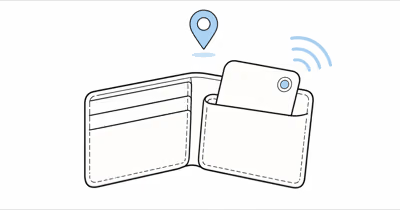
The Pebblebee Card 5 is built for one job: disappearing into an everyday wallet.
At 1.8mm thick, it sits behind your credit cards and stays out of the way. That is the highest compliment you can pay a wallet tracker. Previous card trackers often felt like a compromise: too thick, too short on battery, or locked into a single ecosystem. The Card 5 addresses all three.
- 1.8mm thickness makes the Card 5 roughly 30% thinner than the previous generation and thinner than every major competitor including Chipolo CARD Spot (2.4mm) and Tile Slim (2.3mm)
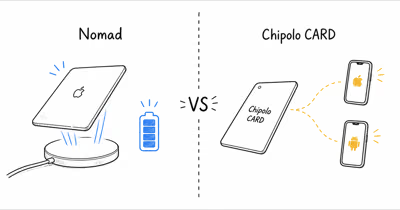
- Qi wireless charging replaces proprietary cables — drop it on any standard charging pad overnight (see our Card 5 charging troubleshooting if your pad isn’t aligning correctly)
- 18-month battery life is the longest of any sub-2mm card tracker available in 2026
- Apple Find My or Google Find Hub support means it works with either ecosystem, but you choose one at setup (switchable via factory reset). It ranked second in our best dual-network tracker roundup
- No UWB Precision Finding — you get general location and sound-based finding, not directional arrows on your phone screen
Pebblebee Card 5: Full Specifications
The Card 5's headline trick is that you choose your network at setup. Pick Google Find Hub and you tap a crowdsourced network Google describes as over a billion Android devices; pick Apple Find My and you get a comparable billion-plus pool on iPhone. Either way the rechargeable battery and 1.8 mm card body, listed below, stay the same.
| Spec | Pebblebee Card 5 |
|---|---|
| Release Date | November 2025 |
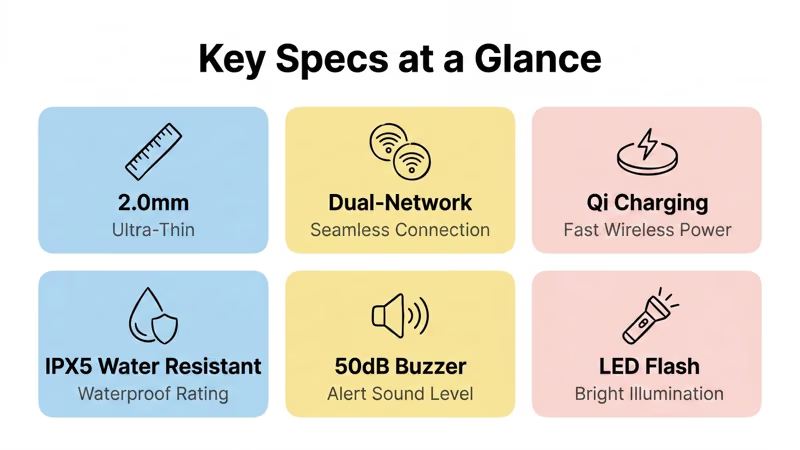
| Thickness | 1.8mm (~0.07 in, roughly 2 credit cards) |
| Weight | 14g (0.49 oz) |
| Networks | Apple Find My OR Google Find Hub (choose one at setup) |
| Bluetooth | Bluetooth Low Energy |
| Detection Range | Up to 500ft (152m) open air |
| UWB Precision Finding | No |
| Battery | Built-in rechargeable, Qi wireless charging |
| Battery Life | Up to 18 months per charge |
| Water Resistance | IP66 (dust-tight, resistant to high-pressure water jets) |
| Speaker | Loud buzzer + LED strobe |
| Extras | NFC "Link" scan-to-return, Phone Finder (double-press) |
| Subscription | None |
| Price | ~$35 (MSRP $34.99) |
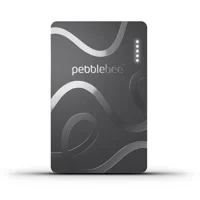 Top Pick
Pebblebee Card 5
- Thinnest rechargeable card tracker at 1.8mm
- Qi wireless charging works with any standard pad
- 18-month battery life eliminates frequent charging
- Works with Find My or Find Hub at your choice
- NFC scan-to-return card helps recover lost wallets
- No simultaneous dual-network (pick one at setup)
- No UWB Precision Finding
- Buzzer is quieter than Pebblebee Clip 5's 130 dB siren
- IP66, not IP67 (no submersion rating)
How Thin Is the Card 5 in a Wallet?
The Card 5 measures 85.6 x 54mm, the exact dimensions of a standard credit card (ISO/IEC 7810 ID-1). At 1.8mm thick and 14g, it occupies about the same space as two stacked credit cards, so a slim bifold or a front-pocket cardholder closes without any extra bulge. That is not true of every card tracker.
The matte finish has a slight texture that keeps it from sliding against smooth leather interiors. On the back, there is an NFC "Link" area with a QR code. If someone finds your wallet, they can tap any NFC-capable phone to the card or scan the QR code. A pre-set contact message appears, no app required on their end.
The Card 5 uses a rigid card-style body, which matters for something living inside a wallet that gets sat on regularly. The LED indicator is visible along one edge and pulses when the card is ringing or charging.
Compared with the older Pebblebee Card, the Gen 5 redesign shaved 30% off the thickness versus the Card 4 while keeping a rigid card body.
How It Compares in Thickness
| Tracker Card | Thickness | Battery Type |
|---|---|---|
| Pebblebee Card 5 | 1.8mm | Qi rechargeable |
| Chipolo CARD Spot | 2.4mm | Sealed (2-year, non-replaceable) |
| Tile Slim | 2.3mm | Sealed (3-year, non-replaceable) |
| Orbit Card | 2.4mm | USB-C rechargeable |
The 0.5-0.6mm advantage over competitors may not sound like much on paper, but it can matter in a packed wallet. For a broader comparison across all card-format trackers, our best wallet tracker cards roundup covers seven options head to head.
Network and Tracking Performance
Here is the most important detail about the Card 5 that gets glossed over in marketing: you choose Apple Find My or Google Find Hub at setup, not both simultaneously. The Clip 5 follows the same one-network-at-a-time model, but in a louder keychain form factor. Our Pebblebee Clip 5 review covers that clip form factor in depth. The Card 5 connects to one network or the other.
If you're choosing between Android-first and dual-network hardware, our Pebblebee Clip 5 and Moto Tag 2 covers the tradeoffs.
You can switch networks later, but it requires a factory reset and re-pairing -- it isn't a toggle you flip daily. Pick the network that matches your phone and stay with it: iPhone users should choose Find My, and Android users should choose Find Hub. Mixed households lose the dual-network advantage that makes the Clip 5 special.
For a detailed breakdown of how these two networks compare, see our Find Hub vs Find My guide. If you want another card-form tracker that can be set up on either network, our Rolling Square AirCard Pro Dual review covers the alternative.
According to Apple's Find My network overview, the crowd-sourced system includes over a billion active devices worldwide. On the Find My network, the Card 5 taps into those over a billion Apple devices, so busy areas have more relay opportunities than quiet ones.
On Find Hub, it reaches over 3 billion Android devices. Dense urban areas usually create more relay chances, while quieter residential areas can leave longer gaps between updates.
That's standard for any Bluetooth tracker without GPS, and for a wallet that's sitting in your house somewhere, network density matters more than a fixed refresh interval.
The rated 500ft (152m) Bluetooth range applies to open air. Through walls and inside buildings the practical range is much shorter, in line with what Tom's Guide found in their testing of Pebblebee's Gen 5 trackers. In practice, range matters less than network density for a wallet tracker -- your wallet is usually indoors, and the crowd-sourced network does the heavy lifting.
Battery Life and Qi Wireless Charging
Pebblebee rates the Card 5 at up to 18 months per charge -- the longest battery life of any rechargeable card tracker currently available. The Chipolo CARD Spot lasts about 2 years but uses a sealed, non-replaceable battery: when it dies, you recycle the entire card and buy a new one. The Tile Slim stretches to 3 years, same deal. See how the Card 5 stacks up in our best rechargeable Bluetooth trackers ranking.
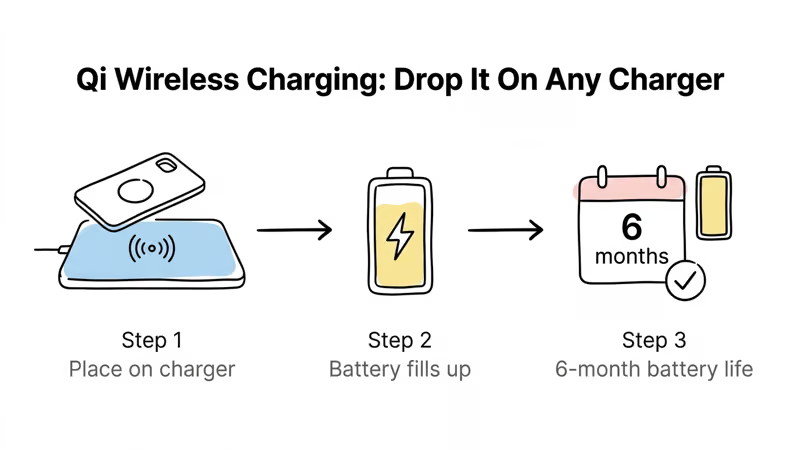
The Card 5 takes a different approach. Drop it on any Qi-compatible wireless charging pad for Pebblebee's listed charge window -- no proprietary cables, no micro-USB nonsense, no hunting for the right connector. If you already charge your phone wirelessly, place the Card 5 next to it when the low-battery alert appears. That's it, and the LED pulses while charging and goes solid when complete.
Pebblebee's official Card 5 spec page confirms that Qi wireless charging reaches full capacity in approximately 3 hours. This is a real step up from earlier Pebblebee cards that used USB-C.
Qi charging means you never need to remove the card from its case or dig through a drawer for a specific cable. The trade-off compared to sealed-battery competitors: you do have to remember to charge it eventually.
Both the Find My and Find Hub apps send low-battery alerts well before the card goes dark, so you won't be caught off guard. 9to5Google's hands-on with the Gen 5 lineup confirmed the wireless charging works reliably across multiple pad brands.
Sound, LED, and Finding Features
The Card 5 has a built-in buzzer that rings when triggered from your phone. In a quiet room it's easy to locate by ear; in a noisy place like a coffee shop or airport it's harder to hear. The buzzer is noticeably quieter than the Clip 5's 130 dB siren, which is expected given the Card 5's ultra-thin form factor -- you can't fit the same acoustic chamber into 1.8mm of space.
An LED strobe complements the buzzer for low-light situations. If your wallet slips between sofa cushions or under a car seat at night, the flashing LED can be easier to spot than the buzzer is to hear. Both features activate simultaneously when you trigger "Play Sound" from Find My or Find Hub.
The Phone Finder feature works via double-press on the card's button. Your phone rings even if it's on silent mode, and this works bidirectionally: lose your phone, press the card; lose your wallet, trigger the card from your phone. It's a feature that Tile popularized years ago, and it remains useful for the daily "where did I put my phone" moment.
What you don't get: UWB Precision Finding. There are no directional arrows guiding you to within inches of the card -- you hear the buzzer, see the strobe, and use your ears and eyes to narrow it down. For most wallet-finding scenarios (it's in the house somewhere, or you left it at the office), the buzzer-and-LED approach is sufficient.
One feature gap that surprises new owners is the lack of a native separation alert. The Card 5 won't buzz your phone the moment you walk away without your wallet. Our guide to the Card 5 separation warning workaround covers how to get an equivalent alert using Virtual Fence or your phone's own settings.
If you need UWB precision, the only wallet-compatible option is stuffing an AirTag 2 into an AirTag wallet, which adds bulk.
As 9to5Mac noted, the card form factor trades UWB for thinness, and for wallet use that is usually the right trade.
Pebblebee Card 5 vs the Competition
| Feature | Pebblebee Card 5 | Chipolo CARD Spot | Tile Slim |
|---|---|---|---|
| Thickness | 1.8mm | 2.4mm | 2.3mm |
| Weight | 14g | 16g | 15g |
| Network | Find My or Find Hub | Find My only | Tile network |
| Battery | Qi rechargeable, 18 months | Sealed, ~2 years | Sealed, ~3 years |
| Water Resistance | IP66 | IPX5 | IP68 |
| UWB | No | No | No |
| Phone Finder | Yes | Yes | Yes |
| NFC Scan-to-Return | Yes | No | No |
| Subscription | None | None | $29.99/yr for full features |
| Price | ~$35 | ~$35 | ~$30 |
Chipolo CARD Spot is the main alternative for iPhone users. It's Find My-only, 0.6mm thicker, and uses a sealed battery that lasts about 2 years before you need to replace the entire card. Chipolo does offer a recycling program with a discount on the replacement -- if you prefer never thinking about charging and you're on iPhone, the CARD Spot is a solid choice. See our Chipolo vs Pebblebee comparison for the full breakdown.
Tile Slim has the longest battery at 3 years, but Tile's network is the smallest of the three options and the $29.99/year subscription unlocks features like Smart Alerts that competitors include for free. At $30 for the hardware plus ongoing fees, the total cost of ownership exceeds the Card 5 within the first year.
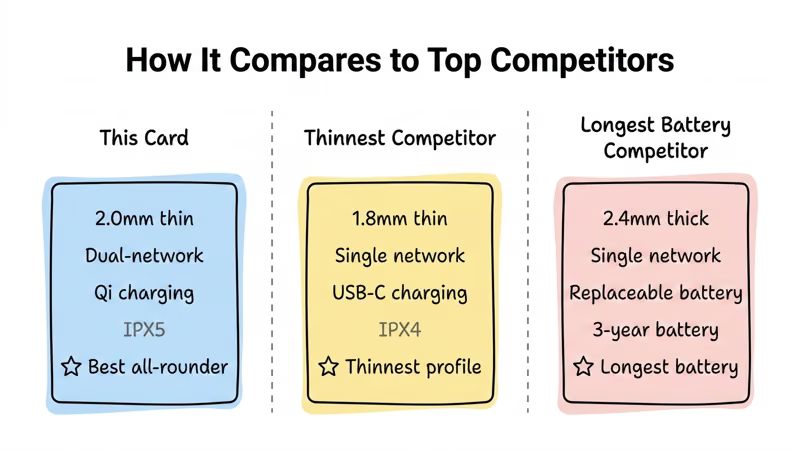
Wirecutter's best Bluetooth tracker guide recommends evaluating card trackers on thickness, battery type, and network coverage. The Card 5 wins on three fronts: thinnest profile, rechargeable battery, and network flexibility. The trade-off is needing to charge it every 18 months instead of buying a replacement card every 2-3 years, which most owners will prefer over generating e-waste.
Who Should Buy the Pebblebee Card 5?
Buy the Card 5 If...
- You want the thinnest rechargeable card tracker for a slim wallet or front-pocket cardholder
- You prefer wireless charging over sealed disposable batteries
- You use Android and want a card tracker on Google Find Hub (most competitors are Find My-only)
- You want NFC scan-to-return for lost wallet recovery
Skip the Card 5 If...
- You need one physical tracker visible in Find My and Find Hub at the same time. No current consumer card or tag does that
- You want UWB Precision Finding. Only the AirTag 2 offers that, and you would need a dedicated AirTag wallet to make it work
- You prefer set-and-forget with no charging at all. The Chipolo CARD Spot (2-year sealed) or Tile Slim (3-year sealed) require zero maintenance until replacement
- You carry a thick bifold wallet where 0.5mm of extra thickness doesn't matter. In that case, any of the best wallet finders will work
Bottom Line
The Pebblebee Card 5 is the wallet tracker to beat in 2026. At 1.8mm with Qi wireless charging, 18-month battery life, and the option to run on Find My or Find Hub, it checks every box that matters for daily carry. The lack of UWB Precision Finding is the one real gap, but no card-format tracker offers UWB today.
At $35 with no subscription, it costs the same as or less than the competition while being thinner, rechargeable, and more flexible in network choice. If you lose your wallet more than once a year, this card pays for itself immediately. And for Bluetooth trackers across all form factors, we've that covered too.
FAQ
Does the Pebblebee Card 5 work with both iPhone and Android?
Yes, but not simultaneously. You choose Apple Find My or Google Find Hub during setup. iPhone users should pick Find My. Android users should pick Find Hub. You can switch later via factory reset and re-pairing, but the card only connects to one network at a time.
How thin is the Pebblebee Card 5 compared to a credit card?
The Card 5 is 1.8mm thick, roughly the same as two credit cards stacked together. A standard credit card is about 0.76mm. It matches credit card length and width exactly (85.6 x 54mm), so it fits any standard card slot without modification.
Can you use the Pebblebee Card 5 on Find My and Find Hub at the same time?
No. The Card 5 connects to one network at a time. You choose Find My or Find Hub during initial setup. The Pebblebee Clip 5 works the same way; it supports either network, but only one is active per setup.
How long does the Pebblebee Card 5 battery last?
Pebblebee rates it at up to 18 months per charge. It recharges wirelessly on any Qi-compatible charging pad. Both Find My and Find Hub send low-battery alerts before it runs out, giving you time to top it off.
Is the Pebblebee Card 5 waterproof?
It has an IP66 rating, which means it's dust-tight and resistant to high-pressure water jets. It handles rain, spills, and sweaty pockets without issue. However, IP66 doesn't include a submersion rating like IP67, so avoid dropping it in water.
Does the Pebblebee Card 5 have UWB Precision Finding?
No. The Card 5 uses Bluetooth Low Energy for tracking. You can ring it and use the buzzer plus LED strobe to locate it, but there are no directional arrows on your phone screen. No card-format tracker currently offers UWB. For Precision Finding, the only option is an AirTag 2 in a wallet holder.
What is the difference between Pebblebee Card 5 and Clip 5?
The Card 5 is a 1.8mm credit-card-shaped tracker for wallets with Qi wireless charging and 18-month battery. The Clip 5 is a keychain tracker with a built-in clip, 130 dB siren, USB-C charging, and 12-month battery. Both support Find My or Find Hub with one active network per setup; the biggest differences are form factor, alarm volume, and charging cable versus Qi.