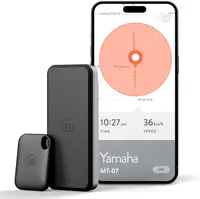
Monimoto is the better motorcycle GPS tracker for most riders. It costs less than Invoxia over three years, uses CellLocate technology for obstructed-location recovery, and works worldwide on 2G/LTE-M networks. Invoxia’s advantages are its rechargeable long-life battery and geofencing, but its higher ongoing costs and less motorcycle-specific security loop make it harder to justify.
Your motorcycle gets stolen. You open your phone. How fast can you tell police exactly where it’s?
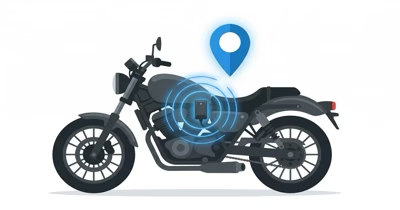
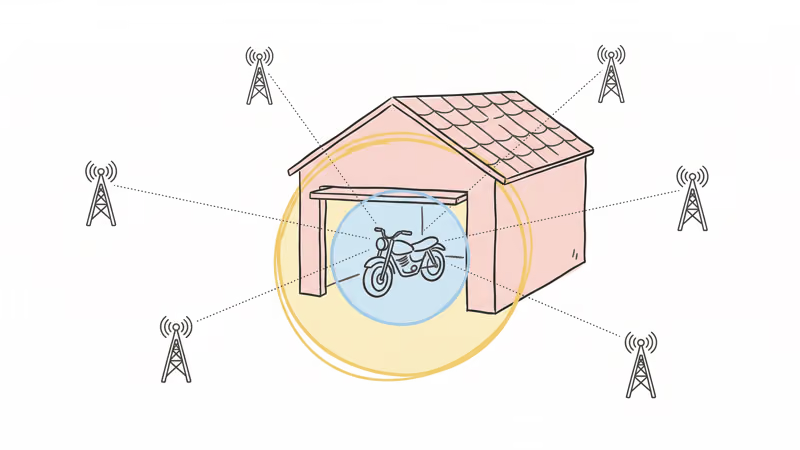
That’s the only question that matters when picking a motorcycle GPS tracker, and it’s where Monimoto pulls ahead. (For the full landscape beyond these two, our best motorcycle GPS trackers guide covers seven options.) Its CellLocate technology triangulates position using cell towers when satellite GPS is weak — exactly the scenario you face when a stolen bike ends up inside a garage or shipping container.
What decides recovery comes down to three things: accuracy in obstructed conditions, total three-year cost, and how each tracker arms itself against theft. This comparison breaks down both devices on exactly those points, with the published specs and pricing laid out side by side, so you can see which one fits how you actually ride, where you park, and how much you want to spend keeping the bike findable.
- Monimoto’s CellLocate stack is better suited to obstructed recovery; Invoxia relies more heavily on GPS and can drift in weak signal areas
- 3-year total cost: Monimoto ~$237 vs Invoxia ~$369 — a $132 difference that compounds over time
- Monimoto uses a keyfob proximity system that triggers alerts only when the bike moves without you, reducing false alarms
- Invoxia has a long-life rechargeable battery vs Monimoto’s replaceable cells — but Monimoto’s battery swap avoids routing a USB cable
- Both support DIY installation with no wiring required
Monimoto vs Invoxia at a Glance
⇄ Head-to-head
Monimoto 9 vs Invoxia Cellular GPS
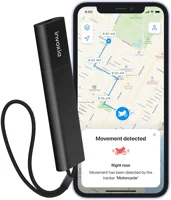
- +CellLocate positioning helps inside garages and containers
- +$2.85/mo subscription — cheapest in the category
- +Keyfob auto-arming reduces motion-only false alerts
- +Compact puck shape easier to hide than rectangular trackers
- +2G + LTE-M coverage works worldwide
- +Long-life rechargeable battery for low-maintenance installs
- +Geofencing alerts when bike leaves a designated zone
- +SOS button for personal-safety scenarios
- +First year of cellular service included
- +Multiple mounting options (magnetic + cable ties + adhesive)
- −Replaceable CR123A batteries (~$5/yr) instead of rechargeable
- −No geofencing or SOS button
- −Keyfob is one more thing to keep on your keychain
- −GPS-first positioning can drift in obstructed signal
- −$120/yr renewal after the first year
- −Larger, more rectangular body harder to hide
- −Geofencing requires fixed parking spot to be useful
You want maximum recovery accuracy in obstructed locations, the lowest 3-year cost, and a hands-free auto-arming security loop.
You park your bike in a fixed location daily, value a rechargeable long-life battery, and want geofencing plus SOS.
Which Tracker Is More Accurate?
The whole point of a motorcycle GPS tracker is locating a stolen bike fast enough for police to recover it. Accuracy under imperfect conditions separates a useful tracker from a vaguely reassuring gadget.
Monimoto uses CellLocate technology alongside GPS and GLONASS satellites. When satellite signal is weak — inside buildings, parking garages, metal containers — CellLocate triangulates position using cell towers, which is the scenario motorcycle theft recovery often has to handle.
Invoxia relies primarily on GPS/GLONASS. In open-sky conditions, that positioning stack can work well.
Signal obstruction adds variance. That extra uncertainty matters when you’re directing police to a specific garage in a row of identical units, because a broader location estimate can still leave too many doors, sheds, or storage bays to check quickly.
For more on how GPS accuracy compares to Bluetooth-based tracking, see our GPS vs Bluetooth tracker comparison.
Installation
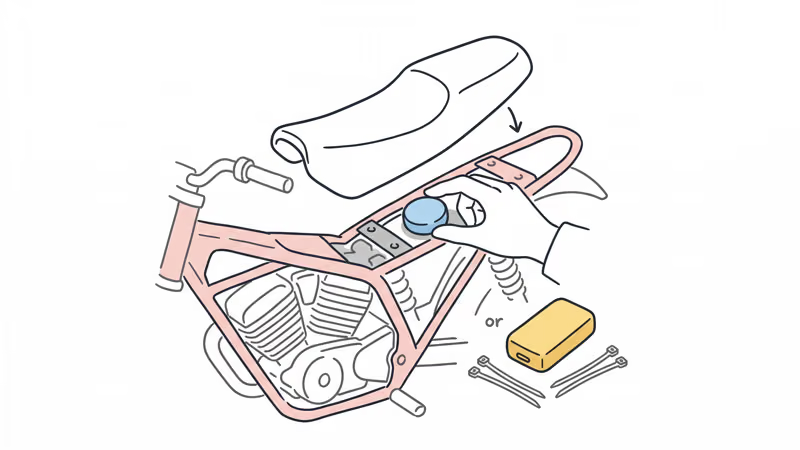
Both trackers are designed for DIY installation. No wiring, no dealer visit, no voiding your warranty.
Monimoto is a rounded puck about the size of a soda can.
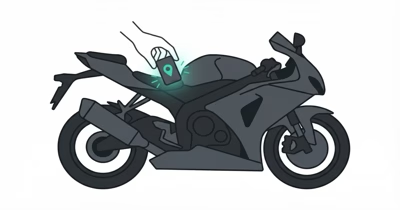
A strong internal magnet lets you stick it to any metal surface on your frame. Most riders tuck it under the seat or behind a side panel. The wireless design means zero cable routing.
Invoxia is slightly larger with a rectangular shape.
It also has magnetic mounting, plus cable ties, screws, and adhesive pads in the box. The extra mounting options are nice, but the angular body is harder to hide in tight spaces compared to Monimoto’s compact puck.
Both need to be hidden well enough that a thief won’t spot them during a quick inspection.
For ideas on concealed tracker placement, see our guide on hiding an AirTag on a motorcycle — the same principles apply to any tracker.
How Much Does Each Tracker Cost Over 3 Years?
| Monimoto | Invoxia | |
|---|---|---|
| Device | $169 | $129 |
| Year 1 data | $34.20 | Included |
| Year 2 data | $34.20 | $120 |
| Year 3 data | $34.20 | $120 |
| Total | $237.40 | $369 |
Monimoto costs $132 less over three years despite a higher upfront price. Invoxia bundles the first year of service, which looks attractive initially, but the $120/year renewal fee quickly erases that advantage.
At $2.85/month, Monimoto has one of the lowest ongoing costs of any GPS tracker on the market.
For comparison, some car GPS trackers skip monthly fees entirely but lack the real-time alerts that motorcycle security demands.
Battery Life
Invoxia’s rechargeable battery is designed for long intervals between charges. That’s impressive for riders who don’t want a frequent maintenance loop, but it also means planning a charging route if the tracker is buried deep behind trim or bodywork.
Monimoto uses two replaceable CR123A batteries instead of an internal rechargeable pack. Monimoto’s official spec sheet states that the Monimoto 9 runs up to 12 months on a battery set.
The same spec sheet confirms that the tracker uses CR123A cells, and it states that the keyfob uses a CR2032 coin cell.
The Invoxia approach is more convenient long-term. But the Monimoto approach is operationally simpler — you’re not routing a USB cable to a hidden tracker, and if the battery dies, you just pop in fresh cells on the spot.
Tom’s Guide’s best GPS tracker picks and CNET’s best GPS tracker guide both treat recovery workflow and battery longevity as critical factors for vehicle trackers that sit idle for weeks, which is why the battery-access trade-off matters as much as the headline runtime.
Features That Actually Matter
Monimoto’s Keyfob System
This is Monimoto’s standout security feature: a keyfob arms the tracker when you walk away.
No manual arming, app tap, or routine check-in.
Come back and it disarms automatically. The keyfob system is designed to reduce false alerts compared with motion-only arming.
False alerts are a common complaint with motion-based alert systems, and the keyfob approach solves that problem cleanly.
Invoxia’s Geofencing and SOS
Invoxia lets you set virtual boundaries on the map.
If your bike leaves a designated zone, you get a push notification. Useful if your motorcycle is parked at a shop or stored at a friend’s place.
The SOS button sends an emergency alert with your GPS coordinates to pre-set contacts. This is a personal safety feature rather than anti-theft, but it’s a nice addition for solo riders.
What Both Offer
Motion and tilt detection are standard on both.
If someone starts tilting your bike to load it onto a trailer, both trackers will alert you.
Both also provide location history so you can review routes after a theft or recovery.
Reliability
Both companies have established track records. Invoxia has been in the GPS tracking space since 2014. Monimoto launched in 2016 with a specific focus on motorcycle security.
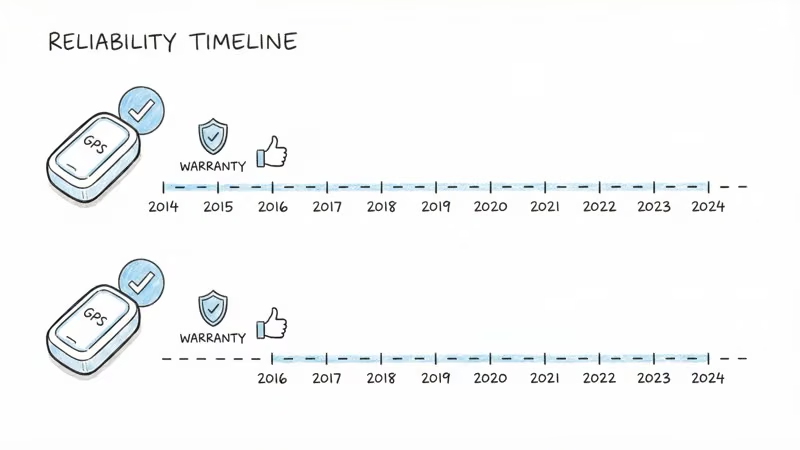
User reviews on Amazon and motorcycle forums mention occasional firmware bugs and connectivity hiccups for both brands — standard for any IoT device. Neither has a significant reliability advantage over the other.
Monimoto’s 2-year warranty covers manufacturing defects. Invoxia offers a similar warranty period. Both have responsive customer support based on community feedback.
Bottom Line
Monimoto wins for most motorcycle owners. It’s better matched to the conditions that matter (indoor/obstructed), costs less over three years, and the keyfob system reduces the false alarm problem that plagues motion-only trackers. Invoxia’s long-life battery and geofencing are genuine advantages, but they don’t outweigh the positioning and cost gaps for typical riders.
If your bike gets stolen, you want the tracker with the stronger obstructed-location recovery workflow. That’s Monimoto. If you’re choosing an Invoxia for a car rather than a motorcycle, our Invoxia vs Tracki comparison weighs it against a cheaper-hardware, pay-monthly rival.
FAQ
Can Monimoto track a motorcycle in real time?
Yes, once the tracker detects unauthorized movement, it sends GPS coordinates to your phone at regular intervals until you acknowledge the alert or the bike stops moving. The updates aren’t as frequent as a pet tracker like Tractive GPS, but they’re meant to relay a theft route to police.
Does Monimoto work outside the US?
Yes. Monimoto supports 2G and LTE-M networks across Europe, North America, and most other regions with cellular coverage. The eSIM in the Monimoto 9 model handles international roaming automatically. Monimoto’s coverage map states that Monimoto 7 and 9 country support varies by region, so check your specific country before purchasing.
How hard is it to replace Monimoto’s battery?
It’s a simple housing-open swap. Remove the tracker from the bike, twist the housing open, swap the two CR123A batteries, and close it back up. No tools required.
Will a GPS tracker prevent motorcycle theft?
No tracker prevents theft — a determined thief will take the bike regardless. What a GPS tracker does is improve the recovery workflow by giving you and police a location lead. The tracker’s value is in what happens after the theft, not before it.
Can thieves disable these trackers?
If they find it, yes. Both trackers can be physically removed. That’s why concealed installation matters. Monimoto’s compact puck shape is easier to hide than Invoxia’s larger rectangular body. Some riders install two trackers in different locations as backup. Neither device broadcasts its presence visually.
Is Invoxia’s geofencing useful for motorcycles?
It’s most useful if you park your bike at a fixed location daily, like a workplace lot or apartment garage. You set a zone, and any movement outside it triggers a notification. For riders who park in different spots regularly, geofencing requires constant zone updates, which reduces its practicality.
Do these trackers work on scooters and ATVs?
Yes. Both Monimoto and Invoxia work on any vehicle with a metal surface for magnetic mounting. Riders use them on scooters, ATVs, jet skis, and even boats. The key requirement is hiding the tracker somewhere a thief won’t look during a quick grab.