Both the Momax PinTag and Apple AirTag use the same Find My network, but the AirTag adds UWB Precision Finding, a louder speaker, and IP67 water resistance for $29 vs about $10. For most people tracking everyday items, the PinTag covers the core Find My job at roughly one-third of the cost. The AirTag is worth the premium only if you need Precision Finding or plan to track just one or two high-value items.
The Momax PinTag often sells around $10. The Apple AirTag costs $29. Both connect to the same Find My network of over a billion Apple devices. So what exactly does that extra $19 buy you?
The answer isn’t as simple as “AirTag is better.” Here’s the full breakdown of what that extra $19 actually buys.
Quick Verdict: Which One Should You Buy?
| Choose | Best for | Why | Buy |
|---|---|---|---|
| Momax PinTag | Keys, bags, umbrellas, gym gear, and 3+ low-risk items | Same Find My network, built-in keyring hole, lower cost per item. | Check PinTag on Amazon |
| Apple AirTag 2 | Wallets, laptop bags, luggage, and anything you need to find fast indoors | UWB Precision Finding, louder speaker, IP67 rating, and deeper Apple support. | Check AirTag 2 on Amazon |
- Both trackers use Apple’s Find My network and deliver the same crowd-sourced location tracking.
- AirTag adds UWB Precision Finding, a louder speaker, and IP67 water resistance for $29.
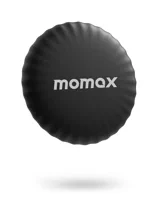
- PinTag often costs around $10 with a built-in keyring hole and comparable battery life (both about 12 months on a CR2032).
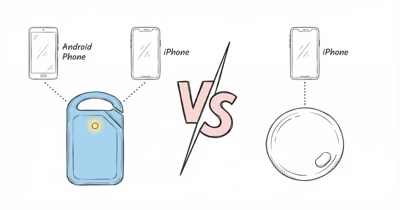
- Neither tracker works with Android — both require iOS 14.5 or later.
- For 4+ items, PinTags save about $59 over AirTags while using the same tracking network.
Momax PinTag vs Apple AirTag 2 at a Glance
⇄ Head-to-head
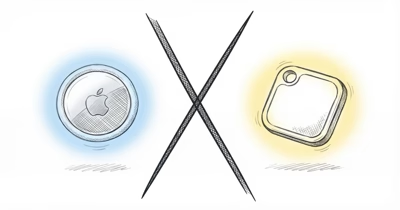
Momax PinTag vs Apple AirTag 2
- +Less than half the AirTag's price on the same Find My network
- +Built-in keyring hole — no $13 loop accessory needed
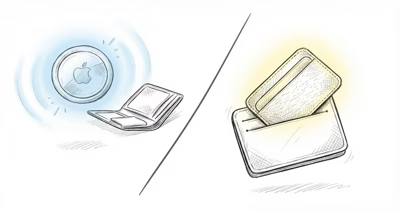
- +Smaller 0.96" body fits wallet card slots and small zipper pulls
- +About 12-month CR2032 battery, on par with the AirTag
- +Same anti-stalking alerts via cross-platform tracker detection
- +UWB Precision Finding with directional arrow + distance (iPhone 11+)
- +Louder, multi-tone speaker that cuts through café and street noise
- +IP67 rating covers accidental submersion, not just rain
- +Tighter Apple integration: Find My, Lost Mode, Vision Pro support
- +$99 4-pack drops effective unit price to $24.75
- −No UWB Precision Finding — relies on sound + general proximity
- −Quieter single-tone speaker drowned out in noisy spaces
- −IPX6 water resistance is rain-safe, but not rated for submersion
- −iOS 14.5+ only; no Android support
- −Shorter direct Bluetooth range than AirTag
- −$29 single is more than 2x the PinTag
- −No built-in attachment point; loop accessory adds ~$13
- −iOS 14.5+ only; no Android support
- −Larger 1.26-inch puck than the PinTag's 0.96-inch body
- −Costs scale linearly with items tracked
You're tracking 3+ items, want the lowest cost on the same Find My network, or need a built-in keyring hole and a smaller body.
You're tracking 1-2 high-value items, want UWB Precision Finding, or value the louder speaker and stronger water resistance.
Both Trackers Share the Same Find My Network
This is the most important thing to understand about this comparison. Both trackers use the exact same Find My network. When your PinTag or AirTag is out of your personal Bluetooth range, the network relies on nearby iPhones, iPads, and Macs to anonymously relay its location to you.
According to Apple, that network covers over a billion active Apple devices worldwide. Apple’s Find My privacy page states that location data is end-to-end encrypted and Apple itself can’t see tracker positions. Detection speed depends on how many participating Apple devices pass near the item.
Because both ride the exact same Find My network, location accuracy is indistinguishable between them. How often the position updates depends on how many Apple devices pass nearby, not on which tracker you bought — dense city blocks refresh faster than quiet suburbs for either one. The PinTag doesn’t have a worse network; it has the same one.
Where Does the AirTag Pull Ahead?
UWB Precision Finding
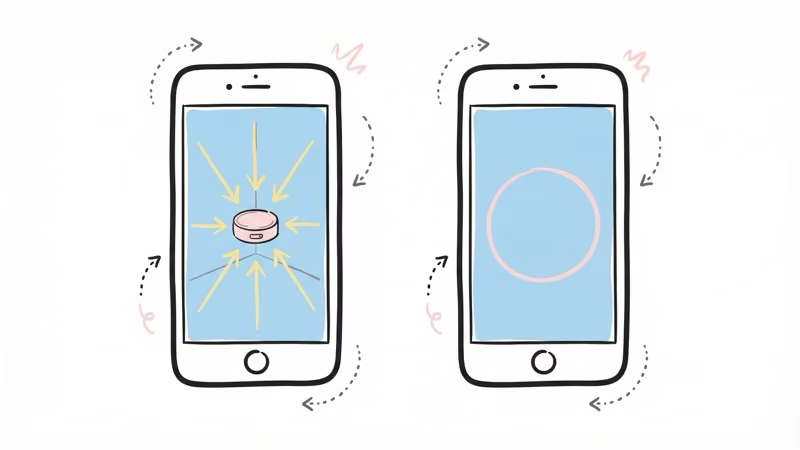
This is the AirTag’s biggest advantage. On an iPhone 11 or later, Precision Finding uses the U1 ultra-wideband chip to guide you directly to the AirTag with arrows, distance readings, and haptic feedback. You literally get a “warmer/colder” experience on your phone screen.
The PinTag doesn’t have UWB. When you’re close to it, you can play a sound from the speaker and use the general proximity indicator in the Find My app. That works, but it’s not the same experience. In a cluttered house or a large office, Precision Finding saves real time.
Leave-Behind Alerts
Leave-behind alerts are not the reason to pay extra for an AirTag. Apple’s Find My app can turn on separation alerts for an AirTag or third-party item, so the PinTag can also warn you when you leave supported items behind.
The practical difference is what happens after the alert. With AirTag, Precision Finding and the louder speaker make the final nearby search easier. With PinTag, you still get the notification, but recovery depends more on map location, Bluetooth proximity, and a quieter sound.
Speaker Volume
The AirTag’s speaker is louder and plays variable tones that are easier to follow. The PinTag emits a single chime that’s audible in a quiet room but gets drowned out by background noise. In a busy cafe, the AirTag’s sound cuts through. The PinTag’s doesn’t always.
Where the PinTag Wins
Price
At about $10 versus $29, the PinTag is roughly one-third the cost. For a single tracker, the $19 difference is easy to justify for AirTag’s extras. But the savings scale:
| Quantity | PinTag total | AirTag total | Savings |
|---|---|---|---|
| 1 | $10 | $29 | $19 |
| 4 | $40 | $99 (4-pack) | $59 |
| 8 | $80 | $198 | $118 |
If you’re tracking eight items, the PinTag saves you more than $100 on the same tracking network.
Built-In Keyring Hole
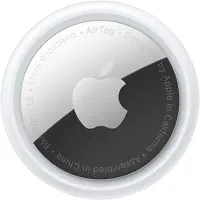
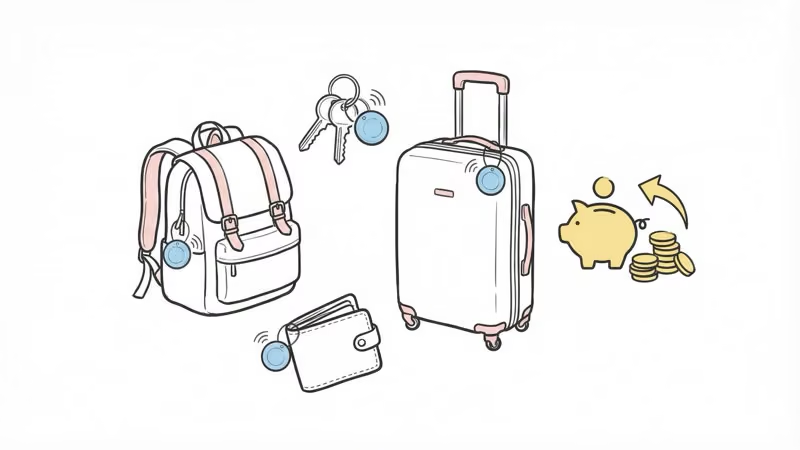
The PinTag comes ready to attach to keys out of the box. The AirTag is a smooth puck with no attachment point. Apple’s cheapest loop accessory costs $12.95, which brings the effective cost to about $42 for a single AirTag on your keychain. The PinTag’s price includes everything you need.
Battery Life
Roughly a tie. Momax’s PinTag spec page rates the battery at up to 12 months on a CR2032, comparable to the AirTag’s roughly year-long life. Both use standard CR2032 cells, so neither holds a meaningful battery edge.
Apple’s AirTag 2 tech specs confirm the same user-replaceable CR2032 design with a second-generation Ultra Wideband chip. According to Momax’s product specifications, the PinTag uses the same CR2032 battery type but skips UWB hardware.
Size
The PinTag is noticeably smaller at 0.96 inches in diameter versus the AirTag’s 1.26 inches. In a wallet card slot, a coin pocket, or attached to a small zipper pull, the PinTag fits where the AirTag won’t. If you’re tracking items where size constraints matter, this is worth considering.
Water Resistance
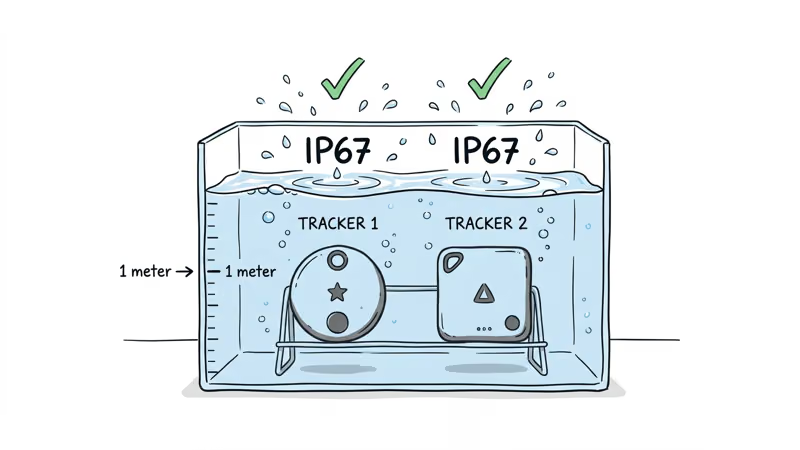
The AirTag is rated IP67 — submersion in 1 meter of water for 30 minutes. The PinTag is rated IPX6, which means it handles rain, splashes, and water jets but is not rated for submersion. For everyday splash and rain protection, both are fine. For accidental sink drops or wet luggage, AirTag has the stronger rating.
Privacy and Anti-Stalking
Both trackers benefit from Apple’s cross-platform tracker detection. If an unwanted PinTag or AirTag is traveling with you, your iPhone will alert you. Android phones with updated Google Play Services also receive these notifications. Both trackers emit a sound after being separated from their owner for an extended period.
The AirTag doesn’t have a meaningful safety advantage here. The anti-stalking protections are built into the Find My network, not into the hardware.
Choosing the Right Tracker
There’s also a solid middle ground: use AirTags for your most important items and PinTags for everything else. AirTag on your laptop bag where Precision Finding matters. PinTags on keys, gym bag, umbrella, and anything you’d rather not spend $29 to track.
The AirTag alternatives guide covers where PinTag fits against the rest of the budget field.
For a deeper look at how the PinTag performs day-to-day, read our full Momax PinTag review. And if you’re considering other options in the Find My tracker market, our roundup covers all the current contenders.
Bottom Line
The AirTag is the better tracker. The PinTag is the better deal. Both use the same network, so the core tracking experience is identical.
The question is whether Precision Finding, a louder speaker, and better water resistance are worth about $19 per tracker to you. For one tracker, probably. For six? Probably not.
FAQ
Does the PinTag work with Android?
No. The PinTag requires Apple’s Find My network, which is iOS-only. If you have an Android phone, look at Samsung SmartTag 2 or Tile Pro 2024 instead. Neither tracker in this comparison supports Android.
Can the PinTag or AirTag prevent theft?
Not really. A thief can remove either tracker in seconds. They’re designed to help you find misplaced items, not stolen ones. That said, marking a tracker as lost means anyone who picks it up will see your contact info, which sometimes helps with recovery.
Do either require a monthly subscription?
No. Both are completely free to use after purchase. The only ongoing cost is a CR2032 battery replacement roughly once a year, which costs about $1.
Is the PinTag’s tracking range really the same as AirTag?
The network range is identical because both use Find My. The difference is direct Bluetooth range: AirTag has the stronger nearby-finding hardware, while PinTag gives you the same crowd-sourced network once either tracker is out of personal range.
Can I mix PinTags and AirTags in the same Find My app?
Yes. You can add up to 16 total items to your Find My account, mixing any combination of AirTags, PinTags, and other compatible trackers like Chipolo Pop or Pebblebee Clip 5.
Which is more water resistant?
The AirTag is more water resistant. AirTag 2 is IP67, meaning it can handle submersion in 1 meter of water for 30 minutes. The PinTag is IPX6, so it handles rain and water jets but is not rated for full submersion.
Is the AirTag 2 worth the upgrade over the PinTag?
The AirTag 2 (released January 2026) added improved speaker volume and better UWB range. Those upgrades widen the gap with the PinTag slightly, but the core value equation is the same: both use Find My, AirTag costs more, PinTag saves money at scale.