Pick Moto Tag 2 if you carry an Android 16 flagship and want UWB plus Channel Sounding precision. Pick Chipolo LOOP for a rechargeable, 125 dB dual-network tag.
Moto Tag 2 and Chipolo LOOP both ride Google’s Find Hub network, but they answer different questions. Motorola’s official Moto Tag 2 page pitches UWB plus Bluetooth Channel Sounding precision and a swappable CR2032 cell, while the LOOP trades a precision radio for a rechargeable battery and the ability to live on Apple Find My or Find Hub.
- Moto Tag 2 has a precision radio, the LOOP does not: UWB plus Channel Sounding for centimeter-class finding versus Bluetooth-only proximity
- LOOP is rechargeable, Moto Tag 2 is replaceable: USB-C cell rated up to a year per charge versus a $1 CR2032 that lasts ~500 days
- Only the LOOP is dual-network: it pairs to Apple Find My or Find Hub, one at a time; Moto Tag 2 is Find Hub only
- LOOP rings louder: a 125 dB alarm versus the Moto Tag 2’s unpublished speaker SPL
- Prices crossed in June 2026: the Moto Tag 2’s U.S. launch reset it to $29.99, now below the LOOP at $39
Moto Tag 2 vs Chipolo LOOP: Spec Comparison
The deciding split is precision versus convenience. Android Authority’s hands-on with Find Hub trackers found that Chipolo and Motorola tags both surface in Google’s app but lean on their own companion apps for extra features, so the hardware radio is what actually separates them. According to Engadget’s 2026 Bluetooth tracker testing, the LOOP runs about 6 months per USB-C charge, while Moto Tag 2 carries a UWB plus Channel Sounding radio the LOOP lacks entirely.
| Spec | Moto Tag 2 | Chipolo LOOP |
|---|---|---|
| Price (single) | $29.99 (U.S. launch) | $39 |
| Network | Google Find Hub only | Apple Find My or Find Hub (one at a time) |
| Precision radio | UWB plus Bluetooth 6.0 Channel Sounding | Bluetooth only (no UWB) |
| Battery type | Replaceable CR2032 | Sealed rechargeable (USB-C) |
| Battery life | About 500 days per cell | Up to 1 year per charge |
| Alarm | Peak SPL not published | 125 dB |
| Water resistance | IP68 (1.5m, 30 min) | IP67 (1m, 30 min) |
| Range | Bluetooth plus UWB direction | Up to about 120m (400 ft) Bluetooth |
| Attachment | Coin puck, holder needed | Built-in silicone loop |
| Subscription | None | None |
The Channel Sounding line hides one constraint: it only activates when both the tag and the phone speak Bluetooth 6.0, which today means Android 16 on a recent flagship. On older Android phones the Moto Tag 2 falls back to UWB or standard Bluetooth ranging, while the LOOP never had a precision radio to begin with.
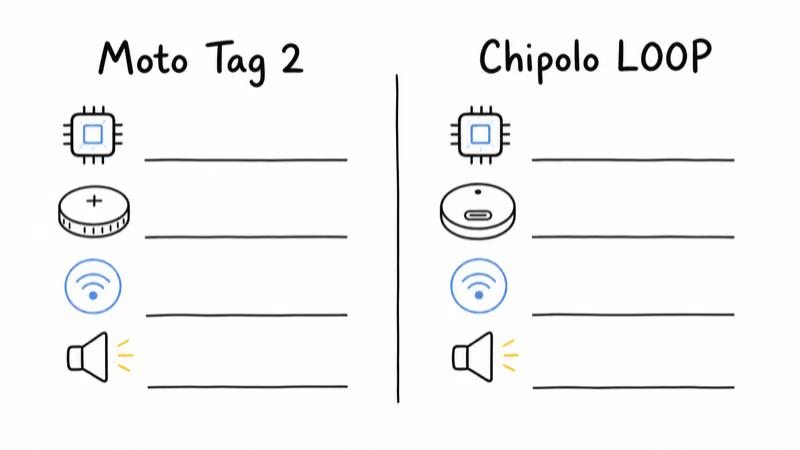
Moto Tag 2 vs Chipolo LOOP: Head-to-Head
⇄ Head-to-head
Motorola Moto Tag 2 vs Chipolo LOOP
- +First tracker to ship Bluetooth 6.0 plus Channel Sounding for sub-meter precision
- +Adds UWB direction so the Find Hub app points you to the item, not just near it
- +About 500 days on a $1 CR2032 you can swap from any drugstore
- +IP68 water resistance survives 1.5 meters submerged for 30 minutes
- +Deep Find Hub integration with phone-finder, camera shutter, and ringtone control
- +Pairs to Apple Find My or Google Find Hub, so it survives an OS switch
- +Rechargeable USB-C cell rated up to a year, no coin cells to buy
- +125 dB alarm is among the loudest in the category for in-house finds
- +Built-in silicone loop clips to keys or a bag with no extra holder
- +Out-of-range alerts in the Chipolo app flag a left-behind item
- −Channel Sounding only activates on Android 16 plus a recent flagship SoC
- −Google Find Hub only; no Apple Find My pairing, even one at a time
- −Coin puck has no built-in attachment, so a keyring holder costs extra
- −Speaker peak SPL is not published, so loudness stays anecdotal
- −The $19.99 U.S.-launch intro price is limited-time; regular is $29.99
- −No UWB or Channel Sounding, so there is no directional precision finding
- −Dual-network is one network at a time; switching needs a factory reset
- −Sealed battery retires the tag in a few years once it stops holding charge
- −Engadget found battery nearer six months than the rated year
- −IP67 is one tier below the Moto Tag 2's IP68
- ·You carry an Android 16 flagship and want centimeter-class precision
- ·You prefer a $1 battery swap over recharging the tag
- ·You want the longest CR2032 cycle in the category
- ·You are a Pixel or Motorola owner who lives inside Find Hub
- ·You want one tag that works whether you switch to iPhone or Android
- ·You hate buying coin cells and prefer recharging over the air
- ·You lose keys inside the house and want the loudest possible ring
- ·You want a built-in attachment with no separate keyring holder
Moto Tag 2: Find Hub’s Precision Flagship
The pitch for Moto Tag 2 is precision-first Android. Motorola dropped a Bluetooth 6.0 radio with Channel Sounding into the puck alongside UWB, so the Find Hub app can show distance and direction rather than just “nearby.” Motorola’s official Moto Tag 2 page states that the tag uses UWB for precise distance and direction and Channel Sounding to pinpoint misplaced keys inside the house.
The page also rates the CR2032 cell to last well over a year between swaps. Because the Moto Tag 2 carries a UWB radio, its directional arrow appears sooner than a Bluetooth-only tag can manage, and the gen-2 radio sharpens that further. For the full daily-carry breakdown, see our Moto Tag 2 review.
The battery story is a quiet strength. The replaceable CR2032 is rated around 500 days, and a refill costs about a dollar from any drugstore, so the tag itself never ages out the way a sealed cell does. The chassis is IP68 rated for 1.5 meters of submersion, a tier above the LOOP, which matters for outdoor and on-water carry.
The trade-off is network lock-in: the Moto Tag 2 pairs only to Google’s Find Hub and never to Apple’s Find My. The precision radio also gates on hardware, since Channel Sounding needs Android 16 plus a current flagship; on older phones the tag falls back to UWB or plain Bluetooth ranging.
For the wider network picture, our Find Hub vs Find My breakdown covers the density math, and how the Moto Tag 2 stacks against Apple’s puck is in our Moto Tag 2 vs AirTag 2 comparison.
Chipolo LOOP: The Rechargeable Dual-Network Tag
The LOOP answers a different need: flexibility over precision. Chipolo’s official LOOP page confirms the tag is rechargeable over USB-C, rated up to a year per charge, carries a 125 dB alarm, and pairs to Apple Find My or Find Hub, though only one network at a time. It also has a built-in silicone loop, so it clips to keys without a separate holder. Our Chipolo LOOP review covers the daily-carry experience in depth.
The headline strengths are loudness and the network switch. At 125 dB the LOOP is among the loudest trackers you can buy, which gives it a spec-sheet edge for the classic “keys are somewhere in this room” hunt. Because it can be reset onto either network, the same tag survives a phone-platform change.
That flexibility matters when a Find Hub-only or Find My-only tag would be stranded after an OS switch. Our best dual-network trackers roundup puts the LOOP in context with the Pebblebee Clip and Chipolo POP.
The cost of that convenience is the sealed cell and the missing radio. The battery is rechargeable but not replaceable, so the tag retires in a few years, and Engadget’s testing puts runtime closer to six months per charge than the rated year. The LOOP also has no UWB or Channel Sounding, so it can ring loud but can’t point you to the exact spot. If recharging is the appeal, our rechargeable tracker guide compares it with the alternatives.
Which Finds Faster, Channel Sounding or a Louder Ring?
This is the core trade in the comparison, and the answer depends on where you lose things. Outdoors and in large spaces, the Moto Tag 2 wins: UWB plus Channel Sounding gives the Find Hub app a directional arrow and sub-meter distance, so you walk straight to a bag in a parking lot or a coat closet. The LOOP can only tell you it’s nearby, then leave you to follow the sound.
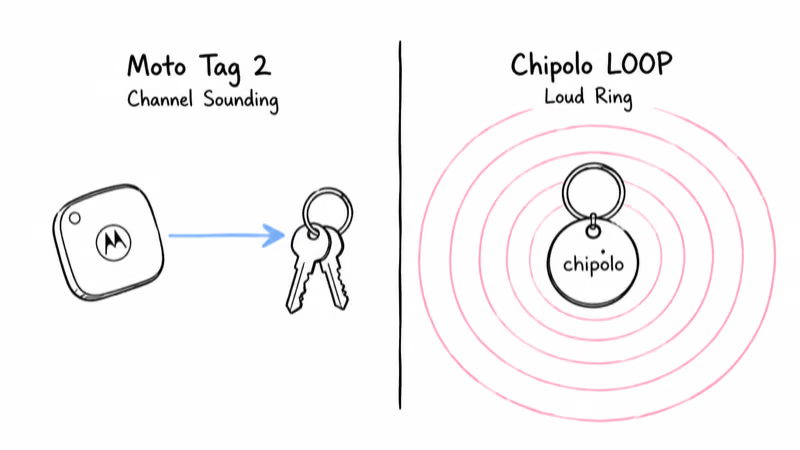
Inside a small home, the math flips. The LOOP’s 125 dB alarm gives it more sound output than a quieter puck, so for keys lost under a couch cushion the loud ring can be more useful than a directional arrow you can read on screen. The Android Authority comparison of Find Hub trackers noted that loud, app-driven extras like out-of-range alerts are where Chipolo pulls ahead of the bare Find Hub experience, while Motorola leans on its radio.
There is also a phone-support gap. The Moto Tag 2’s headline precision needs an Android 16 flagship to fully unlock; on an older or budget Android, you lose Channel Sounding and the gap to the LOOP narrows to “directional UWB if your phone has it” versus “loud ring on anything.” For a broader view, our best Bluetooth tracker guide covers which phones unlock each tracker’s precision features.
Rechargeable or Replaceable: Which Battery Model Wins?
This is the second real fork. The Moto Tag 2 uses a replaceable CR2032 rated around 500 days, so when it dies you spend about a dollar and the tag keeps going for years. The LOOP uses a sealed USB-C cell rated up to a year, which means no coin cells to buy, but the tag itself retires once the battery stops holding a charge, typically in a few years.
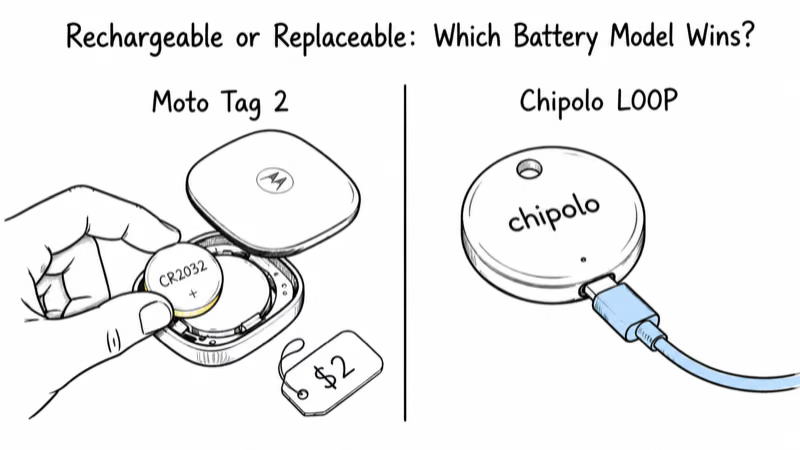
Real-world battery on the LOOP often lands shorter than the rating. Engadget’s reviewers found that the rechargeable LOOP runs about 6 months per charge rather than the rated year, and recharging means remembering to top the tag up. With any rechargeable tag, that reminder-to-charge habit tends to be the real friction, not the battery capacity itself.
The Moto Tag 2’s coin cell is the opposite: set it and forget it for well over a year, then swap in seconds for about a dollar.
On durability the Moto Tag 2 edges ahead with IP68 versus the LOOP’s IP67, since its published rating allows deeper brief submersion. If you want to skip coin cells entirely and value the LOOP’s rechargeable design, the trade is convenience now for a sealed cell that ages the tag out later. For attachment, the LOOP’s built-in loop is a genuine win over the bare Moto Tag 2 puck, which needs a keyring holder.
Who Should Buy Each Tracker
Buy Moto Tag 2 if you carry an Android 16 flagship and want the first hardware implementation of Channel Sounding plus UWB direction, you prefer a $1 battery swap over recharging, you value the IP68 water resistance, or you live deep inside Google’s Find Hub with a Pixel or Motorola phone. It’s the precision pick for Android-only users.
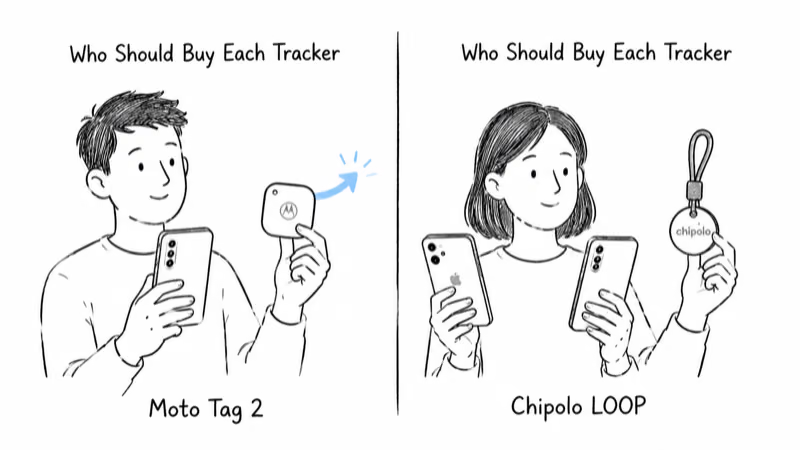
Buy Chipolo LOOP if you want one tag that survives a switch between iPhone and Android, you hate buying coin cells, you lose things inside the house and want the loudest possible 125 dB ring, or you want a built-in silicone loop with no separate holder. It’s the flexible, cross-platform pick.
For mixed-OS households the LOOP is the safer single-tag choice, since the Moto Tag 2 will never pair to an iPhone. The Chipolo LOOP vs AirTag 2 comparison covers the dual-network angle against Apple’s hardware, and the Find Hub hub rounds up every tracker that rides Google’s network.
Bottom Line
Moto Tag 2 and Chipolo LOOP are not the same kind of tracker. The Moto Tag 2 is the precision pick: UWB plus Channel Sounding, IP68, and a $1 replaceable cell, all locked to Android and Find Hub. If you carry a current Android flagship and want a directional arrow to your keys, it’s the answer at $29.99.
The LOOP wins on flexibility and volume. A rechargeable, 125 dB, dual-network tag with a built-in loop is the better buy if you might switch phone platforms, you want the loudest in-house ring, or you simply prefer recharging to coin cells, all for $39. The trade is no precision radio and a sealed battery that retires the tag in a few years.
FAQ
Does the Chipolo LOOP work with both iPhone and Android?
Yes, but only one network at a time. The LOOP pairs to Apple Find My or Google Find Hub, and switching networks requires a factory reset, removing it from the current app and reconnecting it on the other platform. It can’t ping both networks simultaneously, which is a limitation Apple and Google policies impose on all dual-network tags. For day to day use it works fully on whichever network you choose at setup.
Can Moto Tag 2 pair with an iPhone?
No. Moto Tag 2 pairs only to Google’s Find Hub and never to Apple’s Find My, even one at a time. An iPhone owner can detect a nearby unknown Moto Tag 2 through the cross-platform anti-stalking standard and disable it, but can’t register, claim, or track one. If you need a tag that works across platforms, the Chipolo LOOP or another dual-network tracker is the right fit.
Which tracker is more accurate for precision finding?
The Moto Tag 2 is more accurate when its precision radio is active. It combines UWB for direction with Bluetooth 6.0 Channel Sounding for sub-meter distance, so the Find Hub app can point you to the item. The LOOP has no UWB or Channel Sounding, so it can only tell you the tag is nearby and then rely on its 125 dB alarm. The Moto Tag 2 precision features require Android 16 plus a recent flagship to fully unlock.
Is the Chipolo LOOP battery replaceable?
No. The LOOP uses a sealed rechargeable battery that you top up over USB-C, rated up to a year per charge. Because the cell is not user-replaceable, the tag retires once the battery stops holding a charge, typically after a few years. The Moto Tag 2 takes the opposite approach with a swappable CR2032 that costs about a dollar and lets the tag last for years across battery changes.
Which tracker is louder?
The Chipolo LOOP is louder on the published specs. Its alarm is rated at 125 dB, among the loudest of any tracker. Motorola does not publish a peak SPL figure for the Moto Tag 2 speaker, so a direct decibel comparison is not possible, but the LOOP is the only one here with a stated high-output alarm rating. For losing keys inside the house, the LOOP has the edge.
Do either of these trackers need a subscription?
No. Neither the Moto Tag 2 nor the Chipolo LOOP requires a monthly subscription. Both are one-time purchases, $29.99 for the Moto Tag 2 (June 2026 U.S. launch price) and $39 for the LOOP, and all network and app features are included for life. The LOOP’s extra features, such as out-of-range alerts, live in the free Chipolo app, and the Moto Tag 2’s extras live in the Find Hub and moto tag apps.
Which should I buy for a mixed iPhone and Android household?
The Chipolo LOOP is the safer single-tag choice for a mixed household, since it can be set up on Apple Find My or Find Hub depending on who carries it. The Moto Tag 2 only ever pairs to Find Hub, so it’s no use to the iPhone owner in the house. If you want maximum precision on the Android side specifically, you could carry a Moto Tag 2 for Android items and a LOOP for anything that might move to an iPhone.
Does the Moto Tag 2 have a built-in keyring loop?
No. The Moto Tag 2 is a coin puck with no built-in attachment, so clipping it to keys or a bag means buying a separate holder. The Chipolo LOOP has a built-in flexible silicone loop, so it attaches to keys or a zipper pull straight out of the box with no extra accessory. If attachment without buying anything else matters, that is a small but real LOOP advantage.