The Motorola Moto Tag 2 is the first Bluetooth 6.0 tracker, with Channel Sounding, UWB, and a 500-day battery. It launched in the US on June 30, 2026 at $29.99. Channel Sounding needs Android 16.
The Motorola Moto Tag 2 is the first Bluetooth 6.0 tracker shipping at retail. 9to5Google’s CES 2026 coverage reported Channel Sounding “is only available on smartphones with Bluetooth 6.0 and Android 16,” limiting the feature on day one.
This review draws battery and UWB context from the original Moto Tag’s published specs and stacks it against the Moto Tag 2 specs. The chassis is identical, so accessory fit and ergonomics carry over.
- Bluetooth 6.0 with Channel Sounding is the headline upgrade, but it requires a Pixel 10 or newer running Android 16 to unlock
- 500-day battery on a single CR2032 is a 37% gain over the original Moto Tag’s 365-day rating
- IP68 water resistance replaces IP67, so the device survives 1.5 meters submersion versus 1.0 meter
- Same physical chassis as the original Moto Tag, so every existing case, holder, and adhesive mount fits
- $29.99 U.S. launch price (June 30, 2026) with a limited-time $19.99 intro deal and a $69.99 4-pack — well below the $39.99 price Motorola quoted at CES
Moto Tag 2: Key Specs and First Impressions
The June 2026 U.S. launch reset pricing: 9to5Google’s report lists $29.99 regular, $19.99 limited-time intro, and a $69.99 4-pack.
Motorola’s Moto Tag 2 product page states: “Go over 500 days on a single battery.” That headline claim lines up with the 37% battery gain Motorola announced at CES 2026 over the original Moto Tag’s 365-day rating. This section pulls from Motorola’s published specs for the retail unit and the established track record of the first-generation Moto Tag.
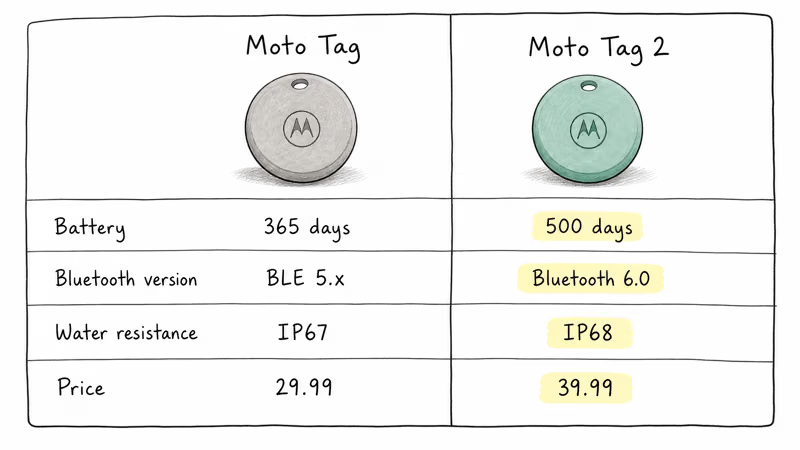
| Spec | Moto Tag 2 | Original Moto Tag |
|---|---|---|
| Bluetooth | 6.0 + Channel Sounding | 5.4 |
| UWB | Yes (retained) | Yes |
| Battery (CR2032) | ~500 days | ~365 days |
| Water resistance | IP68 (1.5 m, 30 min) | IP67 (1.0 m, 30 min) |
| Network | Google Find Hub | Google Find Hub |
| Dimensions | 31.9 × 8.0 mm | 31.9 × 8.0 mm |
| Weight | 7.5 g | 7.5 g |
| Price (single) | $29.99 U.S. launch (limited-time $19.99 intro) | $29.99 MSRP (~$20 street) |
| Multi-pack | $69.99 4-pack at U.S. launch | 4-pack at ~$80 |
At 7.5 grams the Moto Tag 2 stays lighter than the Apple AirTag at 11 g and the Samsung SmartTag 2 at 13.75 g. The disc shape is identical to the first-generation Moto Tag. If you’re deciding whether to upgrade, our Moto Tag 2 vs Moto Tag comparison breaks down what changes from the original Motorola tag.
Because the chassis is identical to the original Moto Tag, AirTag-compatible cases and adhesive mounts fit the new tracker too.
 Hot
HotWhat Is Bluetooth 6.0 Channel Sounding?
Channel Sounding is the precision-distance feature added in the Bluetooth 6.0 specification ratified by the Bluetooth SIG in late 2024. It uses round-trip timing across multiple radio channels to measure the distance between two devices to within centimeters. For a deeper primer on what a Channel Sounding tracker is and how it stacks up against UWB, we cover the technology in full. The Moto Tag 2 is the first item tracker to ship with the feature.
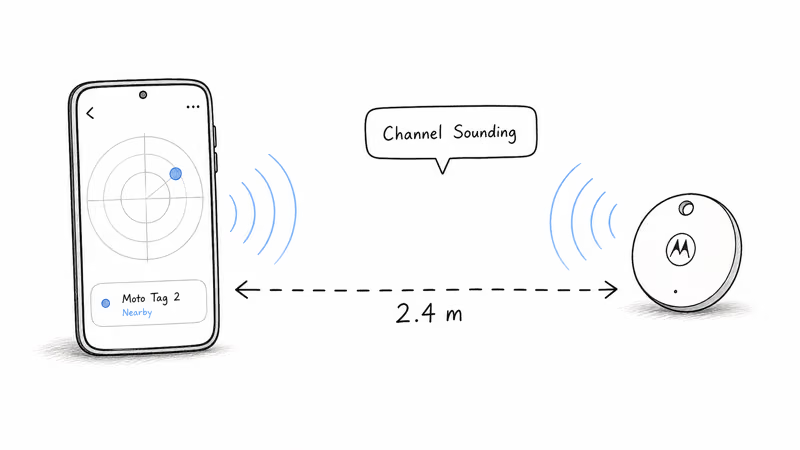
The catch is platform support. According to Motorola’s CES 2026 briefing, Channel Sounding only activates when the paired phone also runs Bluetooth 6.0 and Android 16. That currently means the Pixel 10 series and a small set of Snapdragon 8 Elite Gen 2 flagships shipping later in 2026. iPhone owners get even less, and our look at whether the Moto Tag 2 works with an iPhone explains the limits.
Older Pixels and Galaxy phones fall back to Bluetooth 5.x scanning. The Moto Tag 2 then behaves like the original Moto Tag for those users.
On the original Moto Tag, UWB already covered the “where exactly is this” use case once you were within about 10 meters of the tracker. Channel Sounding adds finer distance estimates beyond the UWB envelope. The benefit is real, but only on Android 16 hardware.
Moto Tag 2 vs Original Moto Tag: Upgrade Path
Three upgrades matter, and one of them only matters on the right phone.
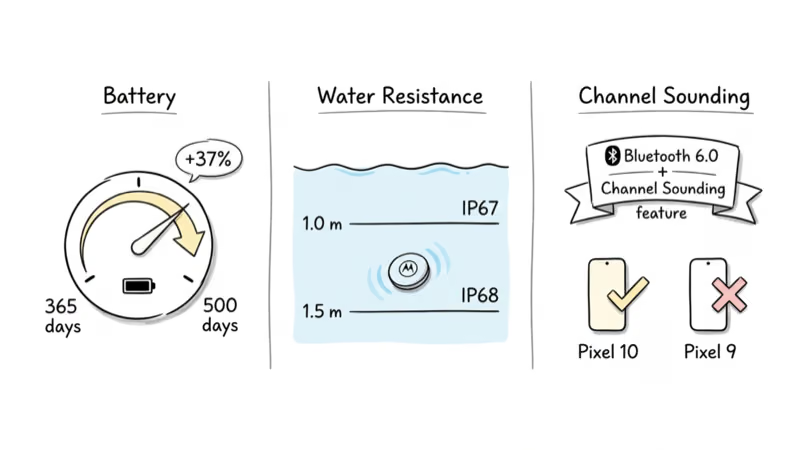
Battery jumps from 365 to 500 days. That is a 37% bump on paper, driven by Bluetooth 6.0’s lower-power scanning plus updated firmware. The original Moto Tag’s 365-day rating is well established, and a 500-day cell at the same usage pattern pushes annual battery swaps down to every 16 months. Across a 4-pack rotation that change cuts a yearly battery purchase out of the schedule.
Water resistance moves from IP67 to IP68. The practical difference is 1.5 meters submersion versus 1.0 meter. According to the IEC’s IP rating standard, IP68 also requires the manufacturer to specify a depth and time, while IP67 is fixed at 1 meter for 30 minutes.
Channel Sounding is the marquee but conditional. Pixel 9 and Galaxy S24 owners don’t get it.
The dimensions, weight, color count, and lack of a built-in keychain hole carry over unchanged. Pantone Arabesque and Pantone Laurel Oak are the new colorways. The June 2026 U.S. launch pricing changed the upgrade math: at $29.99 regular and a $19.99 limited-time intro, the Moto Tag 2 now costs about the same as a first-generation unit, so buying gen-1 to save money no longer makes sense for a fresh purchase.
How Does the Moto Tag 2 Work With Google Find Hub?
The Moto Tag 2 ships as a Find Hub accessory. The relay is the same as before.
Setup is unchanged. You pair through the Moto Tag app on Android 9 or newer. Once paired, the tag joins your Find Hub account alongside any Pebblebee, Chipolo, or eufy trackers you own. The Google Find Hub compatible trackers list covers the broader ecosystem.
Motorola’s product page confirms that device location data is stored within the Google Find Hub network. That means Google’s end-to-end encrypted relay handles location data, not Motorola.
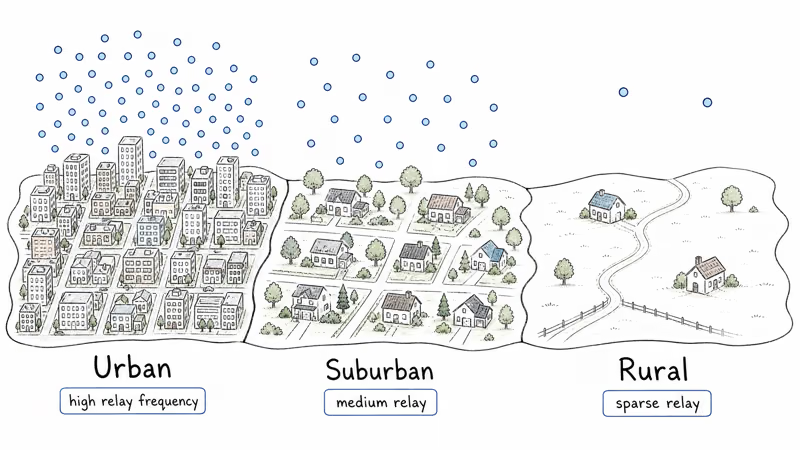
The crowd-sourced part is where Find Hub still trails Apple’s Find My. Find Hub network density depends on how many opted-in Android phones pass near the tag, so busy areas refresh sooner than quiet residential streets. Apple’s Find My security documentation confirms its passive-by-default scanning model, while Google requires opt-in, so density grows more slowly.
For the Moto Tag 2, rural performance still suffers. The new Channel Sounding feature does nothing for crowd-sourced relay. It only helps when you are physically near your own tag with a Bluetooth 6.0 phone in hand. When the map stops moving for reasons beyond thin relay density, our fix for a tag stuck on its last reported spot covers the Find Hub and permission resets to try.
Battery Life and Replacement
The 500-day rating assumes default usage and standard temperatures. Cold weather drops CR2032 capacity by 20-30% near freezing. Energizer’s CR2032 datasheet recommends operating temperatures between 0°C and 60°C for stated runtime.
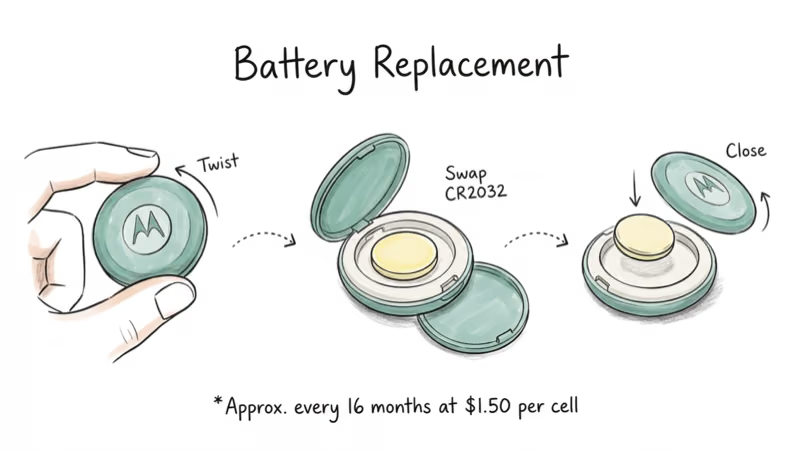
Replacement is identical to the original Moto Tag. Twist the back cover counterclockwise, swap the CR2032, twist closed.
The cover loosens up after the first opening, so the initial unscrewing takes the most effort. A standard CR2032 costs $1.50 at any pharmacy, so total annual maintenance is under $2.
If you are choosing between the Moto Tag 2 and a rechargeable tracker like the Chipolo Pop, our Moto Tag vs Chipolo Pop head-to-head covers the trade-offs. Replaceable CR2032 wins for set-and-forget. USB-C rechargeables win if you object to disposable batteries. For a deeper look at how 500 days stacks up against AirTag, SmartTag 2, and Tile, our Bluetooth tracker battery life comparison ran the numbers across 12 trackers using manufacturer-published cycle assumptions.
Who the Moto Tag 2 Is For
Buy the Moto Tag 2 if…
- You own a Pixel 10 or another Android 16 phone with Bluetooth 6.0, since Channel Sounding is the feature you are paying for
- You replace coin cells reluctantly and want a 500-day cycle
- You need IP68 because you have dropped a tracker in deep water before
- You are starting fresh on Android with no first-generation Moto Tags to migrate
Stick with the original Moto Tag if…
- You already own first-generation tags and can find replacements at $20-25
- Your phone is a Pixel 9 or older, so Channel Sounding does not activate for you
- Annual battery swap is fine and IP67 covers your typical environment
- You find a clearance gen-1 4-pack priced below the Tag 2’s $69.99 4-pack
If you are an iPhone user reading this, the AirTag vs Tile comparison is more relevant than either Moto Tag. Neither Moto Tag works with Find My, only with Find Hub on Android.
Bottom Line
The Motorola Moto Tag 2 is a meaningful upgrade whose value improved sharply at the U.S. launch. Pixel 10 owners on Android 16 get Channel Sounding plus the 500-day battery, and at the $29.99 launch price (or the $19.99 limited-time intro), everyone else on Android gets IP68 and longer battery life for roughly what a first-generation Moto Tag costs.
The Find Hub network is the same. The chassis is the same. If you are buying your first Android tracker today and own an Android 16 phone, the Moto Tag 2 is the strongest non-Samsung option. If you already own first-generation Moto Tags or a Galaxy phone, hold off until your next phone supports Bluetooth 6.0.
FAQ
Where can I buy the Moto Tag 2?
The Moto Tag 2 launched in the United States on June 30, 2026 at $29.99 for a single unit, with a limited-time $19.99 introductory price and a $69.99 4-pack. It sells on Amazon and directly from Motorola.com. Amazon prices fluctuate, so check the current listing before buying.
Does the Moto Tag 2 work with iPhones?
No. The Moto Tag 2 is an Android-only tracker, certified for Google Find Hub. iPhones can detect it as an unknown tracker for anti-stalking alerts but can’t pair with it, locate it, or manage it. If you want a tracker that works on both ecosystems, look at the Chipolo POP or Pebblebee Card 5.
What is the difference between Channel Sounding and UWB?
UWB is a separate radio for sub-meter precision when you are within roughly 10 meters of the tracker, with a directional arrow on screen. Channel Sounding is a Bluetooth 6.0 distance measurement feature that adds finer range estimates beyond the UWB envelope. The Moto Tag 2 includes both, but Channel Sounding only activates on Android 16 phones with Bluetooth 6.0.
Is the 500-day battery claim realistic?
Motorola’s 500-day rating assumes typical Bluetooth-on usage at room temperature. Treat that as a manufacturer estimate rather than a fixed promise: cold weather, frequent ringing, and heavy relay activity can shorten any CR2032 tracker. Since the tag isn’t rechargeable, our Moto Tag 2 battery guide covers cold-weather drain and swapping the coin cell.
Can I attach a Moto Tag 2 to my keys?
Not directly. The Moto Tag 2 has no built-in keychain hole, just like the original Moto Tag and Apple AirTag. You need a third-party case with a loop, a sticker mount, or a leather holder. AirTag-compatible accessories fit because the Moto Tag 2 dimensions match the AirTag.
Is the Moto Tag 2 worth it over the original?
For Pixel 10 owners on Android 16, yes. Channel Sounding plus the 500-day battery make it the default pick, and the $29.99 U.S. launch price removed the old premium over the original. For Pixel 9 and older, or any Galaxy phone, the upgrade is the longer battery and IP68 rating at roughly gen-1 money.
Does the Moto Tag 2 work in checked luggage on flights?
Yes, the same way the original Moto Tag does. Lithium coin cell trackers are permitted in checked bags on most US and international airlines. Find Hub crowd-sourced relay still works through luggage compartments as long as Android phones with Find Hub enabled pass within Bluetooth range.