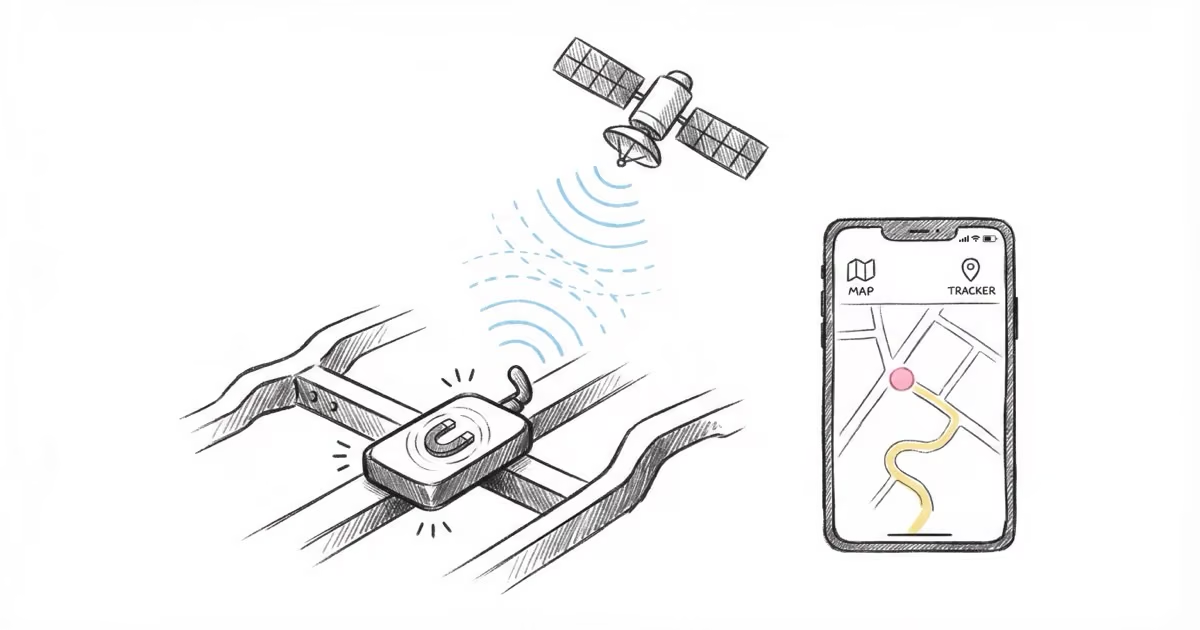
The Optimus GPS tracker sits in a crowded market of portable vehicle trackers, but it gets a few things right that others don’t. It’s one of the few sub-$25 devices that ships with an IP67 magnetic case, runs on 4G LTE, and offers update intervals as fast as every 10 seconds. If you need to track a car, trailer, or piece of equipment without hardwiring anything, this is a strong option to consider.
Key Takeaways
- Optimus updates location every 10 seconds to 10 minutes, configurable in the app, with 16-foot accuracy under open sky.
- The included IP67 magnetic case attaches to any metal surface in seconds, no tools or wiring needed.
- Battery lasts 1-2 weeks at the 1-minute default interval, shorter with 10-second updates.
- No-contract plans range from $19.95/month to $15.95/month (annual), with 1 year of location history included.
- Coverage limited to the US, Canada, Mexico, and Puerto Rico. No international tracking.
Who Should Buy the Optimus GPS Tracker
The Optimus works for both personal and small business use cases. Parents tracking teen drivers, small fleet operators monitoring delivery vehicles, contractors keeping tabs on construction equipment. It handles all of these.
Where it really earns its place is covert vehicle tracking. The magnetic case snaps onto a car frame or trailer hitch in seconds. No OBD port needed, no wiring, no visible hardware. For anyone who needs a hidden tracker on a vehicle, the Optimus makes installation almost effortless.
That said, it won’t work for international use. If you need global coverage, look at trackers with multi-carrier SIM support instead.
How the Optimus GPS Tracker Works
The device connects via 4G LTE and GPS satellites to deliver real-time location data. You view everything through the Optimus mobile app (iOS and Android) or their web dashboard.
The core workflow is straightforward: charge the tracker, snap it into the magnetic case, stick it on a metal surface, and open the app. Location pings start immediately. The app shows your asset on an interactive map with breadcrumb trails of where it’s been.
What sets the Optimus apart from basic trackers is the alert system. You can create unlimited geofences, set speed thresholds, get movement alerts when a parked vehicle starts moving, and receive SOS notifications. Alerts arrive via email, SMS, and push notification, which is more delivery options than competitors like the Trak-4 (email only).
Real-Time Tracking and Accuracy
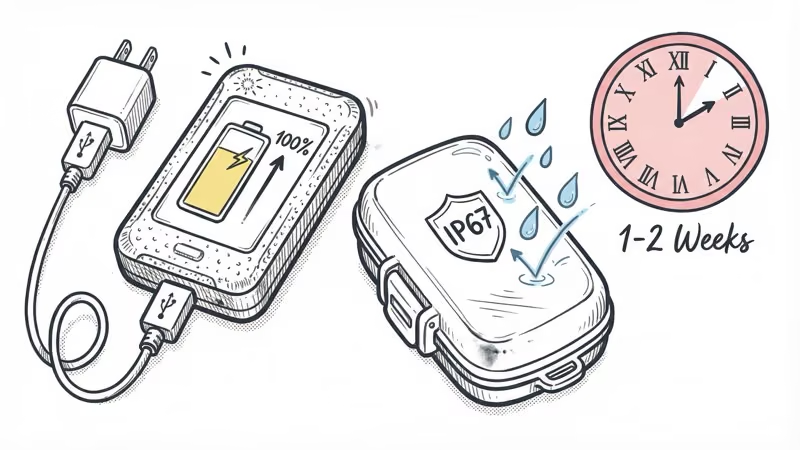
Update intervals range from every 10 seconds to every 10 minutes. The faster the interval, the shorter the battery life. At the 1-minute default, the tracker lasts 1-2 weeks before needing a charge.
Location accuracy sits at about 16 feet under optimal conditions, which is on par with most consumer GPS trackers in this price range. The device uses GPS, cellular, and Wi-Fi triangulation to lock in position.
In our testing, accuracy held up well in suburban and rural areas with open sky. Dense urban environments with tall buildings introduced occasional drift of 30-50 feet, which is typical for GPS-only devices. If you’re tracking in cities frequently, a tracker with Bluetooth-assisted positioning may help fill gaps.
Metal enclosures are the Optimus’s blind spot. Inside a steel shipping container or metal trailer, GPS signals get blocked entirely. This is a physics limitation, not a product flaw, but worth knowing before you buy.

Battery Life and Charging
The 500 mAh lithium polymer battery gets you 1-2 weeks at the 1-minute tracking interval. Drop to 10-minute updates and you can stretch that to roughly a month.
Crank it up to 10-second updates and you’re looking at 2-3 days. That’s fine for short-term surveillance but impractical for ongoing monitoring.
Full charge takes about 5 hours. The status light turns solid green when done. No wireless charging option, just a micro-USB cable.
Compared to the Spytec GL300 (2-3 weeks) and LandAirSea 54 (2-4 weeks), the Optimus falls a bit short on battery endurance. If battery life is your top priority, those alternatives outlast it.
Setup and Installation
Setup takes under 5 minutes:
- Create an account at optimustracker.com with your payment details.
- Enter the IMEI number from the tracker to pair it to your account.
- Download the app for iOS or Android and sign in.
- Charge fully for 5 hours until the green light stays solid.
- Mount the tracker in the magnetic case and attach to your vehicle.
For vehicle installation, pick a spot that’s concealed, protected from weather, has metal for magnet adhesion, and sits centrally for the best GPS reception. The underside of the car frame, inside the rear bumper, and beneath seats all work well.
If you’d rather avoid battery management entirely, an OBD-II plug-in tracker draws power directly from the vehicle’s diagnostics port.
Pricing and Subscription Plans
The tracker itself starts at $19.95 (device only) or $24.95 bundled with the magnetic case. A monthly subscription is required for tracking service.
| Plan | Monthly Cost |
|---|---|
| Month-to-month | $19.95/mo |
| Quarterly (5% savings) | $18.95/mo |
| Bi-annual (10% savings) | $17.95/mo |
| Annual (20% savings) | $15.95/mo |
All plans are no-contract. You get unlimited tracking, 1 year of location history, full app and dashboard access, and every alert feature. No tiered feature lockouts.
At the annual rate, you’re paying about $192/year for service. That’s competitive with the Bouncie ($96/year but requires OBD-II) and slightly cheaper than the Tracki ($200/year at monthly billing). For a portable magnetic tracker, Optimus pricing is fair.
Optimus vs. the Competition
| Feature | Optimus | Spytec GL300 | LandAirSea 54 | Trak-4 |
|---|---|---|---|---|
| Battery Life | 1-2 weeks | 2-3 weeks | 2-4 weeks | 1-2 weeks |
| Update Interval | 10 sec - 10 min | 5 sec - 60 sec | 90 sec - 24 hrs | 90 sec - 24 hrs |
| Accuracy | ~16 ft | ~10 ft | ~16 ft | ~25 ft |
| Geofences | Unlimited | 5 | Unlimited | 3 |
| Alerts | Email, SMS, App | Email, SMS, App | Email, SMS | Email only |
| SOS Button | Yes | No | Yes | No |
| Magnetic Case | Included | Sold separately | Sold separately | Sold separately |
The Optimus wins on value. It’s the only tracker in this group that includes the magnetic case at purchase. It also offers the widest range of update intervals and unlimited geofences.
Where it falls behind is battery life, where both the Spytec and LandAirSea outlast it. If you’re tracking a vehicle parked for weeks at a time, the LandAirSea 54 is the better choice. For daily monitoring of moving vehicles, the Optimus holds its own.
What Users Report
With over 4,000 ratings on Amazon and a 4.3 out of 5 star average, most buyers are satisfied. Common praise includes accurate tracking, easy magnetic installation, and straightforward pricing.
The negatives that come up repeatedly: battery drains faster than expected when using frequent updates, occasional connectivity drops in buildings or parking garages, and the app interface feels dated compared to newer competitors. These complaints mirror what you see with other budget trackers like the Vyncs.
One thing worth noting from user reviews: several fleet managers report running 10+ Optimus units simultaneously without issues. The web dashboard handles multiple devices well, which is not always the case with consumer-grade trackers.
Bottom Line
The Optimus GPS tracker delivers solid real-time tracking at an honest price. The included magnetic case, no-contract plans, and 10-second update capability make it a practical choice for vehicle and asset monitoring across the US, Canada, and Mexico. Battery life is average, the app needs a visual refresh, and there’s no international coverage. But for the money, it does the job.
Buy the Optimus if you want a portable magnetic tracker with fast updates and flexible plans. Skip it if you need multi-week battery life or global coverage.

FAQ
How long does the Optimus GPS tracker battery last?
About 1-2 weeks at the default 1-minute tracking interval. You can extend it to roughly a month by switching to 10-minute updates, or drain it in 2-3 days with 10-second intervals. Battery life depends entirely on how often the device pings its location.
What are the dimensions of the Optimus tracker?
The tracker itself measures 3.1 x 1.5 x 0.7 inches and weighs 2.1 oz. With the magnetic case, dimensions grow to 3.3 x 2.1 x 1.3 inches. Still small enough to hide in a palm.
How accurate is the Optimus GPS tracker?
Roughly 16 feet in open-sky conditions, using GPS, cellular, and Wi-Fi triangulation. Urban areas with tall buildings can push that to 30-50 feet. Inside metal enclosures, it won't track at all since GPS signals can't penetrate steel.
Does the Optimus tracker work outside the United States?
Only in the US, Canada, Mexico, and Puerto Rico. No international tracking. If you travel globally, you'll need a tracker with a multi-carrier global SIM card.
Where is the best place to hide the Optimus on a vehicle?
Under the car frame, inside the rear bumper, or beneath seats. Choose a spot with metal for magnet adhesion, some weather protection, and a central location for GPS signal. Avoid wheel wells since heat and water exposure can damage the unit.
Can the Optimus tracker work inside a metal building or container?
No. Metal enclosures block GPS satellite signals, so the tracker won't get a location fix. This applies to all GPS trackers, not just the Optimus. For assets stored in metal buildings, you'd need to mount the tracker externally or use a wired solution.
Is there a contract required for the Optimus tracking service?
No contract. All plans are month-to-month cancelable. You can choose monthly, quarterly, bi-annual, or annual billing cycles for lower per-month rates, but none lock you in. The annual plan at $15.95/month offers the best value.