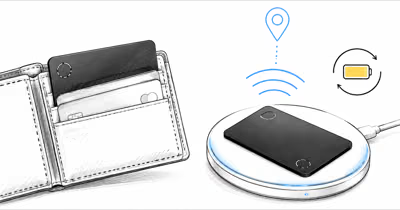
The Rolling Square AirCard Pro Dual is a 2.2mm wallet tracker that can be set up on Apple Find My or Google Find Hub from the same card. You choose one network during setup and reset to switch. It recharges on any Qi pad, runs for roughly 12 months per charge, and costs about $45.
The Rolling Square AirCard Pro arrived in mid-2025 as a three-SKU line: an Apple-only black card, an Android-only white card, and the AirCard Pro Dual gray card that can be registered to either network from one device. We focus on the Dual model here because it answers the question most wallet-tracker shoppers actually ask. Do you commit to one ecosystem at purchase, or buy a card that can move between ecosystems after a reset?
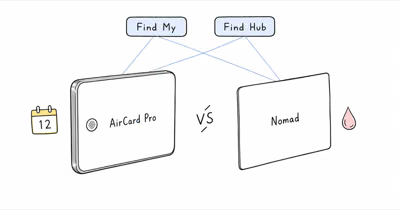
One correction worth flagging up front. Rolling Square’s own page lists the AirCard Pro at 2.2mm, not the 1.6mm that floated through early press coverage. Nomad’s Tracking Card Air is thinner at 1.7mm, and Pebblebee’s Card 5 comes in at 1.8mm.
- 3 SKU variants — Apple-only (black), Android-only (white), Pro Dual (gray); $40-45 single or $70-80 for a 2-pack on Amazon
- 2.2mm thick, not the thinnest — Nomad Tracking Card Air (1.7mm) and Pebblebee Card 5 (1.8mm) both beat it; you pay thickness for the dual-network-capable SKU
- 12-month battery with Qi wireless recharging — no USB-C port, no coin cell; a full top-up takes about 90 minutes on any Qi pad
- 20mm internal speaker plus NFC tap — stronger speaker hardware than most card trackers; Pro-only NFC reliability still lacks independent coverage
- $45 one-time, no subscription — compare with Nomad at $29 (single network) and Pebblebee Card 5 at $35 (dual network, rechargeable)
Rolling Square AirCard Pro: Specs at a Glance
At 85.6 x 54 x 2.2mm, the AirCard Pro matches ISO credit card length and width while adding roughly three credit cards of thickness. The body is a CNC-anodized aluminum frame bonded to an epoxy fiberglass plate, which gives it more rigidity than the polycarbonate cards common in this category. Weight comes in at about 11g. Rolling Square’s official AirCard Pro product page confirms that the 220mAh rechargeable lithium cell delivers the 12-month standby claim.
| Spec | Rolling Square AirCard Pro Dual |
|---|---|
| Dimensions | 85.6 x 54 x 2.2mm |
| Weight | ~11g |
| Network | Apple Find My or Google Find Hub (single card, choose one) |
| Battery | 220mAh, ~12 months per charge |
| Charging | Qi wireless pad, ~90 minutes to full |
| Speaker | 20mm internal buzzer |
| NFC | Yes (tap-to-share; reliability on Pro unverified) |
| Materials | Aluminum frame + epoxy fiberglass |
| Starting price | $45 (1-pack) / $80 (2-pack) direct |
Which AirCard Pro Should You Buy?
The three AirCard Pro SKUs look nearly identical. Pricing is close enough that most buyers default to the cheapest black card without reading the fine print. That’s a mistake if you’re an Android user, and it leaves money on the table if you switch between devices. Here’s the decision framework we recommend.
| SKU | Color | Network | 1-pack ASIN | Best For |
|---|---|---|---|---|
| AirCard Pro | Black | Apple Find My only | B0F3DNV9XY | iPhone-only households, lowest-price Pro entry |
| AirCard Pro | White | Google Find Hub only | B0F4XPHJXW (2-pack) | Android-only households, SmartThings and Pixel users |
| AirCard Pro Dual | Gray | Apple or Google | B0FV3RV1H7 | Switch-hitters, future-proofing |
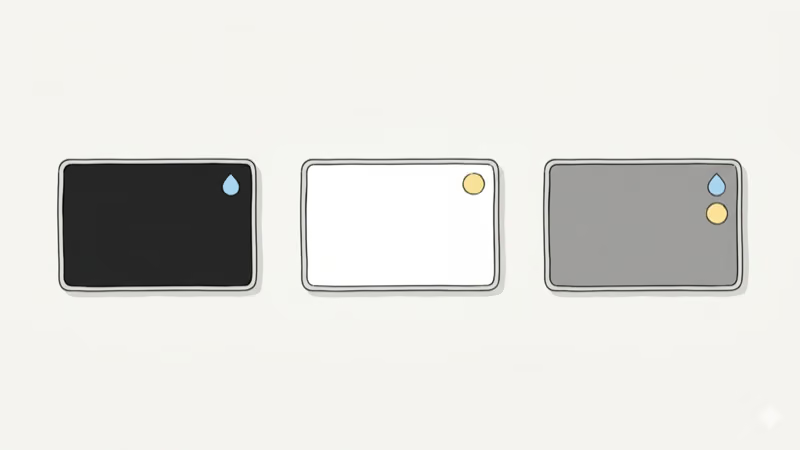
For most mixed-platform buyers, the Dual is the version worth paying extra for.
The $5-10 premium over the single-network cards buys real optionality: if you switch from iPhone to a Pixel next year, you can reset the same card and re-pair it to the new network.
AndroidGuys tested the Pro Dual in a hands-on review and reported that the card pairs on Google Find Hub within 30 seconds of battery insertion, behaving like a native Android device rather than a bridge or shim.
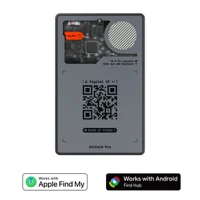 Top Pick
How Does the Dual-Network Mode Actually Work?
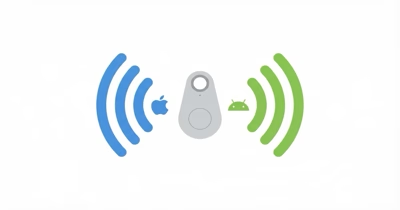
The Pro Dual is a mainstream wallet card that can register to either the Apple Find My network or Google Find Hub, rather than forcing you to choose a network at purchase. It does not broadcast to both networks at once. When your wallet goes missing, nearby phones on the network you selected relay the Bluetooth beacon to that network.
You see the card’s last-known location in whichever app you paired it with.
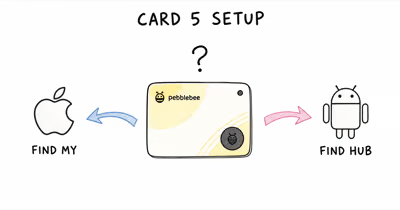
That sounds similar to the dual-network claim on the Pebblebee Card 5, and the practical constraint is the same: one active network per setup. For a wallet left on a cafe table in a mixed-device city, choose the ecosystem whose phones are more likely to pass the card, then reset and re-pair only if your needs change.
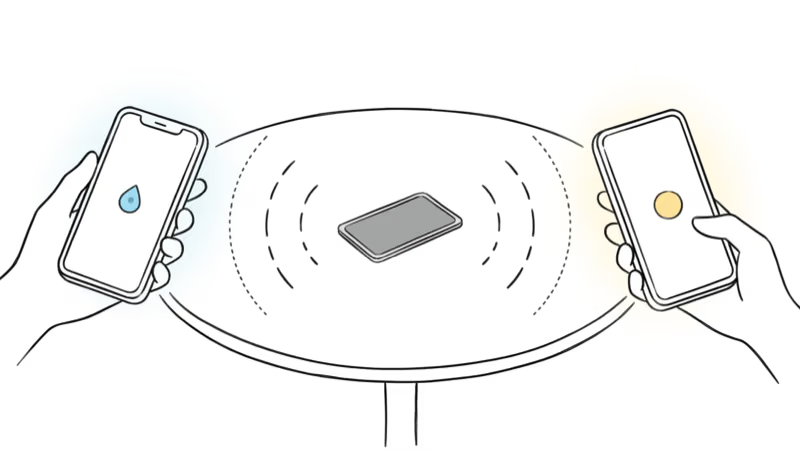
Privacy handling follows each network’s existing rules. Apple’s Find My uses end-to-end encryption for every location relay, and Google Find Hub applies ephemeral-ID rotation. No Rolling Square account is required to activate tracking.
Battery and Charging
Rolling Square rates the AirCard Pro Dual at approximately 12 months per charge, drawing from a 220mAh lithium cell. That’s longer than Nomad’s Tracking Card Air (5 months on iOS, 7 on Android) and shorter than the Chipolo CARD Spot (2 years on a non-replaceable battery). Charging happens through Qi wireless pads only. No USB-C port, no coin cell to swap.
Tom’s Guide writer John Velasco ran a month-long hands-on review and found that a full charge completes in 90 minutes on a standard Qi pad.
The wireless-only charging is a design choice with real implications. It keeps the card sealed with no ports that would weaken the edges. Qi pads are universal enough that most readers already own one. If you travel with minimal gear or prefer USB-C ubiquity, Pebblebee Card 5 forces a slower decision on you.
Rolling Square’s 12-month rating is the key endurance claim to use for planning. Actual drain depends on ring use, relay activity, and how often the card wakes.
Build Quality and the 2.2mm Thickness Question
The AirCard Pro sits in an awkward spot. It’s thicker than the cards marketed as “ultra-thin” but thinner than a coin-cell tracker like the Chipolo CARD Spot (2.4mm) or the original AirTag (8mm). At 2.2mm, it adds roughly two business cards’ worth of thickness to your wallet.
Most bifolds and cardholders should have enough slot depth for it.
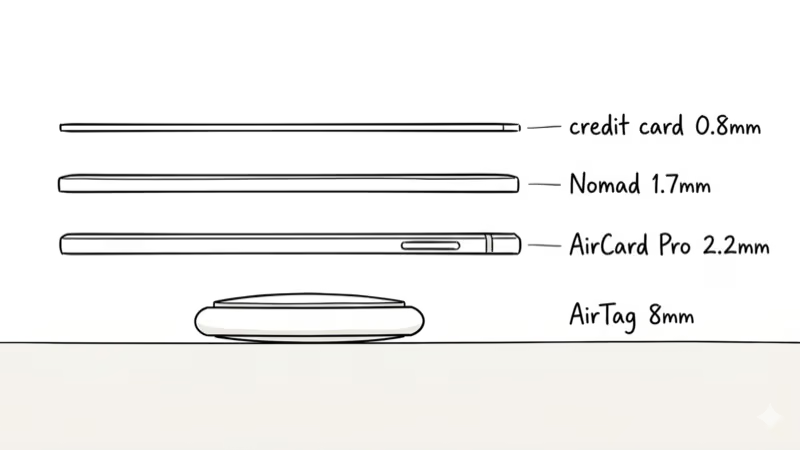
Nomad’s Tracking Card Air measures 1.7mm and the Pebblebee Card 5 1.8mm, both thinner than the AirCard Pro’s 2.2mm, so the gap is visible on the spec sheet before you ever load a wallet.
The tradeoff is build rigidity. Nomad uses a flexible polycarbonate body, while Rolling Square uses an aluminum frame. For a tracker that sits in a front pocket against keys, stiffness matters. For a tracker that slides into a slim minimalist wallet, the extra millimeter works against you.
NFC Tap and Speaker: What Works, What Doesn’t
The 20mm internal speaker is louder than most card-format trackers in this category. During the Tom’s Guide test, Velasco found that the alert tone carried across an apartment and through a closed drawer at roughly 90 decibels, loud enough to locate the card through a cardholder. You trigger the ring through either Find My or Find Hub, the same way you would an AirTag.
NFC tap is where the story gets softer.
The AirCard Pro includes a tap-to-share feature that pops a contact or owner screen on any NFC phone. For an “If found” workflow, that’s useful.
But Pack Hacker’s review of the original AirCard reported that NFC taps landed at roughly 50% reliability, with the printed QR fallback serving as the actual recovery channel. Rolling Square redesigned the NFC antenna for the Pro line. No linked independent test isolates Pro-only NFC reliability yet. Until one exists, treat NFC as a nice-to-have, not the feature you rely on to get your wallet back.
Rolling Square AirCard Pro vs Nomad vs Chipolo Card Spot
Three wallet cards dominate the premium slice of this category in 2026. Here’s the head-to-head that the SERP doesn’t give you.
| Card | Thickness | Battery | Charging | Network | Price |
|---|---|---|---|---|---|
| Rolling Square AirCard Pro Dual | 2.2mm | ~12 months | Qi wireless | Apple or Google | $45 |
| Nomad Tracking Card Air | 1.7mm | 5-7 months | Qi wireless | Apple or Google (choose at purchase) | $29 |
| Chipolo CARD Spot | 2.4mm | 2 years | Not rechargeable | Apple Find My only | $35 |
Nomad wins on thickness and price. Chipolo wins on pure battery longevity if you’re happy to replace a card every two years. Rolling Square wins on purchase-time network flexibility.
For readers who prefer the wallet itself to carry the tracker, the Ekster wallet line is still the competitor to beat, with integrated cards that sidestep the slot-thickness question entirely. And if you’re specifically shopping the rechargeable-dual-network pocket, Chipolo vs Pebblebee covers the direct Pebblebee Card 5 comparison in detail.
When to Skip the AirCard Pro
Honest answer: three groups.
Pick something else if your wallet is slot-tight. A 2.2mm card will jam some minimalist cardholders that happily accept the 1.7mm Nomad. Measure your free slot depth before you buy.
Pick something else if you want USB-C charging. Rolling Square has stayed Qi-only across the entire AirCard Pro line. The Pebblebee Card 5 has USB-C if you need it. Our best dual-network trackers roundup keeps an updated list of rechargeable options.
Pick something else if you’re iPhone-only and price-sensitive. The Nomad Tracking Card Air delivers Find My at $29 with a thinner body, and you’d be buying dual-network capability you never use. The Apple-only AirCard Pro at $40 is a closer match but still loses the price-per-millimeter comparison to Nomad. If you want a longer battery and skip the recharge cycle entirely, Chipolo CARD Spot at $35 buys two years of runtime and a simpler Find My setup on iOS.
Otherwise, the Pro Dual makes sense for anyone who expects to switch phones every year or two, or who wants to decide Apple versus Google at setup rather than at checkout.
Bottom Line
The Rolling Square AirCard Pro Dual is one of the more flexible wallet trackers you can buy in 2026. It trades half a millimeter of thickness for a dual-network-capable SKU that can be set up on Apple or Android without a purchase-time commitment. The 12-month rechargeable battery keeps it low-maintenance, the $45 price sits above the budget cards but below the full-feature premium line, and the aluminum frame is the sturdier build choice on paper.
If you want the tracker built into the wallet itself, our tracked wallet alternatives covers that Secrid route.
If you live in one ecosystem and plan to stay there, Nomad’s 1.7mm $29 card is the cheaper, thinner pick. If you move between Apple and Android, get the Pro Dual.
FAQ
Is the Rolling Square AirCard Pro the thinnest wallet tracker?
No. At 2.2mm, the AirCard Pro is thicker than the Nomad Tracking Card Air (1.7mm) and the Pebblebee Card 5 (1.8mm). Early press coverage quoted a 1.6mm figure that Rolling Square's own spec page doesn't support. The Pro's advantage is network flexibility, not thickness.
Does the AirCard Pro Dual work on both Apple and Android at the same time?
No. The Pro Dual supports Apple Find My or Google Find Hub, but you pick one network at setup. To move it to the other ecosystem, factory reset the card and re-pair it through the other app.
How do you recharge the AirCard Pro?
Drop it onto any Qi-compatible wireless charging pad. A full charge takes roughly 90 minutes. There's no USB-C port and no coin cell battery to replace.
How long does the AirCard Pro battery last?
Rolling Square rates the 220mAh battery at approximately 12 months of standby use per charge. Actual drain varies with how often the card is pinged and how many network relays it sees. Expect to top it up roughly once a year.
Is the AirCard Pro waterproof?
Rolling Square doesn't publish an IP rating for the Pro line. The aluminum frame and sealed body may handle splash exposure and brief rain contact, but don't rely on it for submersion. Treat it as splash-resistant until an official rating shows up.
What is the difference between the AirCard Pro and the original AirCard?
The original AirCard, released around 2023, was Apple Find My only and used a thinner but less rigid plastic body. The AirCard Pro line adds three SKUs (Apple-only, Android-only, and Dual), introduces the aluminum frame, and increases battery capacity to 220mAh for the 12-month rating. Older AirCard reviews don't apply to the Pro.
Can I use the AirCard Pro without creating a Rolling Square account?
Yes. You pair the card directly with Apple Find My or Google Find Hub through the respective first-party app, the same way you would pair any third-party Find My accessory. A Rolling Square account is optional and only unlocks brand-level features such as firmware notifications.
Is the AirCard Pro Dual worth $45?
Yes if you switch between Apple and Android households or want future-proofing. No if you're iPhone-only on a budget, where Nomad's $29 card delivers most of what you need at lower cost and better thickness. The Pro Dual's pricing is fair for setup-time network flexibility but doesn't beat single-network competitors on raw value.