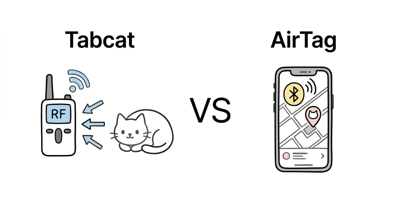
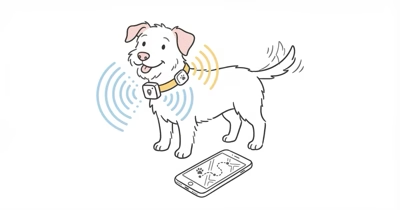
Tabcat V2 is a subscription-free RF cat finder, not a GPS tracker. It uses radio frequency to point you toward your cat within up to 400 feet in open conditions. There is no app, no phone required, and no monthly fee. The trade-off: no map view, no geofencing, and no way to track a cat beyond its short range.
Tabcat V2 uses RF instead of GPS, Bluetooth, or cellular data. The handset guides you toward the collar tag with lights and sound. That makes it a close-range recovery tool, not a roaming-cat tracker.
- RF, not GPS or Bluetooth — handset points you to the tag with no phone or app
- Up to 400 ft in open air — walls, fences, vegetation, and dense buildings reduce useful range
- No subscription — about $100 upfront, then no monthly fee
- Only 6g per tag — lighter than AirTag and any GPS collar
- 3 to 12 months battery — more frequent searches drain it faster
Tabcat V2 Technology and How It Works
Tabcat V2 is made by Loc8tor, a UK company that has sold RF-based finders since the mid-2000s. According to the official Tabcat V2 product page, the system combines a credit-card-sized handheld receiver with small tags that clip to your cat's collar. If you want RF tracking without a monthly fee, our Marco Polo pet tracker review covers that alternative path.
When you press the search button on the handset, it sends an RF signal and the tag responds. The handset then shows direction with a row of LED lights and faster beeps as you get closer. Walk toward the strongest signal, and you walk toward your cat.
This is the same core technology used in products like the Esky RF key finder. RF is line-of-sight and proximity-based. It doesn't rely on satellites, cell towers, or crowd-sourced phone networks.
That independence is both the strength and the limitation. You never pay a subscription, and it works in areas with zero cell coverage or internet. But you can't open an app and see your cat's location on a map. You have to physically walk around with the handset.
If you've ever wondered how AirTag tracking differs from real GPS, the same principle applies here. AirTag uses Bluetooth crowd-sourcing through nearby iPhones. Tabcat skips all networks entirely and communicates directly between handset and tag.
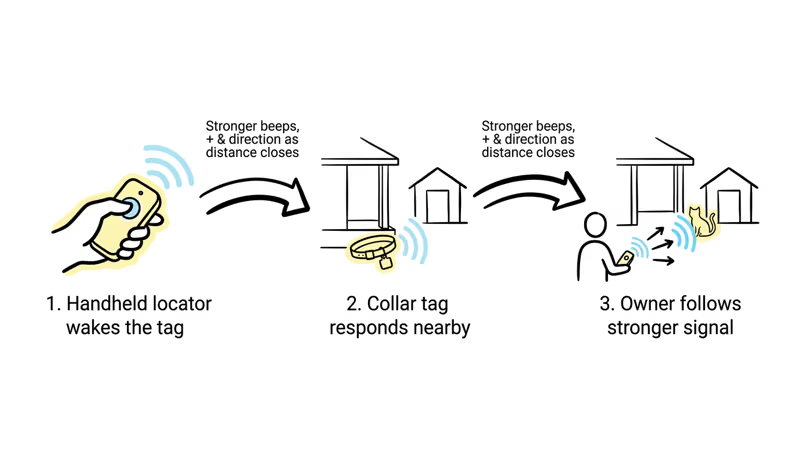
How Far Can Tabcat Actually Track Your Cat?
Loc8tor's official Tabcat V2 product page states that Tabcat V2 is rated for up to 400 feet in open conditions. Walls, fences, vegetation, and dense buildings reduce useful range because RF signals weaken and reflect around obstacles.
That range profile suits a specific scenario well: finding a cat that is hiding nearby. Indoor-outdoor cats that slip under a porch, climb into a neighbor's garage, or curl up in a garden shed are exactly what Tabcat was designed for.
If you know your cat is somewhere close but can't see them, the directional signal helps narrow the search area without relying on a phone network.
The handset is easiest to follow when you move slowly and sweep in short arcs instead of rushing toward the first beep. That makes Tabcat a nearby recovery tool, not a wide-area search device.
Where Tabcat falls short: if your cat regularly travels more than a block or two from home, the handset signal won't reach. There's no "last known location" feature. Once you are out of range, you are out of information. For cats that roam farther, a GPS cat tracker with cellular connectivity provides continuous tracking over unlimited distance.
Setting Up Tabcat V2
Setup is simpler than a GPS tracker because there is no app account or Wi-Fi pairing. The 2-tag starter kit includes the handheld receiver, two RF tags, collar clips, and batteries pre-installed. Pairing is automatic out of the box: press the button on the handset, and it searches for the tags directly.
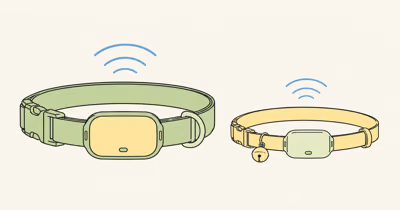
Attaching the tag to your cat's collar is easy. Each tag is 6 grams and roughly the size of a 10-pence coin. At that weight, the tag sits securely on a standard breakaway collar without making it feel top-heavy.
The included silicone holder slides onto any standard collar. For cats, choose a breakaway collar to maintain safety.
The handset supports up to four tags at once. If you have multiple cats or want a spare, the 4-tag bundle covers that without needing a second handset. Each tag shows separately on the handset display so you can search for a specific cat.

How Does Tabcat Compare to AirTag 2 and Tractive?
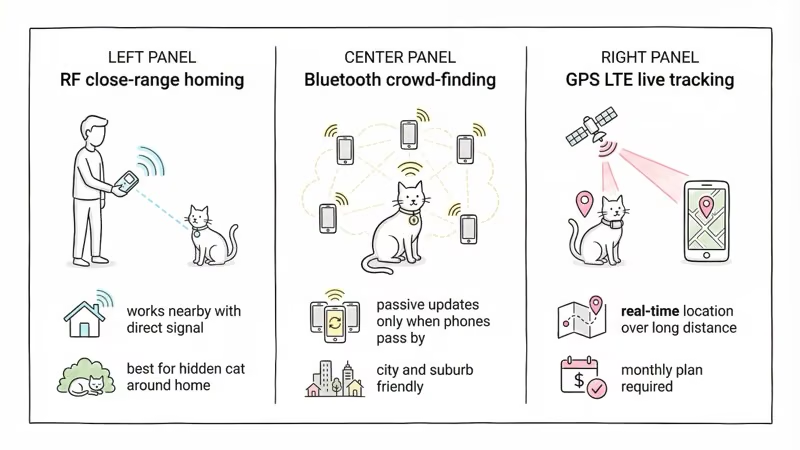
Cat owners shopping for Tabcat are usually comparing three options: a subscription-free RF finder (Tabcat), a subscription-free Bluetooth tracker (AirTag 2), or a real GPS tracker with a monthly plan (Tractive CAT Mini). Each uses a fundamentally different technology, and the right choice depends on your cat's habits and your neighborhood.
| Feature | Tabcat V2 | AirTag 2 | Tractive CAT Mini |
|---|---|---|---|
| Technology | RF (direct signal) | Bluetooth + UWB (Find My) | GPS + LTE cellular |
| Range | Up to 400 ft | Crowd-sourced (citywide) | Unlimited (cell coverage) |
| Live map | No | Last-known location only | Yes, real-time |
| Subscription | None | None | From $5/mo |
| Phone required | No | iPhone only | iOS or Android |
| Tag weight | 6g | 12g (+ holder) | 25g |
| Battery | 3-12 months | ~12 months (CR2032) | 2-5 days (rechargeable) |
| Geofencing | No | No | Yes |
| Price | ~$100 (2-tag kit) | $29 | $50 + subscription |
AirTag 2 is the strongest competitor for cat owners who want zero monthly fees. At $29, it costs a third of the Tabcat kit. It works passively through Apple's Find My network of over a billion devices, which means location updates come automatically without you walking around with a handset.
The catch: AirTag requires an iPhone, provides no directional guidance at close range unless you are within UWB Precision Finding distance, and depends on nearby Apple devices.
Apple states that the AirTag 2 product page keeps the same 31.9mm form factor as earlier AirTags, so it still fits existing collar mounts and other accessories, including breakaway cat collar mounts. In rural or low-density areas, updates are slow or absent.
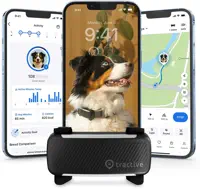
Tractive CAT Mini is the only option that provides real-time GPS tracking with a live map, geofence alerts, and activity monitoring. It weighs 25g, which is heavier than both Tabcat and AirTag but still within safe limits for most cats over 8 pounds.
The trade-off is the ongoing subscription starting at $5 per month. For a deeper look at all cat tracker options without a subscription, our dedicated guide compares the full landscape.
Best Fit for Tabcat V2
Tabcat V2 makes sense for a narrow but real set of cat owners. The best fit is someone whose cat stays close to home but regularly hides in hard-to-find spots.
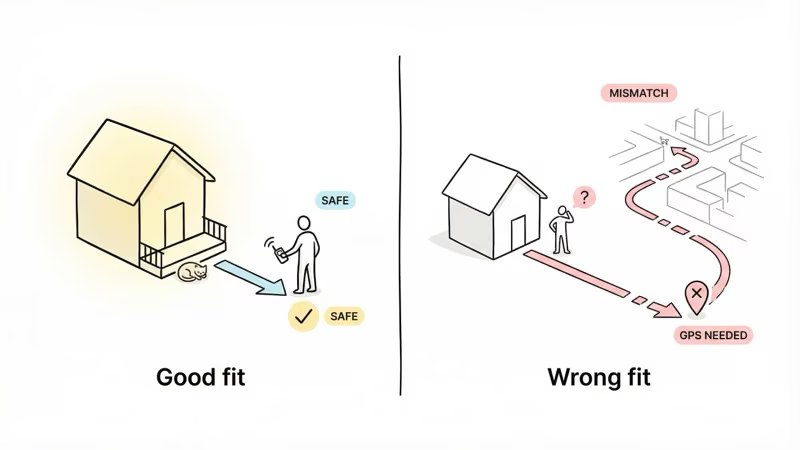
If your cat spends hours under porches, in garages, or behind hedges within a few hundred feet of your house, Tabcat's directional finder is faster and more precise than checking a map app on your phone.
It also works for households without smartphones or without iPhones. Tabcat needs no phone, no app, and no internet. For older family members keeping track of an indoor-outdoor cat, the standalone handset is easier than configuring a Bluetooth tracker.
Where Tabcat Falls Short
Tabcat is the wrong choice if:
- Your cat regularly roams more than a block from home
- You want to check your cat's location from work or another room via your phone
- You need geofence alerts when your cat leaves a safe zone
- You want a location history or activity tracking data
For those scenarios, a GPS tracker with a subscription plan or an AirTag in a dense urban area will serve you better. The Cats.com cat tracker roundup also shows how much narrower Tabcat's use case is than GPS or Bluetooth alternatives.
Bottom Line
Tabcat V2 does one thing well: it points you directly toward a hiding cat within a few hundred feet, with no subscription, no phone, and no network dependency. That's useful for cats that stay close to home. It's not a GPS tracker, can't show a map, and won't help once your cat is beyond its range.
At roughly $100 for the 2-tag kit, it costs more upfront than an AirTag but saves money over time compared to any subscription GPS tracker. Know what it does and what it doesn't do, and it earns its place on a cat collar.
FAQ
Does Tabcat use GPS?
No. Tabcat V2 uses radio frequency (RF), not GPS, Bluetooth, or cellular data. The handheld receiver communicates directly with the tag on your cat's collar. It can't show location on a map or track over the internet.
How far can Tabcat track a cat?
Tabcat V2 is rated for up to 400 feet in open conditions. Through walls, fences, vegetation, and dense buildings, useful range drops because RF signals weaken and reflect around obstacles.
Does Tabcat need a phone or app?
No. Tabcat works entirely through its standalone handheld receiver. There is no app, no Bluetooth pairing with your phone, and no internet connection required.
How long does the Tabcat battery last?
The manufacturer rates Tabcat tag batteries at 3 to 12 months depending on how often you activate the search signal. Daily searching shortens battery life toward the lower end. The tags use replaceable batteries.
Can Tabcat track multiple cats?
Yes. One Tabcat handset supports up to four tags. The 2-tag starter kit covers two cats, and the 4-tag bundle covers a larger household. Each tag is individually selectable on the handset.
Is Tabcat waterproof?
Tabcat tags are described as weather-resistant but don't carry a formal IP rating like IP67. They handle rain and damp grass, but you should avoid submerging them. Cats that swim or wade in water regularly need a tracker with a certified waterproof rating.
How does Tabcat compare to AirTag for cats?
Tabcat uses direct RF signal with a handheld receiver, while AirTag uses Bluetooth crowd-sourcing through nearby iPhones. Tabcat works without any phone and costs nothing after purchase, but its range is limited to a few hundred feet. AirTag costs $29, works passively at city-wide range in dense areas, but requires an iPhone and provides no signal in areas without Apple devices nearby.