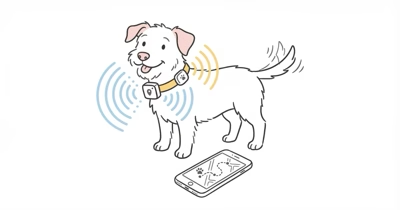
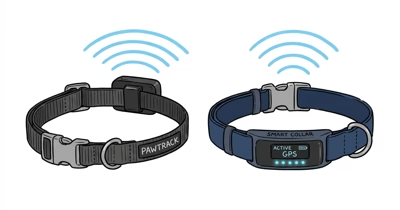
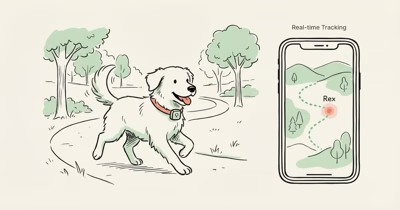
The Apple AirTag ($29, no fee) is the most practical no-subscription tracker for most dog owners. Pick Invoxia ($130, 2-yr prepaid) for true GPS without a recurring bill.
Here’s the honest truth about dog GPS trackers without subscriptions: most of them aren’t GPS at all. They’re Bluetooth trackers that piggyback on nearby smartphones to report location. Real GPS requires a cellular modem to transmit coordinates, and cellular data costs money. As of 2026, almost every dedicated dog GPS tracker on the market charges a monthly fee.
That doesn’t mean you’re out of options. This guide covers the no-fee and low-fee options that actually work for keeping tabs on your pet across urban, suburban, and rural environments.
- True GPS trackers (Fi, Tractive) require $5-8/month subscriptions because they use cellular data to transmit your dog’s location in real time
- The Apple AirTag ($29, no fee) works well in cities with high iPhone density but becomes unreliable in rural areas or off-leash trails
- The Invoxia GPS Tracker ($129) includes 2 years of prepaid cellular, making it the only real GPS option without a separate monthly charge
- Samsung SmartTag 2 ($27) is the best no-fee option for Android users, using the SmartThings Find network
- For dogs that roam in rural or wilderness areas, a subscription GPS tracker like Fi Series 3 or Tractive DOG 6 is worth the monthly cost
Why Aren’t Most “No Subscription GPS Trackers” Actually GPS?
Serious hunters lean on radio handhelds instead, like the pair in our Garmin Alpha 300 vs 200i comparison.
Search for “dog GPS tracker no monthly fee” and you’ll find dozens of results recommending AirTags, Tiles, and SmartTags. None of these contain a GPS chip.
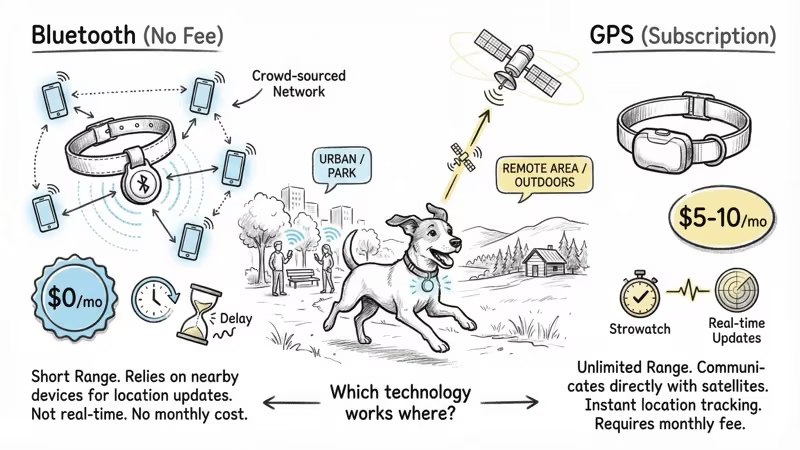
Bluetooth vs GPS: The AKC’s pet safety guide recommends GPS trackers for dogs that roam off-leash, noting that 10 million pets go missing each year in the US. Bluetooth trackers (AirTag, SmartTag, Tile) broadcast a short-range signal that nearby smartphones pick up and relay. They don’t know their own location. GPS trackers contain satellite receivers and cellular modems that calculate and transmit coordinates independently. This distinction matters because Bluetooth trackers stop working once your dog moves beyond smartphone range.
The confusion is understandable. Marketers label everything a “GPS tracker” because that’s what people search for. But the technology gap is massive.
A Bluetooth tracker has a short direct-connection range, and beyond that it depends entirely on strangers’ phones passing nearby. A GPS tracker works anywhere with cell coverage, sending its own location updates regardless of who’s around.
The difference is stark. An AirTag on a dog collar in a dense city can update frequently thanks to the massive density of iPhones. The same AirTag on a remote trail can go dark until someone with an iPhone passes within Bluetooth range.
Best No-Subscription Dog Trackers Compared
| Tracker | Technology | Monthly Fee | Range | Battery | Water Rating | Best For |
|---|---|---|---|---|---|---|
| Apple AirTag | Bluetooth + UWB | $0 | Crowd-sourced (1B+ iPhones) | about 1 year (CR2032) | IP67 | iPhone owners, urban areas |
| Samsung SmartTag 2 | Bluetooth + UWB | $0 | Crowd-sourced (SmartThings) | about 500 days (CR2032) | IP67 | Samsung/Android users |
| Invoxia GPS Tracker | GPS + LTE | $0 (2 yr prepaid) | Anywhere with cell service | 1-4 weeks | IPX7 | True GPS without monthly bill |
| Fi Series 3 | GPS + LTE | $8.25/mo (annual) | Anywhere with cell service | 3-6 weeks | IP68 | Active/escape-prone dogs |
| Tractive DOG 6 | GPS + LTE | $5/mo (annual) | Anywhere with cell service | 3-7 days | IPX7 | Health monitoring + tracking |
Apple AirTag — Best No-Fee Tracker for iPhone Users
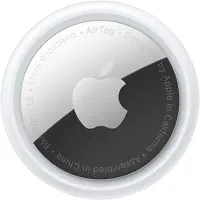
The AirTag isn’t a GPS tracker, and Apple doesn’t market it as a pet tracker. But it’s what most dog owners end up using because the math makes sense: $29 once, $0 per month, and it uses the billion-plus iPhones in Apple’s Find My network to relay location. No other tracking network comes close in device density.
Clipped inside an Elevation Lab TagVault Pet holder on a dog collar, an AirTag in a suburban yard (moderate iPhone density) updates whenever an iPhone passes nearby, often within minutes. If a dog slips out of the gate, that relayed ping is usually quick enough to find a dog a few blocks away, even if it’s not real-time.
The AirTag’s UWB Precision Finding feature is surprisingly useful once you’re within range. It shows a directional arrow and distance down to centimeters on iPhone 11 and newer. For finding a dog hiding under a deck or behind a fence, nothing else is this precise at close range.
§ Review summary
Apple AirTag 2 — at a glance
≡ Specs
- Network
- Apple Find My (1B+ devices)
- Precision Finding
- UWB, longer range
- Battery
- CR2032, about 12 months
- Water rating
- IP67 waterproof
- Weight
- 11g
- Subscription
- None
✓ Pros
- +$29 with zero recurring costs
- +Largest tracking network in the world (1B+ Apple devices)
- +UWB Precision Finding for close-range accuracy down to centimeters
- +1-year user-replaceable CR2032 battery
- +Weighs only 11g, comfortable for dogs 15 lbs and up
✗ Cons
- −Not real-time tracking, relies entirely on nearby iPhones
- −Unreliable in rural areas or low-population zones
- −iPhone only, no Android support
- −Not designed for pets: no collar integration, no activity tracking
- −CR2032 battery is an ingestion risk for chewers
§ Buy if
- ·You own an iPhone and your dog spends time in urban or suburban areas with high iPhone density
- ·You want zero ongoing cost and accept crowd-sourced updates instead of live GPS
- ·You can pair the AirTag with a chew-resistant collar holder like TagVault Pet
- ·You don't need geofencing, activity monitoring, or escape alerts
Samsung SmartTag 2 — Best No-Fee Tracker for Android Users
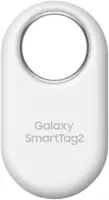
If you’re on Android, the SmartTag 2 is your best no-fee dog tracking option. It works through Samsung’s SmartThings Find network, which according to Samsung includes over 200 million devices. That’s a fraction of Apple’s network, so coverage depends more heavily on nearby Galaxy phones.
The SmartTag 2 may update less frequently than an AirTag in many US neighborhoods, simply because Samsung’s Galaxy phone market share doesn’t match iPhone density. The thinner the local Android crowd, the longer the gaps between updates.
That said, the SmartTag 2 has a couple of advantages. Battery life rated at 500 days outlasts the AirTag by several months. The compass-style AR finding feature works on any Galaxy phone with UWB. And the design includes a built-in clip hole, so you can thread it directly onto a collar ring without buying a separate holder.
§ Review summary
Samsung SmartTag 2 — at a glance
≡ Specs
- Network
- SmartThings Find (200M+ Galaxy devices)
- Precision Finding
- UWB compass view (Galaxy only)
- Battery
- CR2032, about 500 days
- Water rating
- IP67 waterproof
- Weight
- 33g
- Subscription
- None
✓ Pros
- +$27 with no subscription, one of the cheapest no-fee options here
- +Built-in clip hole eliminates the need for a separate holder
- +500-day battery life, longest of any tracker here
- +IP67 water resistance handles rain and puddles
✗ Cons
- −SmartThings Find network significantly smaller than Apple's Find My
- −Slower location updates where Galaxy-phone density is thin
- −Samsung Galaxy phone required
- −No geofence alerts or activity tracking
§ Buy if
- ·You're a Samsung Galaxy user and live in an area with reasonable Android density
- ·You want the cheapest no-subscription tracker available
- ·Crowd-sourced update gaps are acceptable for backup recovery, not live tracking
- ·You value the built-in clip hole over buying a separate collar holder
Invoxia Cellular GPS Tracker — Only True GPS with No Monthly Bill
The Invoxia is the only product on this list that contains an actual GPS receiver and doesn’t charge a separate monthly subscription. The catch? Invoxia bundles 2 years of prepaid LTE-M cellular service into the purchase price.
After those 2 years, you’ll need to pay for a renewal to keep the cellular connection alive. So “no subscription” has an asterisk, but for 2 years you actually pay nothing beyond the initial cost.
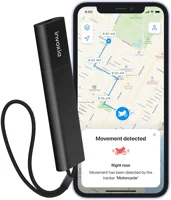
It was originally designed for asset tracking (vehicles, equipment, luggage), not pets. The unit measures roughly 3.5 x 1.5 x 0.6 inches and weighs about 1.4 ounces, which makes it too bulky for small dogs but manageable on medium to large breeds. You’d need to attach it to a collar or harness with a case or pouch. There’s no dog-specific mounting solution from Invoxia.
Invoxia’s GPS is accurate enough for open-area recovery, and the app supports geofencing, location history, and motion alerts.
Battery life varies wildly depending on tracking frequency. Low-frequency check-ins last much longer, while real-time tracking drains the battery quickly.
One important caveat: Invoxia’s product availability has been inconsistent. Check current stock before committing, and verify that prepaid service is still included at the current price point.
§ Review summary
Invoxia Cellular GPS Tracker — at a glance
≡ Specs
- Network
- GPS + LTE-M cellular
- Accuracy
- GPS + LTE-M positioning
- Battery
- Multi-week standby / shorter live tracking
- Water rating
- IP33 splash resistant
- Weight
- 1.4 oz (40g)
- Subscription
- 2 years prepaid, renewal required after
✓ Pros
- +Real GPS tracking with no separate monthly fee for 2 years (prepaid LTE-M)
- +Geofencing, location history, and motion alerts included
- +Works with both iOS and Android
- +GPS-based open-area recovery instead of Bluetooth crowd-finding
✗ Cons
- −Not designed for pets, no collar-specific mount
- −Too bulky for dogs under 25 lbs (3.5 x 1.5 x 0.6 inches, 1.4 oz)
- −Cellular service requires renewal after 2 years
- −Battery drains fast in real-time tracking mode
- −Availability and pricing can fluctuate
§ Buy if
- ·You want real GPS (not Bluetooth crowd-sourcing) without a recurring monthly bill
- ·Your dog is medium-to-large size and can carry a 1.4 oz tracker
- ·You accept that the device needs a cellular renewal after 2 years
- ·Cross-platform support matters because your household mixes iOS and Android
Wirecutter’s pet tracker review found that AirTag is the best no-fee option for urban dog owners, while the Invoxia offers true GPS with a 2-year prepaid plan. For dog owners in rural areas without cell coverage, the Aorkuler GPS dog tracker offers an RF-based alternative that works entirely offline with up to 3.5-mile range and zero monthly fees.
Fi Series 3 — Best GPS Dog Tracker (with Subscription)
We’re including the Fi Series 3 because many readers searching for “no subscription” trackers are really searching for “the cheapest way to GPS-track my dog.” And if you need reliable live GPS, a subscription tracker is currently the only way to get it. The Fi stands out because its subscription is less than the cost of a single vet visit if your dog gets lost.
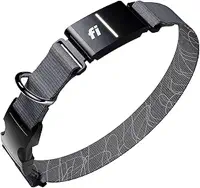
The Fi Series 3 collar integrates the GPS module directly into a durable, IP68-rated collar band. It’s one of the top picks in our best smart dog collars guide. No separate holder, no dangling tag.
When your dog escapes, Fi’s Lost Dog Mode increases GPS polling to every few seconds, giving you a near-live breadcrumb trail on your phone — far more precise than the crowd-sourced pings of a Bluetooth tracker.
Battery life is the Fi strength for a GPS tracker, with multi-week ratings under normal use. The collar also tracks daily steps, distance, and sleep quality.
If your dog’s activity drops suddenly, it could flag an early health issue. That feature alone gives the Fi value beyond pure location tracking.
§ Review summary
Fi Series 3 Smart Dog Collar — at a glance
≡ Specs
- Network
- GPS + LTE-M real-time
- Accuracy
- GPS + LTE-M positioning
- Battery
- Multi-week normal use / longer Lost Dog mode
- Water rating
- IP68 waterproof
- Module weight
- 28g
- Subscription
- $14-19/mo (required)
✓ Pros
- +Integrated smart collar with GPS module built into the band, no separate holder
- +Multi-week battery life under normal use
- +GPS-based live tracking for escape recovery
- +IP68 waterproof, durable collar band
- +Daily activity, sleep, and step tracking included
✗ Cons
- −Requires a $14-19/month subscription (the article's biggest caveat)
- −Cellular coverage is US-first; international service is patchy
- −Replaces the everyday collar rather than clipping onto an existing harness
§ Buy if
- ·You decided live GPS is worth a subscription cost
- ·You want the cheapest path to reliable real-time tracking on a known-quality collar
- ·Your dog stays in the US and benefits from a battery that lasts weeks, not days
- ·You value sleep and activity insights as health monitoring beyond pure GPS
Tractive DOG 6 — Best Value GPS Tracker (with Subscription)
The Tractive DOG 6 costs half what the Fi collar does and packs in more health features. For $49.99 upfront and $5/month on an annual plan, you get live GPS tracking, heart rate monitoring, bark detection, and activity tracking. The 2025 refresh added USB-C charging and improved the sensor suite.
Battery life is the Tractive’s weak point. Active GPS tracking and health monitoring drain a smaller clip-on tracker faster than Fi’s collar-sized battery. You’ll be charging this tracker more often, which is a routine you have to build into your schedule.
The upside is coverage. Tractive works in 175+ countries, making it the best option if you travel internationally with your dog. The tracker clips onto any existing collar, so you’re not locked into a proprietary collar band like Fi.
Two-Year Cost of Ownership
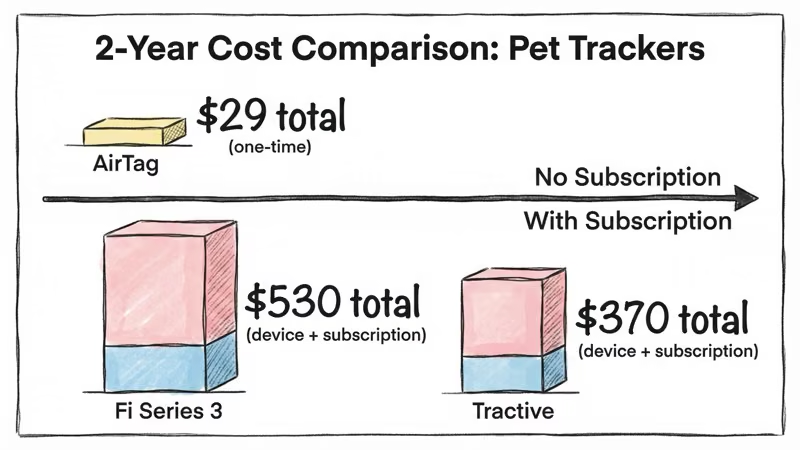
The “no subscription” framing can be misleading when you look at total cost over time. Subscription trackers cost $300-600 over 2 years while Bluetooth trackers stay under $35. Here’s what each tracker actually costs:
| Tracker | Device Cost | Year 1 Fees | Year 2 Fees | 2-Year Total |
|---|---|---|---|---|
| Apple AirTag | $29 + about $15 holder | $0 | about $5 (battery) | about $49 |
| Samsung SmartTag 2 | $27 | $0 | $0 | about $27 |
| Invoxia GPS | $129 (includes 2 yr cellular) | $0 | $0 | about $129 |
| Fi Series 3 | $149 | $99 | $99 | about $347 |
| Tractive DOG 6 | $49.99 | $60 | $60 | about $170 |
The AirTag and SmartTag 2 are dramatically less expensive. But remember: they’re Bluetooth trackers, and you’re paying less because you’re getting less. The Invoxia occupies the middle ground at $129 total for 2 years of actual GPS.
The Fi and Tractive cost more, but they provide active GPS tracking rather than crowd-sourced pings that depend on strangers’ phones passing nearby. For a broader comparison of subscription models across all tracker types, see our tracker subscription costs breakdown.
Which Dog Tracker Is Right for Your Situation?
Before choosing: Ask yourself one question. If your dog escaped right now, would there be enough iPhones or Galaxy phones near wherever your dog would run? If yes, a Bluetooth tracker can work. If not, you need GPS with cellular.
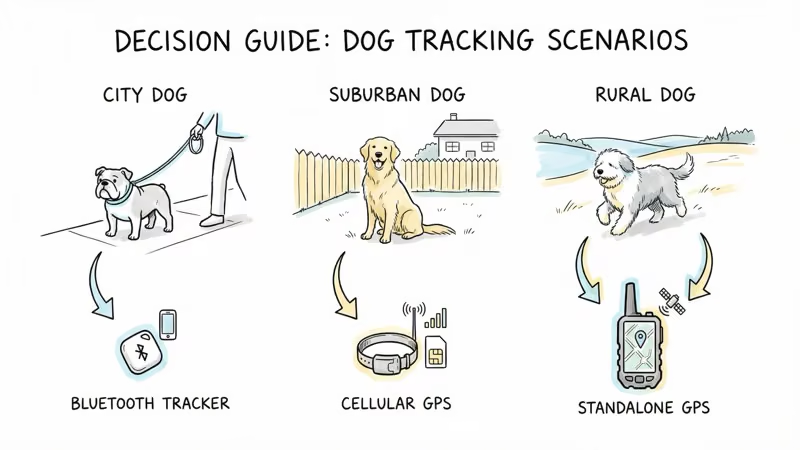
Buy the AirTag if: You have an iPhone, you live in a city or dense suburb, and your dog mostly stays within a populated area. The AirTag won’t give you live tracking, but in high-iPhone-density environments, it updates frequently enough to locate a missing dog within minutes. At $29 with no recurring fees, it’s the lowest-risk option. Pair it with a secure collar mount to keep it from falling off.
Buy the SmartTag 2 if: You use a Samsung Galaxy phone. Same Bluetooth crowd-sourcing principle as the AirTag, but on Samsung’s smaller network. Best used in areas with high Samsung phone penetration.
Buy the Invoxia if: You want actual GPS tracking and refuse to pay monthly. Just know the tracker isn’t pet-specific, the form factor is bulky for smaller dogs, and you’ll need to renew the cellular service after 2 years.
Buy the Fi Series 3 if: Your dog has escaped before, you hike or camp in areas without many people, or you won’t sleep well without real-time GPS coordinates on your phone. The $8.25/month subscription is a small price for peace of mind when your dog is off-leash in the backcountry.
Buy the Tractive DOG 6 if: You want GPS tracking at the lowest monthly cost, you travel internationally, or you’re interested in health monitoring (heart rate, bark detection, activity scores). The shorter battery life is the main trade-off.
Bottom Line
The market for no-subscription dog GPS trackers is smaller than marketing would have you believe. If you truly want zero ongoing costs, the AirTag is the most practical choice for iPhone users in populated areas. The Invoxia gives you real GPS without a monthly bill, but with caveats around size and eventual renewal. If you want RF tracking without a monthly fee, our no-subscription pet tracker alternatives covers that alternative path.
For dogs that run in rural areas, escape regularly, or go off-leash in the wilderness, spend the $5-8/month on a proper GPS tracker like the Tractive DOG 6 or Fi Series 3. Your dog’s safety is worth more than a Netflix subscription. If you want a mid-priced subscription alternative aimed specifically at multi-handler households, our Pawfit 3 review covers the spec trade-offs against Tractive.
Frequently Asked Questions
Is there a true GPS dog tracker with no monthly fee?
The Invoxia Cellular GPS Tracker is the closest option. It includes 2 years of prepaid LTE-M cellular service in the purchase price, so you pay nothing extra during that period. After 2 years, you’ll need to renew the cellular plan. Every other GPS dog tracker on the market requires a separate subscription because real-time GPS tracking depends on cellular data transmission, which has ongoing carrier costs.
Can I use an AirTag to track my dog?
Yes, and millions of dog owners do. The AirTag works by broadcasting a Bluetooth signal that nearby iPhones pick up and relay to you through Apple’s Find My network. It’s not real-time GPS, but in areas with lots of iPhones, it updates frequently enough to locate a missing dog. You’ll need a collar holder like the Elevation Lab TagVault Pet since the AirTag has no built-in attachment point. Apple doesn’t officially recommend AirTag for pet tracking, and the accessible CR2032 battery poses an ingestion risk for dogs that chew.
How far can a Bluetooth dog tracker reach?
Direct Bluetooth range is short and obstacle-sensitive. Beyond that, Bluetooth trackers like AirTag and SmartTag 2 rely on crowd-sourced networks. If another person’s compatible phone passes within Bluetooth range of your dog’s tracker, it relays the location. In a busy city, this can mean frequent updates. In a rural area, you might wait much longer or get no update at all.
What’s the best dog tracker for rural areas?
A GPS tracker with cellular connectivity is the only reliable option in rural areas. The Fi Series 3 and Tractive DOG 6 both use LTE modems to transmit location directly to your phone, regardless of whether other people are nearby. Bluetooth trackers like AirTag are effectively useless in areas with low smartphone density. If your property is more than a mile from neighbors, skip Bluetooth entirely.
Do dog GPS trackers work without cell service?
GPS trackers need cell service to transmit location data to your phone. The tracker’s GPS receiver can calculate its position using satellites alone, but without a cellular connection, it has no way to send that position to you. Some trackers store location history locally and sync when the connection returns. Bluetooth trackers don’t need cell service themselves, but they need nearby smartphones that do have internet access to relay your tracker’s position.
Are AirTags safe for dogs to wear?
The AirTag itself is safe for most dogs when properly secured in a sturdy collar holder. The main risk is the CR2032 battery compartment, which opens with a simple twist. Dogs that chew their collars could potentially access and swallow the battery, which is a medical emergency. Use a hard-shell holder that fully encloses the AirTag rather than a silicone sleeve. For heavy chewers, a purpose-built GPS collar like the Fi Series 3 eliminates this risk entirely because there are no removable parts.
How long do dog tracker batteries last?
It depends entirely on the technology. Bluetooth trackers last the longest because they use very little power, while GPS trackers drain faster because satellite receivers and cellular modems consume significantly more energy. Collar-style GPS trackers usually last longer than small clip-on GPS trackers, and live tracking drains any model faster than standard check-ins.