UGREEN FineTrack and Tile Mate's sealed battery lead the longest-life group, while Samsung SmartTag2 reaches 500-700 days. Chipolo Pop, AirTag 2, Tile Pro, and most other CR2032 trackers last about 1 year per battery.
Bluetooth tracker battery life varies wildly across products, from 6 months to 3 years depending on battery type, network activity, and usage patterns. This comparison uses manufacturer data, linked product-level coverage, and independent reviewer context rather than lab-run drain tests.
- UGREEN FineTrack leads replaceable CR2032 claims at 2 years — Chipolo Pop is rated up to about 1 year
- Samsung SmartTag2 hits 500-700 days — the longest among UWB-equipped trackers, thanks to Samsung’s efficient power-saving mode
- Rechargeable trackers cost $0 per year in batteries — but Pebblebee Clip 5 and Card 5 need a charge every 12-18 months
- Annual battery cost for replaceable trackers ranges from $0.50 to $3 — a CR2032 costs under $1 at most stores
- Tile Mate’s sealed 3-year battery eliminates maintenance entirely — but you replace the whole tracker when it dies
Bluetooth Tracker Battery Life: The Complete Comparison Table
This table covers every major Bluetooth tracker available in 2026. Battery life figures come from manufacturer specifications, with linked product-level coverage used for context where available.
| Tracker | Battery | Life | Replaceable | Annual Cost | Network |
|---|---|---|---|---|---|
| Chipolo Pop | CR2032 | ~1 year | Yes | ~$1.00 | Find My + Find Hub |
| UGREEN FineTrack | CR2032 | ~2 years | Yes | ~$0.50 | Apple Find My |
| Samsung SmartTag2 | CR2032 | 500-700 days | Yes | ~$0.75 | SmartThings |
| Tile Mate (2024) | Sealed | ~3 years | No (sealed) | $0 (replace tracker) | Life360 |
| AirTag 2 | CR2032 | ~12 months | Yes | ~$1.00 | Apple Find My |
| AirTag (1st Gen) | CR2032 | ~12 months | Yes | ~$1.00 | Apple Find My |
| Tile Pro (2024) | CR2032 | ~12 months | Yes | ~$1.00 | Life360 |
| Chipolo ONE Point | CR2032 | ~12 months | Yes | ~$1.00 | Google Find My Device |
| Motorola Moto Tag | CR2032 | ~12 months | Yes | ~$1.00 | Google Find Hub |
| eufy SmartTrack Link | CR2032 | ~12 months | Yes | ~$1.00 | Apple Find My |
| Pebblebee Clip 5 | Rechargeable (USB-C) | ~12 months/charge | N/A | $0 | Find My + Find Hub |
| Pebblebee Card 5 | Rechargeable (Qi) | ~18 months/charge | N/A | $0 | Find My or Find Hub |
Apple’s AirTag 2 product page states that battery life exceeds one year, while Samsung’s SmartTag2 specifications confirms that the CR2032 lasts up to 700 days in power-saving mode.
Our AirTag review explains why annual CR2032 replacement is the practical expectation for most AirTag owners.
 Top Pick
Which Bluetooth Trackers Have the Longest Battery Life?
The longest replaceable-cell claim belongs to the UGREEN FineTrack, which rates up to 2 years from a standard CR2032 coin cell. The Chipolo Pop uses the same battery size but is rated up to about 1 year, putting it closer to AirTag 2 and Tile Pro than to the longest-life group.
How does UGREEN stretch longer? It skips power-hungry UWB hardware entirely and uses aggressive Bluetooth sleep schedules to conserve power.
Samsung SmartTag2 pairs a standard CR2032 with Samsung’s efficient power management to deliver 500-700 days. That rating is nearly double Tile Pro’s annual rating, a gap our SmartTag2 vs Tile comparison breaks down from the same battery form factor.
Tile Mate is the sealed outlier: 3 years rated, then replacement instead of a battery swap.
Rechargeable vs Replaceable: What Costs Less Over 3 Years?
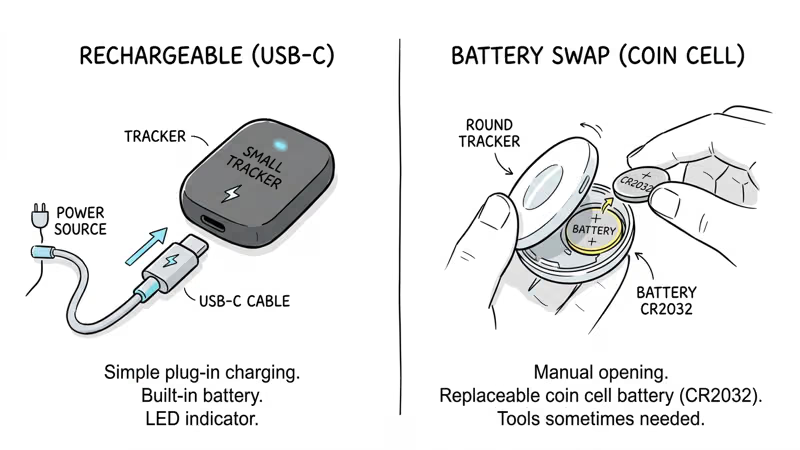
The math is simple. A CR2032 costs $0.50-$1.00 at most retailers, so a tracker needing one per year runs $1.50-$3.00 over three years. That’s nearly invisible next to the $29-$35 device price.
Rechargeable trackers like the Pebblebee Clip 5 and Card 5 cost $0 in replacement batteries.
The Clip 5 charges via USB-C once per year, while the Card 5 uses Qi wireless charging every 18 months. As covered in our Pebblebee Clip 5 review, plugging the Clip in once a year is a comparable chore to swapping a coin cell on a non-rechargeable tag.
Rechargeable models land in the same maintenance band: occasional charging instead of coin-cell replacement. For our curated rechargeable tracker picks, we rank every USB-C and Qi option by battery life and total cost.
Here is the 3-year total cost of ownership for the most popular trackers:
| Tracker | Device | 3-Yr Battery | 3-Yr Total |
|---|---|---|---|
| UGREEN FineTrack | $20 | ~$1 (1 battery) | ~$21 |
| eufy SmartTrack Link | $20 | ~$3 (3 batteries) | ~$23 |
| AirTag 2 | $29 | ~$3 (3 batteries) | ~$32 |
| Chipolo Pop | $29 | ~$3 (3 batteries) | ~$32 |
| Pebblebee Clip 5 | $35 | $0 | $35 |
| Tile Pro (2024) | $35 | ~$3 (3 batteries) | ~$38 |
| Tile Mate (2024) | $25 | $0 (sealed, replace at ~$25) | $25-$50 |
The UGREEN FineTrack wins the TCO race at about $21 over three years. For buyers who want the best Bluetooth trackers regardless of battery cost, the AirTag 2 remains the strongest overall pick thanks to its billion-plus-device Find My network and UWB precision finding.
 Hot
Hot
How Battery Type Affects Tracking Performance
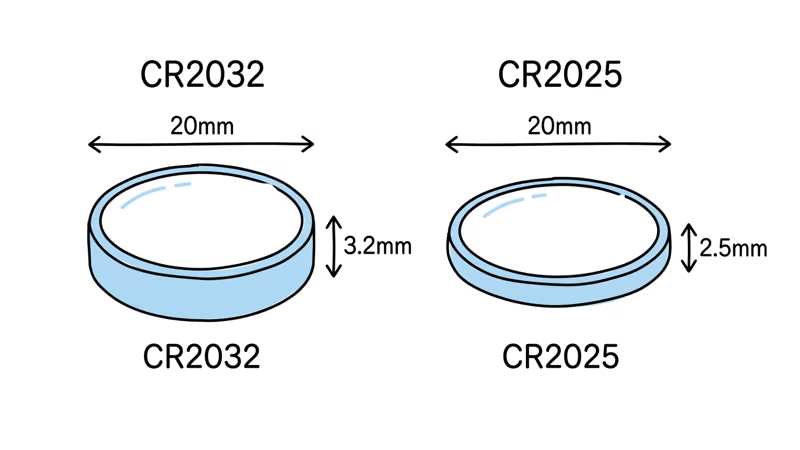
Not all coin cells are equal. The CR2032 holds about 235 mAh, while thinner cells like the CR2025 store roughly 170 mAh and turn up in slimmer gadgets. Nearly every Bluetooth tracker, the SmartTag2 included, standardizes on the CR2032 for its higher capacity.
Battery voltage curves matter for speaker performance too. A fresh CR2032 outputs 3.0V, but voltage drops gradually as the cell discharges.
Trackers with louder speakers drain batteries faster. As detailed in our Chipolo Pop review, the Pop pairs a loud speaker (Chipolo rates it around 120 dB) with a replaceable CR2032 rated up to about 1 year. The speaker only fires when you trigger it from the app, so it has little effect on standby life.
Rechargeable lithium-polymer cells in the Pebblebee models maintain steadier voltage throughout their charge cycle, delivering consistent speaker volume and Bluetooth signal strength from month 1 to month 12. The trade-off: finite charge cycles, typically 300-500 before noticeable capacity loss.
Factors That Drain Tracker Batteries Fastest
UWB Precision Finding is the single biggest battery drain on trackers that support it. Every time you activate “Find Nearby” on an AirTag 2 or Motorola Moto Tag, the UWB radio fires up and exchanges signals with your phone. Heavy daily use of Precision Finding can shorten battery life noticeably below the rated figure, since each activation draws far more power than passive Bluetooth advertising.
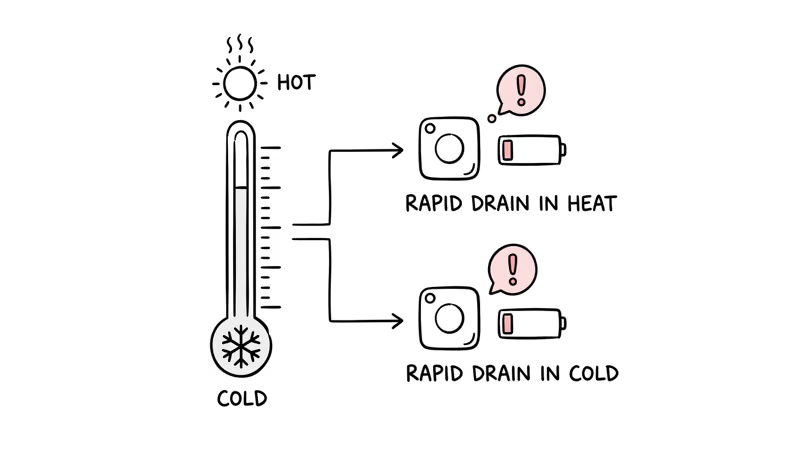
Extreme temperatures accelerate degradation. CR2032 cells perform best in moderate conditions, so a tracker left on a hot dashboard or a freezing bike frame can underperform its rating. Apple’s AirTag battery replacement guide recommends a bitterant-coated CR2032 to discourage accidental ingestion, yet warns in the same guide that some coated cells may not make contact at all.
Frequent Play Sound usage also drains batteries faster. Trackers on commonly-misplaced keys that ring several times daily will underperform their rated life.
 Best Value
How We Source the Battery Numbers
We don’t run controlled battery drain tests in a lab. Instead, we combine three data sources to assess real-world battery performance for each tracker.
Manufacturer specifications form the baseline. Every number in our comparison table starts with the official claim from the product page or spec sheet. We also cross-check these figures against press materials, regulatory filings, and packaging documentation where available to catch any discrepancies.
Product-level coverage adds context for each tracker. Our eufy SmartTrack review walks through its 1-year CR2032 rating, and our Tile tracker review covers the Tile Pro’s 12-month rated life and how its replaceable battery affects total cost. These pages explain what each spec means in everyday use rather than re-deriving the numbers.
Reviewer consensus fills the gaps. Wirecutter’s annual tracker roundup and other independent reviewers provide supplementary battery data.
Bottom Line
Battery life matters.
UGREEN FineTrack delivers the longest replaceable-CR2032 claim here at 2 years, but the AirTag 2 remains our top pick overall because its 12-month CR2032 life is adequate for most people and no other tracker matches its Find My network reach and UWB precision. Chipolo Pop lands in the same roughly annual-swap group while adding dual-network flexibility.
FAQ
Which Bluetooth tracker has the longest battery life?
UGREEN FineTrack claims approximately 2 years on a single CR2032 coin cell. Among sealed-battery trackers, the Tile Mate (2024) rates at 3 years but can't be user-serviced when the battery dies. Chipolo Pop is rated up to about 1 year on a replaceable CR2032.
How often do you need to replace an AirTag battery?
Apple rates the AirTag 2 battery at "over one year." Heavy Play Sound and Precision Finding use can shorten that rating, while light use keeps the replacement cycle closer to annual. Swapping the CR2032 is inexpensive, and your iPhone sends a low-battery notification through Find My when it's time to replace.
Are rechargeable trackers better than replaceable-battery trackers?
Neither is objectively better. Rechargeable trackers like the Pebblebee Clip 5 eliminate battery purchases entirely, but you'll need a USB-C cable or Qi charger once a year. Replaceable-battery trackers let you swap a $1 coin cell in seconds. Pick based on preference: zero ongoing cost versus zero charging hassle.
Does UWB Precision Finding drain the battery faster?
Yes. UWB radios consume noticeably more power than Bluetooth alone, so frequent Precision Finding can shorten the rated battery life on AirTag 2 or Motorola Moto Tag. Trackers without UWB, like the Chipolo Pop, avoid this drain, though Chipolo still rates the Pop at about 1 year.
Can you use any CR2032 battery in a Bluetooth tracker?
Most standard CR2032 batteries work fine. Avoid batteries with a bitter coating, which Apple warns may prevent proper contact in AirTags. Energizer, Duracell, and Panasonic CR2032 cells are all safe choices. Buy them in bulk packs online for under $0.50 each.
How much does it cost per year to keep a Bluetooth tracker running?
Between $0 and $3 per year. Rechargeable trackers cost nothing beyond electricity. Trackers with 2-year batteries cost about $0.50 per year. Most 1-year battery trackers cost $1-$3 per year depending on how often you replace the cell and where you buy it.
Do Bluetooth tracker batteries last as long as manufacturers claim?
Often, yes, when use is light and temperatures are moderate. Real-world battery life depends on usage patterns, temperature exposure, and network density. Manufacturers rate under controlled conditions with minimal Play Sound and Precision Finding usage, so frequent ringing or extreme climates push you toward the lower end of the rated range.